
Hello,
On Tuesday we covered the Commission's wildfire strategy and how CEPF helped get active forest management named as the foundation. Today, the same organisation is at work on a different file — and the verdict is more complicated.
The EU's Carbon Removals and Carbon Farming framework is the legal architecture for how forest owners get paid for carbon. The carbon farming methodology was open for public consultation until February 19. CEPF has now published its response.
It is not a rejection. It is not a celebration. It is the most useful kind of intelligence: a detailed list of what will go wrong if Brussels does not fix the implementation before adoption this summer.
Here's what's moving European forestry this week:
🔍 The Big Story
What CEPF Just Told Brussels About Carbon Farming
The EU Carbon Removals and Carbon Farming framework — the CRCF — is the most important piece of forest carbon legislation Europe has ever produced. We covered the basics in EFP #55 when the first methodologies were adopted. Today the file moves into a new phase.
On February 3, 2026, the Commission adopted the first delegated act covering permanent carbon removals — direct air capture, biogenic CCS, and biochar. The next batch covers carbon farming. The draft was open for public feedback until February 19. Adoption is expected in summer 2026.
The carbon farming methodologies are the ones that matter for forest owners. They cover afforestation, peatland rewetting, agroforestry, and improved soil carbon practices. This is where European forests turn into a verifiable carbon asset class. Or where they don't.
The CEPF position
The Confederation of European Forest Owners published its formal response in its April 2026 newsletter. Here is the substance, in plain English:
CEPF welcomes the progress on the afforestation methodology. They support the CRCF's overall direction. They want this framework to succeed.
But they raise four specific concerns:
1. Disproportionate monitoring burdens. The proposed methodology asks forest owners to track and report data on a scale that most operations cannot afford. Small and medium owners — who hold the majority of European forest by area — are likely to be excluded simply by the cost of compliance.
2. Restrictive eligibility criteria. The current draft sets the bar for what qualifies as "additional" carbon farming so high that many sustainably managed forests cannot enter the system. Foresters who have been doing the right thing for decades may find their forests don't count.
3. No safeguards against changing legislation. A forest owner who enters a carbon farming agreement today is exposed to whatever the EU decides about that land in 2030, 2035, or 2040. Without protection clauses, the contract is one-sided.
4. Lack of practicality and inclusivity. Across all four points, the underlying message is the same. The current draft is written for big projects with big monitoring budgets. It is not written for the 16 million European forest owners who actually manage the continent's forests.
The pressure from the other side
CEPF is not the only voice. Environmental groups have been pushing in the opposite direction.
Carbon Market Watch published an analysis calling the proposed CRCF methodologies "among the lowest quality" the organisation has reviewed. Oeko-Institut warned that the methodologies "continue to set a much lower standard than the Paris Agreement Crediting Mechanism." Their concern is that the rules are too lenient — that forest projects could generate credits without delivering real climate benefit.
So the Commission is being told two opposite things at the same time. NGOs say the framework is too lax. Forest owners say the framework is too restrictive. Both sides are right, in different ways.
The technical bar is high enough to look serious from outside but is shaped by assumptions that don't match how European forests actually work. That is the worst of both worlds.
Why this matters now
The summer 2026 adoption is six weeks of horizon scanning away. Once the delegated act is published in the Official Journal, the rules are set. Operators will have a five-year window of certainty. Methodologies will be reviewed every four years.
For forest owners, the question is not whether to engage with CRCF. It is whether the version that lands this summer is workable.
CEPF has handed Brussels a roadmap. Whether the Commission follows it will tell us how serious the EU is about forest carbon as a real revenue source for the people who own the forests — versus a paper exercise to satisfy climate reporting.
We will keep tracking this. The next inflection point is the formal adoption of the carbon farming delegated act. ForestryBrief will be reading the published version line by line. Sources: CEPF Newsletter — April 2026 | European Commission — Carbon Removals and Carbon Farming | Carbon Market Watch — CRCF methodologies among lowest quality (June 2025) | Bellona — CRCF Permanent Removals November 2025
📊 Quick Hits
1. 🇬🇧🇺🇸 Gresham House + Molpus = $8 Billion Combined — Third-Largest Global Timberland Manager
The biggest forest investment news of the week comes from London. Gresham House announced it will acquire a majority stake in Molpus Woodlands Group, a Mississippi-based TIMO with deep roots in US southern forestry. The combined business will manage approximately $8 billion (£6 billion+) of forestry assets globally.
That makes the new entity the third-largest timberland investment manager in the world by AUM. The combined platform spans the UK, Ireland, US, Australia, and New Zealand. Total area under management: more than 2.2 million acres. Molpus alone manages 1.9 million acres across 15 US states.
The legacies tell you why this matters. Gresham House dates to 1857. Molpus dates to 1905. Together, that's more than 250 years of disciplined forestry investment. Molpus keeps its brand and its leadership team. Terrell Winstead remains President of Molpus and joins the Gresham House Global Executive Management Team.
Why it matters: This is the first US corporate acquisition by Gresham House, the UK's leading natural capital alternative asset manager. It signals that European forest investment expertise is now competing for global institutional mandates — not just regional ones. Gresham House and Molpus together raised approximately $2.5 billion in timberland mandates since 2020, including more than $1 billion in 2025 alone. That's where the institutional money is heading.
The takeaway: If you're a European forest owner watching where the big capital is positioning, this is a marker. Natural capital is consolidating. The ability to offer both European and North American exposure under one roof will become the standard for the top tier of timberland managers. The middle is going to feel squeezed. Source: Gresham House — Press Release
2. 🇫🇮 Metsä Group Plans 100,000-Tonne Wood-Based Carbon Capture Plant in Rauma
While Brussels argues about how to certify forest carbon, Metsä Group is building infrastructure to capture it. The Finnish forest cooperative announced plans for a commercial wood-based carbon capture plant at its Rauma site. The facility would capture approximately 100,000 tonnes of CO₂ per year from pulp mill flue gases. Metsä is seeking public financing to support the investment.
Why it matters: This is BECCS — bioenergy with carbon capture and storage — at industrial scale. Pulp mills already burn biomass to generate steam and power. Adding carbon capture means the CO₂ that would otherwise return to the atmosphere gets pulled out. If the wood is sustainably sourced and the storage is permanent, it counts as carbon removal.
The Rauma project sits exactly in the gap between two CRCF frameworks. BioCCS is one of the three permanent carbon removal pathways already adopted by the Commission in February. The legal architecture exists. What is missing is the financing structure to make these projects viable at scale. That's why Metsä is asking for public money.
The takeaway: This is what BECCS looks like when a real forest industry company commits to it. Watch this project — if Metsä gets the financing and the plant is built, it will be one of Europe's first commercial wood-based carbon removal facilities. The model could spread to every large pulp mill in Europe. Source: Lesprom — Metsä Group plans commercial wood-based carbon capture plant in Rauma
3. 🇺🇸🇪🇺 European Suppliers Gain US Softwood Share as Canadian Exports Fall 16%
The US softwood lumber market is shrinking — and European suppliers are picking up share inside the smaller pie. According to Lesprom data published April 3, US softwood lumber imports fell 22% in February. Canadian exports to the US fell 16% in the same period. The price for softwood lumber from Canada rose 7%, suggesting Canadian mills are pushing through cost increases on falling volume.
European suppliers — already advantaged by the 15% Section 232 tariff cap versus Canada's stacked duties of up to 58% — gained share on the smaller market.
Why it matters: This continues the transatlantic shift we documented in ForestryBrief Professional #9. The US market is hard for everyone right now — high mortgage rates (the 30-year averaged 6.46% in early April), weak housing starts, and falling lumber demand. But the relative position matters. When the whole market shrinks, the suppliers who lose less share are the ones positioned to lead the recovery.
The takeaway: If you sell European softwood into the US, this is the moment to lock in distribution relationships. Canada's tariff burden is structural. European exporters who built channels last year are reaping the relative advantage now. The price-volume scissors will keep widening until either US demand recovers or US tariff policy shifts. Source: Lesprom — European suppliers gain share of US softwood lumber imports as Canada declines | Lesprom - Imports of softwood lumber to U.S. lose 22% in February
4. 🇫🇷 Sofidel's Frouard Mill Now Runs on 95% Biomass
Italian tissue producer Sofidel activated a new biomass boiler at its Frouard site in northeastern France. With two biomass units now operating, the facility covers 95% of its steam needs from wood biomass. Natural gas is reserved for peak demand only. The change cuts the site's CO₂ emissions by approximately 9,100 metric tonnes per year. The project was supported by France's ADEME (Agence de la Transition Écologique) under the BCIAT 2022 programme — Biomasse Chaleur Industrie, Agriculture et Tertiaire.
Sofidel CEO Luigi Lazzareschi framed the move bluntly: decarbonisation is "an industrial choice rather than merely a regulatory obligation."
Why it matters: This is fossil substitution at the mill level — exactly the second lever in the climate mitigation framework that European Forest Institute's Bernhard Wolfslehner described at the PEFC Brussels event (EFP #74). Forest products don't just store carbon. The processing energy that makes them can also displace fossil fuels.
The takeaway: Biomass demand at the mill level is structural and growing. If you sell wood residues, sawmill chips, or recovered wood in the European market, sites like Frouard are your buyers. The substitution case for forest products in their own production process is one of the strongest stories European forestry has — and it's happening now, not in a strategy document. Sources: Lesprom — Sofidel activates new biomass boiler in France | Sofidel — Sofidel France bets on biomass
📅 The Weeks Ahead
April 14, 2026: EFI Bioregions Investment Readiness Webinar 3 — online
April 14–17, 2026: Pulp & Beyond — Helsinki, Finland
April 16, 2026: Karelia Symposium — Joensuu, Finland
April 21, 2026: 🔴 SoEF 2025 Webinar — Forest Health & Vitality, 12:00–13:00 CEST. Moderated by FoRISK — Pan-European Forest Risk Facility (FOREST EUROPE)
April 22, 2026: PEFC SFM Working Group nomination deadline | Nordic Forest Summit 2026 — Stockholm
April 23, 2026: Forests for Resilient Water — Brussels
April 28–29, 2026: CIFB Europe — Corporate Investments into Forestry & Biodiversity — Frankfurt, Germany
April 30, 2026: EUDR simplification review package due | EFI Young Leadership Programme application deadline | Weyerhaeuser Q1 2026 results
May 14, 2026: PEFC Forest Forum — Istanbul
May 22, 2026: SoEF 2025 Webinar — Forest Resources and Carbon, 12:00–13:00 CEST (FOREST EUROPE)
June 2–4, 2026: Carrefour International du Bois — Nantes, France
June 9–10, 2026: FAIS — Forestry & Agriculture Investment Summit — London, UK
June 17, 2026: SoEF 2025 Webinar — Bioeconomy, 12:00–13:00 CEST (FOREST EUROPE)
September 16–18, 2026: EFI Annual Conference — Växjö, Sweden
September 22, 2026: SoEF 2025 Webinar — Biological Diversity in Forest Ecosystems, 12:00–13:00 CEST (FOREST EUROPE)
October 5, 2026: WAN-IFRA World Printers Summit — Rotterdam (ForestryBrief presenting)
October 7–8, 2026: 19th European Congress (FOGE) — Cologne, Germany
October 13–14, 2026: CIFB London — London, UK
October 20–21, 2026: Global Bioeconomy Summit 2026 — Dublin, Ireland
October 22, 2026: SoEF 2025 Webinar — Green Jobs, 12:00–13:00 CEST (FOREST EUROPE)
November 5–6, 2026: 11th International Hardwood Conference — Antwerp (ATIBT)
December 30, 2026: EUDR deadline for large and medium operators
💡 One Thing to Try This Week
Audit your own monitoring costs against CRCF.
Before you commit to any carbon farming agreement, you need to know what compliance will cost you. Not in marketing language — in real euros per hectare per year.
Twenty minutes:
Read CEPF's points about monitoring burden in their April newsletter
Estimate what your forest currently spends on inventory, growth measurement, and reporting
Add a realistic assumption for what CRCF certification audits will cost on top
Divide by the carbon revenue you'd realistically capture (use €70/tonne as a starting price)
Ask: does the math work for a forest your size?
If the answer is "only if my carbon revenue is significantly higher than current voluntary credit prices," you're not alone. That's exactly why CEPF is pushing for the framework to be redesigned for the 16 million European forest owners who don't have a dedicated carbon team.
The right answer isn't to walk away. It's to engage with eyes open — and to know your bottom line before someone else sets it for you.
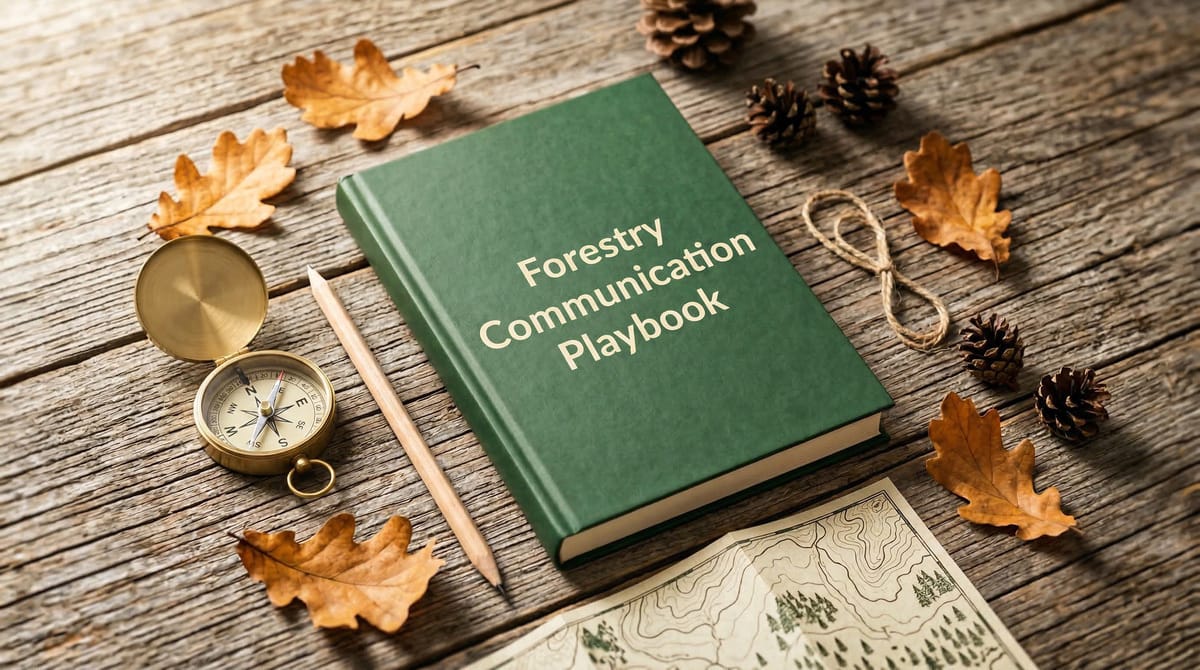
📖 The Forestry Communication Playbook
Ten chapters. Fifteen tools. €29.
Today's Big Story is also a communication problem. CEPF wrote a substantive technical response to a Commission consultation. Most forest owners will never read it. Most journalists will never report on it. The Brussels conversation about forest carbon is happening in a language that's too technical for the public and too political for the foresters.
That gap is exactly what the Playbook is built to close. Chapter 4 explains how to translate technical positions into messages that move readers. Chapter 7 gives you the eleven core messages that work across audiences.
🤝 ForestryBriefing
The brief is free. The briefing is not.
ForestryBrief publishes verified intelligence — free, three times a week, in 25+ countries. When you need that intelligence applied to your specific situation, that's a ForestryBriefing.
Intelligence — Investment due diligence, market intelligence, EUDR compliance, cross-sector risk analysis, background verification in three languages.
Communication — Strategy, trade publication articles, stakeholder messaging, newsletters that people actually open. EN | DE | HU.
Live — Conference presentations, panel moderation, keynotes. Next: WAN-IFRA World Printers Summit, Rotterdam, October 2026.
First briefing guarantee: if it doesn't deliver intelligence you can act on, you don't pay.
Until Tomorrow!
Wish you all the best: Peter
🤝 Need help with forestry communication, intelligence, or due diligence? See what we offer → ForestryBriefing
📩 Got this email forwarded to you? Subscribe to ForestryBrief here.
📚 Missed an issue? Browse the ForestryBrief archive
P.S. What’s the biggest challenge you’re facing in forestry right now?
Hit reply and let me know — I read every message personally.
P. P. S. Know a forest professional who’s drowning in EUDR complexity or missing out on timber market shifts? Forward this email to them!
Shauna Matkovich's Forest Invest Podcast is one of the best resources for understanding where forest finance is heading. If you are interested in Forest Investments, start there.
If you like FB be sure to subscribe to Boreal Tech Brief, a newsletter of my friend Axel covering tech in forestry with a Nordic angle:
