
Hello,
Last week I was in Brussels for a PEFC policy event. The title asked whether forest-based bioeconomy and ecosystem services are friends or foes.
The answer from EFI's Bernhard Wolfslehner was the most honest thing I've heard in a forestry policy room: "No foes — but utter complexity."
That line should be printed on every EU forest policy document. Here's what happened.
Here's what's moving European forestry this week:
🔍 The Big Story
"No Foes — But Utter Complexity": Inside PEFC's Brussels Policy Event
On March 25, PEFC hosted an in-person policy event in Brussels. The room was full. The question on the table: can the forest-based bioeconomy and ecosystem services work together?
The short answer: yes. The honest answer: it's harder than any single policy acknowledges.
Kulmuni: Forests Are Not Optional
Finnish MEP Katri Kulmuni opened with a structural observation. Forests are not formally part of EU competence. Yet approximately 30 EU initiatives, strategies, and pieces of legislation touch forests directly.
"You cannot deal with climate, environment, or energy without talking about forests," she said.
Drawing on her Finnish background, she noted that Finland has 5.5 million people and over 600,000 forest owners. Roughly every ninth Finn. Forests are private property, economic backbone, cultural cornerstone, and "almost something sacred."
She stressed the importance of bioeconomy for substituting fossil fuels. Not only through carbon sinks. Also through providing alternatives for fossil-based materials. She framed the maintenance of Europe's bioeconomy as a security issue.
Her central concern: the EU's bioeconomy ambitions are strong on paper. But the legislative framework does not match. "The good ideas and intentions are good. But the rest of the framework doesn't really support our path in that direction."
She called for less complexity, less political turmoil, and more policy longevity. She asked for actual bioeconomy legislation to follow the bioeconomy strategy. And for the Environmental Committee and the Industry and Energy Committee to work together more closely on these interlinked files.
Wolfslehner: The Research Says It's Complicated
Bernhard Wolfslehner from the European Forest Institute delivered the research perspective. His presentation framed the question through data. The core message landed in one slide title: "No foes — but utter complexity."
Using a comprehensive indicator map (Wolfslehner et al., 2016), he showed the full scope of what forests deliver across Forest Europe criteria. Forest area. Soil condition. Carbon stock. Biodiversity. Workforce. Trade in wood. Energy from wood resources. Recreation. Cultural and spiritual values. Contribution to GDP.
The message was clear: any discussion of bioeconomy versus ecosystem services is already a simplification of a far more complex reality. Forests deliver provisioning, regulating, and cultural services simultaneously. The question is not which one wins. It's how trade-offs are managed in practice.
He presented a circular bioeconomy framework (Hetemaki et al., 2017) showing how sustainable forest management sits at the centre of biomass, bioenergy, products, and services. And he showed climate mitigation as a two-lever system: the sequestration lever (wood in the forest) and the substitution lever (wood products replacing fossil-based materials). Both matter. Neither is sufficient alone.
His key messages were direct. No more black and white thinking. Integrative solutions are needed — but at proper scales. Forests can contribute to both climate mitigation and biodiversity conservation. Within ecological limits. And certification can help by translating these objectives into operational management requirements.
The Panel: Trust Was the Word
The panel discussion brought together Sven-Erik Hammar (President, CEPF), Markus Lier (DG AGRI), Giulia Cancian (UPM), Ana Belén Noriega Bravo (PEFC Spain), and Wolfslehner.
Trust emerged as the dominant theme. Multiple panelists returned to it independently. The sector needs trust from the public, from policymakers, and from buyers. Certification is one mechanism for building it. But certification alone isn't enough if the underlying communication fails.
Hammar delivered a powerful proof point from Sweden: forests grew from 1.5 billion cubic metres to 3 billion cubic metres of standing volume over the past century. During the same period, Sweden harvested 6 billion cubic metres. Growth outpaced harvest. That's what sustainable management looks like over a century.
Lier from DG AGRI made an unexpected invitation. He asked the forestry sector to communicate better. To explain what it does and why it matters. Coming from the Commission, that was notable. (Happy to help the industry with that, see the end of the email…)
Cancian from UPM emphasised the mitigation hierarchy: reduce emissions first. Forests play a role, but they are not a substitute for decarbonising industry.
The €4.2 Billion Question
One number kept surfacing: €4.2 billion in CAP forestry measures allocated in the 2014–2020 period. The concern from multiple speakers: this money is not reaching the ground effectively. Forest owners — especially small ones — face barriers to accessing it. The administrative complexity is a problem in itself.
This connects to the additionality paradox that frustrates European foresters. Forests managed sustainably for generations struggle to prove they are doing something "additional." The system rewards those who start from degradation. It penalises those who never let degradation happen.
The Mic-Drop
Toby Aykroyd, Director of Wild Europe Foundation, was not on the programme. He took the audience microphone during Q&A and delivered what several attendees later called the moment of the event.
His prediction: ecosystem services payments will become the dominant revenue stream for European forests within a generation. Not timber. Services. And the sector needs to prepare for that shift now.
What This Means
Wolfslehner's "utter complexity" is not a weakness. It's a description of reality. European forests deliver timber, carbon, biodiversity, water, recreation, and cultural identity simultaneously. No other land use does this.
The challenge is that EU policy treats these as separate files. Separate directorates. Separate budgets. Separate constituencies. Kulmuni named this problem directly. Until the legislative framework matches the biological reality, the sector will keep fighting policy battles on 30 fronts simultaneously.
The good news: the research is clear. The data exists. The frameworks are published. What's missing is the political will to integrate — and the communication to explain why it matters.
ForestryBrief was in the room. We'll continue covering where this leads.
ForestryBrief attended this event in person. Speaker notes for Bernhard Wolfslehner's presentation were shared with permission. Isaac Lievevrouw and Maja Drča (PEFC) organised the event. PEFC published their own event article on April 1. Sources: PEFC — Brussels Policy Event, March 25, 2026 | Wolfslehner presentation slides (shared with permission) | Aggestam et al., 2025 | Hetemaki et al., 2017 | Wolfslehner et al., 2016 | Nabuurs et al., 2015, 2024 | Linser et al., 2025 | Muys et al., 2022
📊 Quick Hits
1. 🇺🇸 US Plywood Duties Heading to 200% — What It Means for European Wood Trade
The US has set a July 16 hearing in its plywood trade case against China, Indonesia, and Vietnam. Preliminary duties of up to nearly 200% already apply to imports from those countries.
The European angle: When the US shuts out Asian plywood, those volumes need a home. Some will redirect to Europe, the Middle East, and Africa. European plywood producers face potential competition from displaced Asian supply at discounted prices.
Meanwhile, Domtar announced it will idle its Coosa Pines pulp mill in Alabama in May. The mill has 270,000 tonnes of annual capacity. North American pulp capacity is shrinking. That tightens global pulp supply — and could support European pulp prices.
The takeaway: The US is building walls. European operators need to watch what climbs over them. Sources: Lesprom — US sets July 16 hearing in plywood trade case | Lesprom — Domtar to idle Coosa Pines pulp mill
2. 🇸🇪 Swedish Forest Companies Automate Climate Reporting with AI
Two Swedish climate-tech companies — Emission Twin and GoClimate — won a joint procurement to help four forest companies automate their climate reporting. GoClimate's AI connects to financial and business systems to calculate emissions. The data feeds into Emission Twin's digital twin for scenario simulation.
The pilot includes initial documentation for digital product passports — ahead of tightening EU traceability requirements.
The takeaway: If you're still doing climate reporting manually, watch what Sweden builds. The first-movers are automating now. Source: Impact Loop — Emission Twin and GoClimate AI deal | Boreal Tech Brief #037
3. 🇸🇪 Treebula Launches Subscription Dashboard for 65,000 Swedish Forest Owners
Treebula launched Treebula Plus. The subscription combines real-time timber price comparisons, forest property valuations, and stand-level inventory data in a single dashboard.
Treebula already has 65,000 registered owners using free tools: digital management plans, drone-based inventory through Copture, and carbon credit access via Arbonics. The paid tier adds financial intelligence.
The takeaway: If you manage forests in Scandinavia, test it. If you build forest tech anywhere in Europe, study the model. Source: Treebula — Launches Treebula Plus | Boreal Tech Brief #037
📅 The Weeks Ahead
April 21, 2026: 🔴 SoEF 2025 Webinar — Forest Health and Vitality (FOREST EUROPE)
April 28–29, 2026: CIFB Europe — Corporate Investments into Forestry & Biodiversity — Frankfurt, Germany (CE Events & Media)
April 30, 2026: EUDR simplification review package due from Commission
May 14, 2026: PEFC Forest Forum — Istanbul
May 22, 2026: SoEF 2025 Webinar — Forest Resources and Carbon (FOREST EUROPE)
June 2–4, 2026: Carrefour International du Bois — Nantes, France
June 9–10, 2026: FAIS — Forestry & Agriculture Investment Summit — London, UK (CE Events & Media)
June 17, 2026: SoEF 2025 Webinar — Bioeconomy (FOREST EUROPE)
September 16–18, 2026: EFI Annual Conference — Växjö, Sweden (European Forest City 2026)
October 5, 2026: WAN-IFRA World Printers Summit — Rotterdam (ForestryBrief presenting)
October 13–14, 2026: CIFB London — Corporate Investments into Forestry & Biodiversity — London, UK (CE Events & Media)
November 5–6, 2026: 11th International Hardwood Conference — Antwerp (ATIBT)
December 30, 2026: EUDR deadline for large and medium operators
💡 One Thing to Try This Week
Ask yourself Wolfslehner's question: which forest services does your management actually deliver?
Not which ones you think it delivers. Which ones you can prove.
Ten minutes:
List every service your forest provides: timber, carbon, water, biodiversity, recreation, cultural value
For each one, ask: can I measure this? Can I document it?
For those you can't: that's your communication gap
Pick one gap. Start documenting it this month
The PEFC event showed that the research frameworks exist. Wolfslehner's indicator map covers 30+ dimensions. Your forest probably delivers on most of them. You're just not tracking — or communicating — the evidence.
The sector that proves what it delivers is the sector that gets paid for all of it.
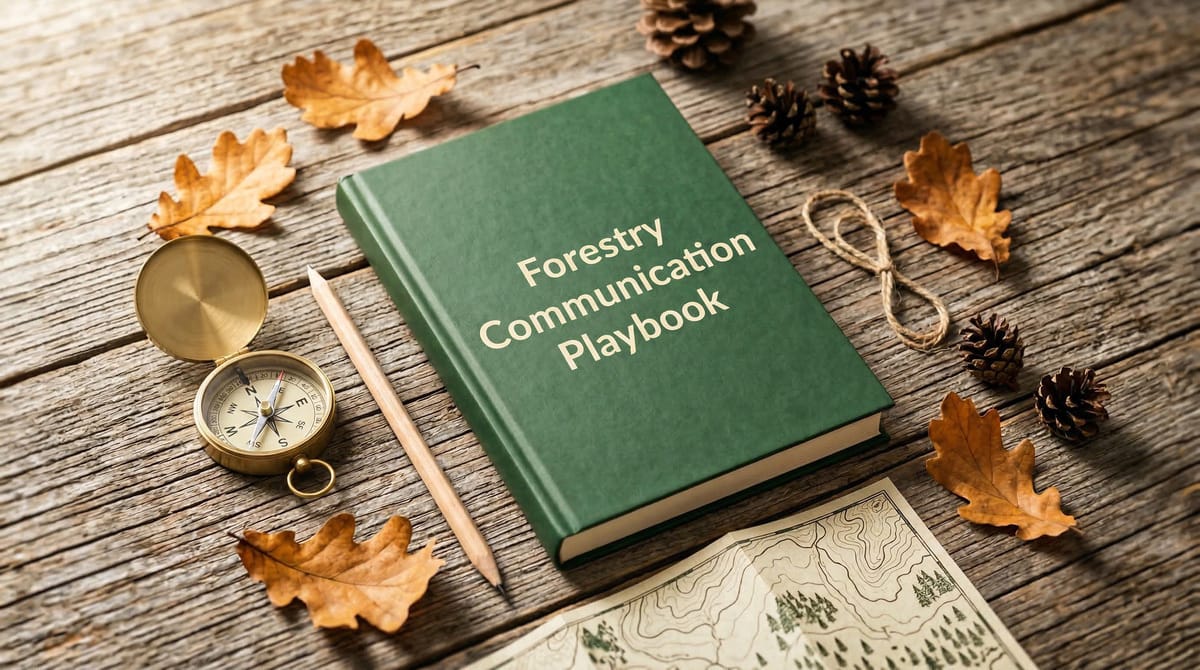
📖 The Forestry Communication Playbook
The only book that teaches foresters how to communicate. 10 chapters. 15 tools. Quizzes. Flashcards. 9 illustrations. €29. Instant download.
🤝 ForestryBriefing
The brief is free. The briefing is not.
ForestryBrief publishes verified intelligence — free, three times a week, in 25+ countries. When you need that intelligence applied to your specific situation, that's a ForestryBriefing.
Intelligence — Investment due diligence, market intelligence, EUDR compliance, cross-sector risk analysis, background verification in three languages.
Communication — Strategy, trade publication articles, stakeholder messaging, newsletters that people actually open. EN | DE | HU.
Live — Conference presentations, panel moderation, keynotes. Next: WAN-IFRA World Printers Summit, Rotterdam, October 2026.
First briefing guarantee: if it doesn't deliver intelligence you can act on, you don't pay.
Until Tomorrow!
Wish you all the best: Peter
🤝 Need help with forestry communication, intelligence, or due diligence? See what we offer → ForestryBriefing
📩 Got this email forwarded to you? Subscribe to ForestryBrief here.
📚 Missed an issue? Browse the ForestryBrief archive
P.S. What’s the biggest challenge you’re facing in forestry right now?
Hit reply and let me know — I read every message personally.
P. P. S. Know a forest professional who’s drowning in EUDR complexity or missing out on timber market shifts? Forward this email to them!
Shauna Matkovich's Forest Invest Podcast is one of the best resources for understanding where forest finance is heading. If you are interested in Forest Investments, start there.
If you like FB be sure to subscribe to Boreal Tech Brief, a newsletter of my friend Axel covering tech in forestry with a Nordic angle:
