
Hello,
Two forest money stories landed in one week. One owner refinanced with €200 million. One fund sold 2,600 hectares. Different moves. Both point the same way.
Here's what's moving European forestry this week:
One question for you
What's the one forest-market question your team must answer before 2027 budgets close? Hit reply with one line. I read every answer and never name who asked.
Want the answer for your own business? Add "briefing" to your reply, and I'll send a one-page outline.
🔍 The Big Story
🇫🇮 🇱🇻 A €200 million refinancing and a 2,600-hectare sale. Forest capital stays active.
What happened: the loan
On 8 October, Tornator said it signed a new bank loan of €200 million. The source is its own stock exchange release. Tornator owns forests in Finland, Estonia and Romania. The loan is green and secured. "Secured" is a lending term. In plain words, assets back the loan. It runs for three years. Danske Bank, OP Corporate Bank and SEB arranged it.
Tornator draws €100 million first.
Part of it goes toward repaying a €350 million secured green bond. That bond was due on 14 October.
Part pays for forest investments in the rest of 2026.
The rest stays available until the end of March 2027. It is for growth investments next year.
The loan completes an autumn refinancing. In September, Tornator issued a new €300 million secured green bond. Moody's rates its secured debt Baa3, with a stable outlook.
What happened: the sale
On 7 October, INVL announced a forest sale in Latvia. One of its funds sold more than 2,600 hectares. Most of it lies in Vidzeme and Latgale. The fund held it through two Latvian companies, Zemvalde Forest and Zemvalde Agro.
The buyer is a Latvian-registered company owned by Danish investors. The price was not disclosed. Karl Danielsson Farm & Forest ran the sale.
The fund, INVL Sustainable Timberland and Farmland Fund II, raised €98 million from investors. It manages about 21,000 hectares of forest and farmland in the Baltics and Romania.
INVL said it has concluded this investment cycle. It plans to reinvest the proceeds in other forest and farmland. No price or reinvestment timetable was given. Partner Martynas Samulionis said: "This transaction is a further confirmation that sustainably managed forest creates real, market-recognised value."
Why this matters
A long-term owner refinances and keeps room to invest. A fund at the end of a cycle sells, and plans to buy again. The buyer is owned by investors too.
My read, and it is a read rather than a finding: Both point to more forest investment ahead. Part of the loan is refinancing. INVL's reinvestment is a plan. Neither shows where every euro will land.
In #118, Tornator reported buying more than 12,000 hectares in Finland in the first half. Total investments were nearly €60 million.
Now note what is missing. INVL gave no price. So this sale tells you buyers exist. It does not tell you what a hectare is worth.
What this means for you
If you own forest in Finland, Estonia, Romania or the Baltics: Both say they plan to keep investing. Tornator owns forest in the first three. The INVL fund invests in the Baltics and Romania. Know your forest's value before someone asks.
If you might sell: INVL used a specialist to run the sale. A prepared file and a run process bring buyers to the table. See One Thing to Try, below.
If you invest: Treat a deal without a price as a volume signal, not a valuation benchmark. Ask for priced comparable sales first (I can help you with that, see below).
If you speak for forestry: "Investors are selling forest" will be someone's headline. The fuller answer is one line. The seller plans to reinvest, and the buyer is investor-owned too. Sources: Tornator — Tornator signs EUR 200 million bank loan arrangement to secure investment capacity (8 Oct 2026) | INVL — INVL fund sold 2,600 hectares of forests in Latvia (7 Oct 2026) | prior ForestryBrief coverage: EFP #118
📊 Quick Hits
1. 🇩🇪 🇦🇹 Less sawmill production, dearer wood chips
On 6 October, top agrar reported the third-quarter wood chip price in Germany. The German Pellet Institute (DEPI) collects it every quarter.
A1 chips averaged €38.90 per loose cubic metre, net. That is about 13% more than in the second quarter. It is a survey average for 80 loose cubic metres delivered within 50 km. It is not a spot price.
DEPI points mainly to sawmill residues. Managing director Martin Bentele put it simply (translated from German). "If sawing stops, our raw material is missing too." Weak building keeps sawmill output low, top agrar reports. Less sawing means fewer residues.
Austria shows weak sawn-wood trade too. It is a related signal, not the cause of the German price. Softwood lumber exports fell 7% in January to July, Timber-Online reports. Exports to the EU fell 3%. Glulam and CLT exports reached 1.12 million m³, down 2.1%.
Why it matters: Residues are every sawmill's second product. When saws slow, energy-wood buyers feel it next. Per top agrar, chips still cost about 68% less than heating oil.
The context: In #124, DEPI's September pellet price was €454.21 per tonne, up 6.2% in a month.
The takeaway: My advice: if you sell energy wood, check your next contract against the third-quarter price. Source: top agrar — Hackschnitzelpreise im 3. Quartal deutlich gestiegen (6 Oct 2026, German) | Timber-Online — Decreasing softwood lumber exports (9 Oct 2026) | Timber-Online — Laminated timber exports down by 2% (8 Oct 2026)
2. 🇫🇮 Drones are increasingly used for boron in Finland's private forests
On 8 October, Forest News from the Finnish Forest Association looked at remedial fertilisation. That is fertilising to fix growth problems caused by a missing nutrient.
Boron covered more than 80% of the area in this year's support applications for it. The data are Finnish Forest Centre applications from 1 January to 31 August.
The article says drones now do a large share of boron work in private forests. It gives no percentage. Helicopters and ground spreading did it before. Granular boron is rising. Liquid boron fell to 5%, from 21% a year ago. The average site is still about 1.5 hectares.
Pine is rising fast. The share of pine stands getting boron more than doubled in two years.
Markku Remes of the Finnish Forest Centre lists the gains. He says drones need less fertiliser per area, carry larger loads and spread faster. He says the work now costs less. The article gives no cost figures.
Why it matters: Small sites become worth treating. Lower costs and higher support have raised interest, Remes says.
The takeaway: Walk a young pine or spruce stand. The article lists possible signs of boron shortage. Look for abnormal or dying top buds, branching, several leaders and bushy growth. Signs are a reason to ask, not a diagnosis. Source: Forest News — Drones are changing forest fertilisation (8 Oct 2026)
3. 🇩🇪 Bavaria's state forests sold more, lost less to damage, and saved for the next risk
On 12 October, the Bavarian State Forests (BaySF) published results for their 2026 business year. It ran from 1 July 2025 to 30 June 2026.
Sales reached €536 million. Net profit was €71.7 million. BaySF calls it one of the best results in its history. In the previous business year, sales were €501.8 million. Profit was €43.7 million, epd reported then.
Damaged wood fell to about 0.63 million m³. That is more than half below the year before. Bark beetle wood was about 0.35 million m³.
BaySF paid €50 million into its climate forest fund. The fund now holds €200 million. The long-term goal is €300 million. About 7,500 hectares became climate-adapted mixed forest. About 5.8 million young trees were planted.
Why it matters: Finance board member Manfred Kröninger said it plainly (translated from German). "We must use good years to provide for difficult years."
The context: In #128, Czech state forests earned 23% more pre-tax profit on 8% less wood.
The takeaway: My advice: after a good wood year, set part of it aside. Damage years come back. Source: BaySF — Bayerische Staatsforsten ziehen Bilanz (12 Oct 2026, German) | Holz-Zentralblatt — Ergebnis gesteigert, Schadholz halbiert (13 Oct 2026, German) | epd via Sonntagsblatt — previous business year (13 Oct 2025, German)
📅 The Weeks Ahead
October: Commission EUDR Information System training sessions. Micro and small primary operators: today, 15 October, 14:00 CEST, and 27 October, 14:00 CET. Upstream operators: 22 October, 14:00 CEST. Register here
Thu 15 October: New Information System rule under Regulation (EU) 2026/1565: due diligence statements go to the authority of the operator's Member State of establishment (for non-EU operators, the Member State linked to their identifier) | Metsä Group's commercial offer to owner-members closes (one-year pulpwood price guarantee)
Thu–Sun 15–18 October: INTERFORST 2026 — Munich
Sun 18 – Fri 30 October: COP17 Biodiversity — Yerevan, Armenia (opening ceremony Sunday evening, sessions from Monday)
Mon 19 October: SLU and Skogsstyrelsen webinar on the new forest age and site index maps
Tue–Wed 20–21 October: Global Bioeconomy Summit 2026 — Dublin
Tue–Fri 20–23 October: SICAM — Pordenone
Thu 22 October: US Softwood Lumber Board rule takes effect for net-size lumber imports. See #125 | UK Forestry Statistics 2026 (Forest Research)
Fri 23 October: SCA third-quarter report
Wed–Thu 28–29 October: International Softwood Conference — Malahide, Dublin
Thu 29 October: Weyerhaeuser third-quarter results
Fri 30 October: Stora Enso third-quarter report
Tue 3 November: Bergslagets Skogar Capital Markets Day — Stockholm
Wed 4 November: TDUK Global Market Conference — London
Thu–Fri 5–6 November: 🌳 11th International Hardwood Conference — Antwerp
Mon–Thu 9–12 November: ITTC 62 — Yokohama (ITTO)
Tue 10 November: BiodivFuture pre-proposals due, 12:00 CET (Biodiversa+)
Tue–Fri 10–13 November: FIMMA + Maderalia — Valencia
Wed–Thu 11–12 November: Puupäivä — Helsinki (Puuinfo)
Wed–Thu 18–19 November: German Timber Congress 2026 (DeSH) — Wiesbaden
Wed 25 November: Forest Bioeconomy Investment Accelerator (FBIA) 2026 final event — EIB, Brussels (by invitation)
Fri 27 November: Timber and Circular Economy CPD — online and free (PEFC via TDUK)
Mon 30 November: Södra's temporary birch premium window closes. See #126
Tue 1 December: SMURF Carbon Standard consultation closes, 17:00 CET
Wed 2 December: FOREST Partnership first joint call: pre-proposals due, 13:00 CET (up to €40 million)
Wed 9 December: 📌 European Commission deadline for a decision on the UPM/Sappi joint venture (Case M.12270). See #128
Wed 30 December: EUDR applies to large and medium operators, and to micro and small operators already covered by the EU Timber Regulation
Wed 30 June 2027: EUDR applies to the remaining micro and small operators
💡 One Thing to Try This Week
Build the file a buyer will ask for. Even if you never sell.
INVL's sale ran through a specialist. Serious buyers ask for paperwork first. A missing paper becomes a question, and questions become discounts.
Put your current forest management plan and maps in one folder.
Add your harvest and sales records for the last five to ten years.
Add certificates, grants and their end dates. #122 shows how to find them.
Add road rights, easements and hunting leases, with end dates.
Write one page: area, species, standing volume, age classes.
The file helps you even if you keep the forest. Your heirs, your bank and your next buyer will all ask for it.
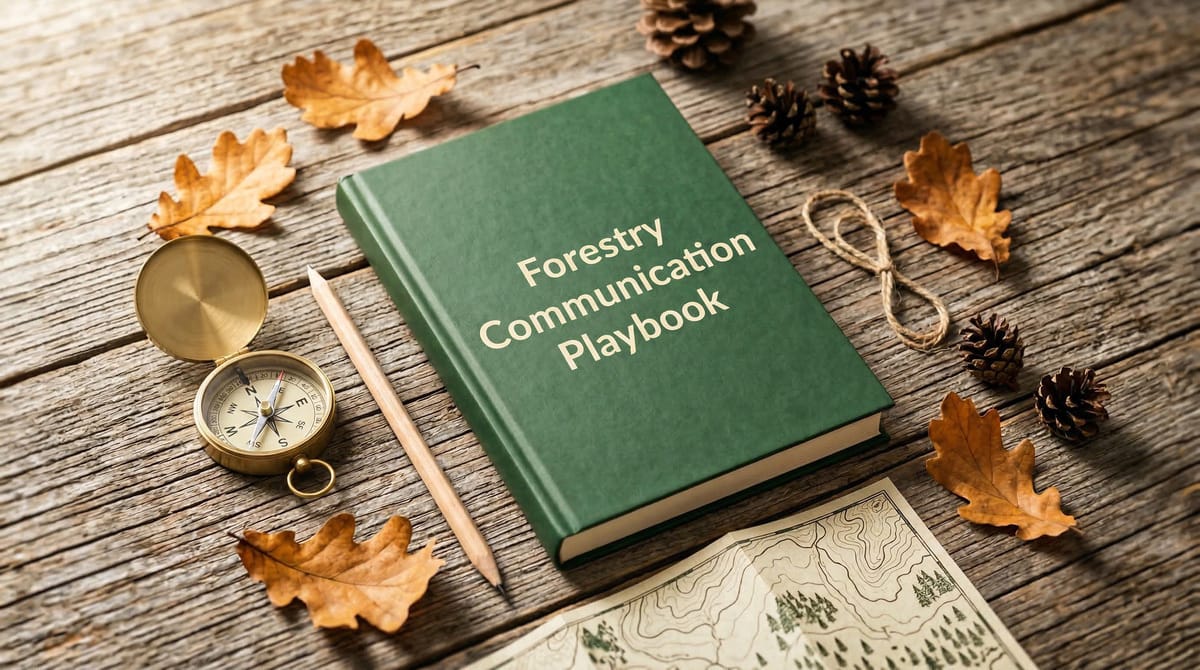
📖 The Forestry Communication Playbook
"So investors are dumping Baltic forest now?"
You may hear it after a headline like this week's. From a neighbour, a council member, or a reporter. The honest answer is short. One fund sold at the end of its cycle. It says it plans to buy again. The buyer is owned by investors too.
Saying that calmly, in one breath, takes practice.
Part 1 covers the questions that arrive without warning.
📗 The Forest-Investment Dictionary
A sale without a price is a signal, not a benchmark.
2,600 hectares changed hands this week. Nobody outside the deal knows the price. Investors call the missing number a comparable. Foresters call it the neighbour's sale. Neither works without a price.
I wrote the Forest-Investment Dictionary with Danish forest economist Anders Tærø Nielsen. It has 151 pages, 11 chapters, 14 printable tools, and 3 calculators. Investors learn to read a forest. Foresters learn to read a term sheet.
When the market turns, the people who can read the numbers make the better calls. The price is €99. Get yours below.

📘 The Organization — Playbook Part 3
A refinancing is news too. Someone has to explain it.
Finance news has many readers. Staff, owners, lenders and neighbours all read it differently. Part 3 is about who in your organisation speaks to each of them. And whether they have the time.
I wrote The Organization, Part 3 of the Playbook. It has 165 pages, 10 chapters, 10 printable tools, and a survey. It shows what it takes to be heard, and who does the work.
Almost nobody in European forestry publishes what communication costs. The survey inside starts the count. The price is €149. Get yours below.

🤝 ForestryBriefing
The brief is free. The briefing is not.
ForestryBrief publishes verified intelligence — free, three times a week, in 25+ countries. When you need that intelligence applied to your specific situation, that's a ForestryBriefing.
Intelligence — Investment due diligence, market intelligence, EUDR compliance, cross-sector risk analysis, background verification in three languages.
Communication — Strategy, trade publication articles, stakeholder messaging, newsletters that people actually open. EN | DE | HU.
Live — Conference presentations, panel moderation, keynotes. Most recent: WAN-IFRA World Printers Summit, Rotterdam, October 2026.
First briefing guarantee: if it doesn't deliver intelligence you can act on, you don't pay.
Until Tomorrow!
Wish you all the best: Peter
🤝 Need help with forestry communication, intelligence, or due diligence? See what we offer → ForestryBriefing
📩 Got this email forwarded to you? Subscribe to ForestryBrief here.
📚 Missed an issue? Browse the ForestryBrief archive
P.S. What’s the biggest challenge you’re facing in forestry right now?
Hit reply and let me know — I read every message personally.
P. P. S. Know a forest professional who’s drowning in EUDR complexity or missing out on timber market shifts? Forward this email to them!
Independent since issue one. Read the charter.
Shauna Matkovich's Forest Invest Podcast is one of the best resources for understanding where forest finance is heading. If you are interested in Forest Investments, start there.
If you like FB be sure to subscribe to Boreal Tech Brief, a newsletter of my friend Axel covering tech in forestry with a Nordic angle:
