
Hello,
Open your organisation's website. Find the page about sustainability.
Read the adjectives.
On Sunday, the ones you use with consumers start carrying a legal test. On Saturday they did not.
Here's what's moving European forestry this week:
🔍 The Big Story
On Sunday, the words in your brochure change status.
What actually happens on 27 September
No new regulation arrives. An old one changes.
Directive (EU) 2024/825 was adopted on 28 February 2024. People call it EmpCo, short for empowering consumers.
It amends two older laws. The Unfair Commercial Practices Directive from 2005. The Consumer Rights Directive from 2011.
Member States had to write it into national law by 27 March 2026. Article 4 sets the second date plainly. They "shall apply those measures from 27 September 2026".
So Sunday is not the day Brussels acts. It is the day your own national law starts to bite.
Three new entries on the blacklist
The directive adds several practices to Annex I. That is the list of practices treated as unfair in every case. There is no case-by-case fairness test to argue about.
Three of those additions matter most for forestry.
01 · Generic environmental claims
"Making a generic environmental claim for which the trader is not able to demonstrate recognised excellent environmental performance relevant to the claim."
Look closely at that phrase. Recognised excellent environmental performance is defined in the directive. It means the EU Ecolabel. Or an officially recognised national scheme under EN ISO 14024 type I. Or top performance under other EU law.
Recital 10 lists what counts as generic. "Environmentally friendly", "eco-friendly", "green", "ecological", "climate friendly", "gentle on the environment", "carbon friendly", "biodegradable", "biobased". Read your own copy against that list.
02 · Carbon neutrality built on offsets
"Claiming, based on the offsetting of greenhouse gas emissions, that a product has a neutral, reduced or positive impact on the environment in terms of greenhouse gas emissions."
The reasoning is spelled out in the recitals. Such claims must rest on the product's real lifecycle impact. Not on offsetting outside its value chain.
03 · Labels with no scheme behind them
"Displaying a sustainability label that is not based on a certification scheme or not established by public authorities."
This is the one the forestry sector should read twice. It is also the one carrying good news.
The trap in the sector's favourite word
Recital 10 goes further, and this is the part forestry needs.
It says a claim like "sustainable" or "responsible" cannot be justified by recognised excellent environmental performance alone.
The reason is precise. Those words carry more than environmental meaning. They imply social characteristics too. So the best environmental evidence in the world does not, by itself, support the word "sustainable".
That is worth sitting with. It is the word this sector reaches for most often. The directive names it directly.
Who this actually applies to
Here is a limit worth knowing, because plenty of coverage will skip it.
EmpCo amends consumer law. The blacklist sits inside a directive about business-to-consumer practices.
If you sell logs to a mill, that is a business-to-business sale. A purely B2B transaction sits outside the core scope. The blacklist is not aimed at your delivery note.
But look at where your sector does market to consumers. Pellets in bags. Garden products. Furniture. Paper. Consumer-facing web pages, product pages, advertising and brochures. That is a lot of forestry, and it is where the risk sits.
A page is not caught simply because the public can see it. It is caught when it is part of marketing to consumers. If your communications do both jobs, they need looking at separately.
Why the third entry is good news
A "certification scheme" is defined too, and the definition is demanding.
Access has to be transparent, fair and open to all. Requirements must be developed with experts. There must be procedures for handling non-compliance and withdrawing the label. An independent third party has to monitor it.
Now read that list against what forest certification has been doing for thirty years.
The schemes this sector built already look like what the law now wants. The invented green leaf on a website is what the law is written to stop.
One caution, because it matters. The directive names no scheme. It sets conditions, and a scheme either meets them or does not. Nobody gets pre-approved.
Even so, it is a rare position to be in. A compliance burden landed on everybody. The infrastructure that answers it was already built and paid for.
FSC has already moved
On 21 September FSC published guidance for its licence holders on exactly this.
Helen Chepkemoi Too, FSC Senior Director of Markets, put the choice simply. "EmpCo gives companies a clear choice: make environmental claims they can stand behind, or rethink how they communicate."
Be precise about what that is. It is a certification body helping its own licence holders get ready. It is not new law, and FSC places no duty on anyone outside its system.
The law is the national measure in your country. FSC's own position is that its system and labels line up with the directive's conditions. That is FSC speaking about FSC. No public authority has ruled on it.
German trade associations asked for transition relief on EmpCo back in early September. We covered that in issue #119. Sunday arrives regardless.
What this means for you
If you are certified: your certificate is evidence for claims that match its scope. It does not substantiate every green sentence on the page. Say the specific thing.
If you use the word "sustainable" on its own: the directive names it. Environmental evidence alone will not carry it, because the word promises social things too. Say the narrower true thing instead.
If you sell anything carbon neutral: check whether the claim rests on offsetting. If it does, it is on the blacklist.
If you run your own in-house label: check whether a certification scheme sits behind it. Then check that the scheme meets the conditions. If not, retire the label.
If you only sell logs to mills: your contracts are not the target. Your consumer-facing pages may still be.
The useful part
Vague claims were always weak. They convinced nobody who was paying attention, and they annoyed the people who could tell. What changes on Sunday is that vagueness stops being merely unconvincing. Where a practice is covered, a national authority can act on it.
The fix is the same one good communicators reached years ago. Say a smaller, truer thing. Name the standard. Name the scope. Name who checked. This sector has spent decades hearing that proof is a cost. From Sunday, proof is also permission to speak. Sources: Directive (EU) 2024/825, Official Journal | FSC, 21 September 2026 | prior ForestryBrief coverage: European Forestry Pulse #119
📊 Quick Hits
1. 🇪🇺 European construction is not one market, and July proved it.
Eurostat published July construction figures on 18 September.
Production in construction fell 0.3% in the EU from June. In the euro area it was stable. These are calendar-adjusted output figures. For recent months Eurostat estimates some missing national data. Year on year the EU fell 1.8%. The euro area fell 2.0%.
Those averages hide the interesting part. Over twelve months Hungary fell 12.2%, Spain 9.7% and France 5.0%. Over the same months Finland rose 12.8% and Slovenia 11.6%.
Why it matters: Construction is a major end-use market for sawn timber. Among the countries reporting, a quiet EU average sits on top of a 25-point spread.
The takeaway: If you sell into construction, the EU figure is close to useless for you. Track the two or three countries your wood actually reaches. One may be growing at 12% while the headline says the market shrinks. These measure building output, not timber bought. Source: Eurostat, production in construction, July 2026, released 18 September 2026
2. 🇸🇪 Swedish owners notified a fifth less forest for felling in August.
Skogsstyrelsen published its August figures on 15 September.
Registered felling notifications and mountain-forest permit applications covered 15,312 hectares. That is 19% less than August 2025. Against the five-year average for the month it is 32% lower.
A felling notification is not a harvest. It is a legal step taken before cutting. It signals intent, not volume. Skogsstyrelsen also warns that its two most recent months are preliminary. Treat August as a first reading.
Why it matters: Notifications run ahead of supply. They are one of the few places where you watch owners deciding, before wood moves.
My read, and it is a read rather than a finding: Skogsstyrelsen gives no reason for the fall. I am not going to invent one. What I would say is this. Standing timber keeps growing while an owner waits. That makes postponement unusually cheap to hold. It also makes it hard for a buyer to see coming. Source: Skogsstyrelsen, felling notification statistics, 15 September 2026
3. 🇩🇪 German pellets hit €454 a tonne, and still undercut oil by nearly half.
The German Pellet Institute published September prices on 16 September.
A six-tonne order averaged €454.21 per tonne. That is up 6.2% on August. In heat terms it works out at 9.1 cents per kilowatt hour. On that basis DEPI puts pellets about 48% below heating oil. And about 20% below gas.
A note on the year-on-year figure. DEPI's own September release gives none. Its September 2025 release gave €335.04 a tonne. Anyone comparing the two is doing their own arithmetic, not quoting DEPI.
Why it matters: Pellets are made largely from sawmill residues and low-grade roundwood. They are one of the few outlets that pays for material a sawmill cannot use.
My read, and it is a read rather than a finding: This is a German retail heating price. It does not travel straight to your roadside. Collection cost, moisture, haul distance and your contract all sit in between. What it does tell you is that the energy outlet is bidding. That is worth knowing before you settle a price for tops and thinnings. Source: Deutsches Pelletinstitut, 16 September 2026
📅 The Weeks Ahead
Ongoing: EUDR Information System virtual training sessions — new dates on the Commission implementation page
In force 18 September 2026: EUDR product-scope Delegated Regulation (EU) 2026/2102. The three newly added product groups apply from 30 December 2027
Expected Q3 2026: Commission adoption of the revised EU Taxonomy Climate and Environmental Delegated Acts (advisory target, not a binding deadline)
Thursday–Saturday, September 24–26, 2026: APF Exhibition 2026 — Ragley Estate, Warwickshire, UK
Friday, September 25, 2026: Precious Forests Foundation seminar — Bayonne, France
🔴 Sunday, September 27, 2026: EU EmpCo Directive national measures apply — see today's Big Story
Tuesday–Thursday, September 29 – October 1, 2026: FinnBuild — Helsinki
Wednesday, September 30, 2026: Laurus Network 6th webinar — "Wildfire management: lessons learned and future challenges. The experience of Castilla y León (Spain)" | Produrable, Paris | TNC NatureVest and Forest Trends webinar on private investment in nature across emerging markets
Wednesday–Thursday, September 30 – October 1, 2026: Forisk Timber Market Analysis class — virtual
Thursday, October 1, 2026: Japan Ministry of the Environment nature-finance guidelines pilot closes | Blue Catalyst Fund second call closes, 19:00 BST
🔴 Sunday–Tuesday, October 4–6, 2026: WAN-IFRA World Printers Summit — Rotterdam (I present on October 5)
Monday, October 5, 2026: Verra VM0033 blue-carbon consultation closes | ATIBT call for service providers closes (EU-funded, Congo domestic timber)
Wednesday–Thursday, October 7–8, 2026: 19th European Congress (FOGE) — Cologne, Germany | RFSI Forum — Denver
Friday, October 9, 2026: PEFC consultation on the revised Vietnam Forest Certification Scheme closes
Sunday, October 11, 2026: Cercarbono second biodiversity methodology consultation closes
🔴 Tuesday–Wednesday, October 13–14, 2026: CIFB London: Corporate Investments into Forestry & Biodiversity — London, UK
Tuesday, October 13, 2026: Timber Development UK online — Timber in Construction 101: Onsite Excellence, 13:00–14:00
Thursday, October 15, 2026: Metsä Group campaign closes
Thursday–Sunday, October 15–18, 2026: INTERFORST 2026 — Munich (quadrennial forestry technology trade fair)
Sunday, October 18, 2026: COP17 Biodiversity opens — Yerevan, Armenia
During October 2026: Article 6.4 Supervisory Body decision on reversal risk expected
Tuesday–Wednesday, October 20–21, 2026: Global Bioeconomy Summit 2026 — Dublin, Ireland
Wednesday–Thursday, October 28–29, 2026: International Softwood Conference — Dublin
Tuesday, November 3, 2026: Bergslagets Skogar Capital Markets Day — Stockholm
Wednesday, November 4, 2026: TDUK Global Market Conference — London
🌳 Thursday–Friday, November 5–6, 2026: 11th International Hardwood Conference — Antwerp (ATIBT)
Monday, November 9, 2026: ITTC 62 — Yokohama (ITTO)
Tuesday, November 10, 2026: BiodivFuture mandatory pre-proposals due (Biodiversa+, around €40 million, 25 countries plus the Commission)
📌 Wednesday, November 11, 2026: European Commission deadline for a final decision on the UPM/Sappi joint venture (Case M.12270)
Wednesday–Thursday, November 11–12, 2026: Puupäivä — Helsinki (Puuinfo)
Wednesday, November 25, 2026: FBIA 2026 final event, EIB Brussels (by invitation)
Friday, November 27, 2026: Timber and Circular Economy CPD — online and free (PEFC via TDUK)
🔴 Wednesday, December 30, 2026: EUDR applies to large and medium operators, and to the timber products the old EU Timber Regulation covered
End 2026 / early 2027: Revised German climate-adapted forest management guideline expected (Natura 2000 "Lebensraumtyp-Synergiemodul", BMUKN)
Friday, January 1, 2027: Revised EU Taxonomy technical screening criteria expected to apply
Wednesday–Thursday, March 3–4, 2027: RFSI Europe — Brussels
Friday, April 16, 2027: BiodivFuture full proposals due
Wednesday–Friday, May 12–14, 2027: Ligna — Hannover
During 2027: Commission guidance and portal on integrated wildfire risk management due
Wednesday, June 30, 2027: EUDR applies to micro and small operators outside the timber sector
Thursday, December 30, 2027: EUDR newly added products apply — soluble coffee, palm oil derivatives, frozen cattle tongues
Thursday, July 17, 2031: FRM Regulation (EU) 2026/1392 applies
💡 One Thing to Try This Week
Print your own sustainability page and take a pen to it.
Print the page. On paper. You will read it differently.
Underline every environmental adjective. Sustainable. Green. Eco. Responsible. Climate-friendly. Natural.
Beside each one, write the evidence in the margin. A standard, a certificate number, a measurement, a date.
Cross out every adjective with an empty margin.
Read what is left. That is the version you can defend.
Most pages lose half their adjectives and read better for it.
Then do the same for one brochure and one sales deck. The website gets the attention. The deck is what actually goes to customers.
Working with an agency? Send them this exercise before they send you their next draft.
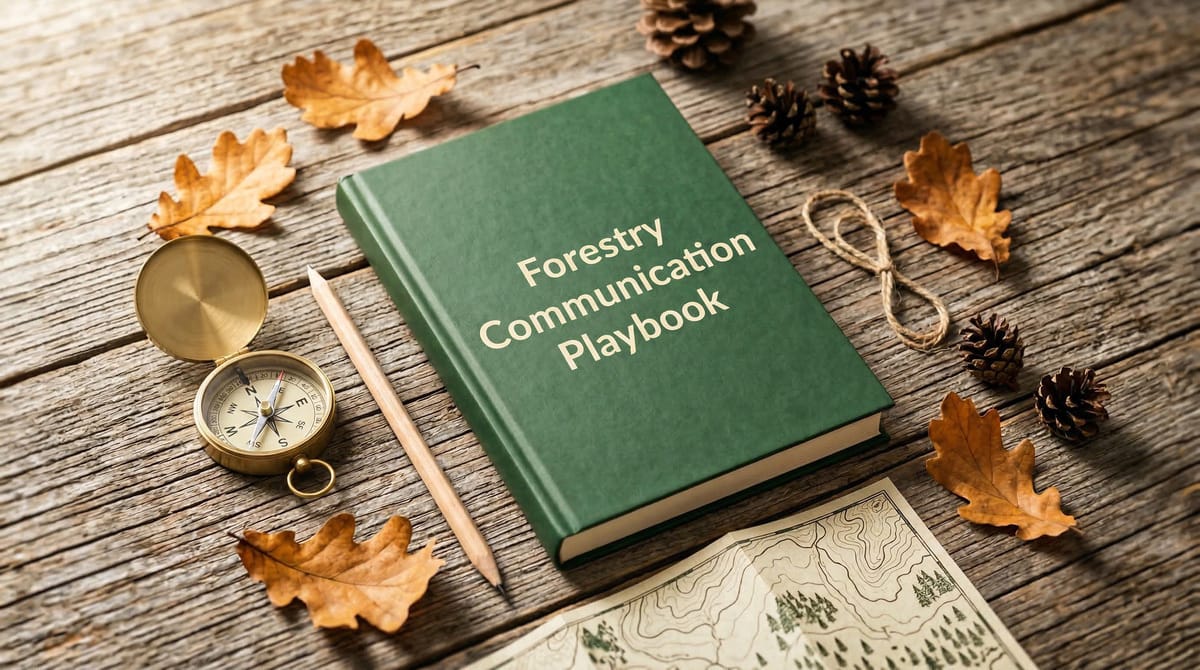
📖 The Forestry Communication Playbook
"So you can't call it sustainable any more?"
You will get this one from Monday onwards. From a customer, a colleague, or someone who read a headline. The correct answer has three conditions and a definition in it. By the time you reach the second condition, they have stopped listening.
There is a version that fits in one breath and is still true. That takes preparation, not improvisation.
Part 1 covers the questions that arrive without warning.
📗 The Forest-Investment Dictionary
A certificate you already hold just gained legal standing. A claim you cannot back just became a liability.
Certification has been carried as a cost line for thirty years. From Sunday it is also the thing that lets you speak in a consumer market.
Costs that turn into permissions belong on a different side of the page. Very few valuation models know how to move them.
I wrote the Forest-Investment Dictionary with Danish forest economist Anders Tærø Nielsen. It has 151 pages, 11 chapters, 14 printable tools, and 3 calculators. Investors learn to read a forest. Foresters learn to read a term sheet.
When the market turns, the people who can read the numbers make the better calls. The price is €99. Get yours below.

📘 The Organization — Playbook Part 3
Your website makes claims. Who signed them off?
Somebody wrote that sustainability page. Somebody approved it. Somebody is responsible for it on Sunday.
In many forestry organisations those are three different people. None of them thinks it is their job.
I wrote The Organization, Part 3 of the Playbook. It has 165 pages, 10 chapters, 10 printable tools, and a survey. It shows what it takes to be heard, and who does the work.
Almost nobody in European forestry publishes what communication costs. The survey inside starts the count. The price is €149. Get yours below.

🤝 ForestryBriefing
The brief is free. The briefing is not.
ForestryBrief publishes verified intelligence — free, three times a week, in 25+ countries. When you need that intelligence applied to your specific situation, that's a ForestryBriefing.
Intelligence — Investment due diligence, market intelligence, EUDR compliance, cross-sector risk analysis, background verification in three languages.
Communication — Strategy, trade publication articles, stakeholder messaging, newsletters that people actually open. EN | DE | HU.
Live — Conference presentations, panel moderation, keynotes. Next: WAN-IFRA World Printers Summit, Rotterdam, October 2026.
First briefing guarantee: if it doesn't deliver intelligence you can act on, you don't pay.
Until Tomorrow!
Wish you all the best: Peter
🤝 Need help with forestry communication, intelligence, or due diligence? See what we offer → ForestryBriefing
📩 Got this email forwarded to you? Subscribe to ForestryBrief here.
📚 Missed an issue? Browse the ForestryBrief archive
P.S. What’s the biggest challenge you’re facing in forestry right now?
Hit reply and let me know — I read every message personally.
P. P. S. Know a forest professional who’s drowning in EUDR complexity or missing out on timber market shifts? Forward this email to them!
Shauna Matkovich's Forest Invest Podcast is one of the best resources for understanding where forest finance is heading. If you are interested in Forest Investments, start there.
If you like FB be sure to subscribe to Boreal Tech Brief, a newsletter of my friend Axel covering tech in forestry with a Nordic angle:
