
Hello,
More than a fifth of Germany's private and communal forest area is under a management commitment.
Ten years for most of it. Twenty years for one part of it.
Almost nobody outside the programme can tell you when those commitments actually end. That is not carelessness. It is how the rule is written.
Here's what's moving European forestry this week:
🔍 The Big Story
More than a fifth of Germany's private and communal forest is under commitment. The end date depends on a budget line.
First, the date stamp
This is not this week's news. It is a programme explainer, and the dating matters.
The programme opened for applications in November 2022. It was declared exhausted on 18 October 2024. No new first-time applications are being accepted.
The figures below come from the German agriculture ministry's press release 63/2026 of 16 July 2026, and from the 2026 update published by FNR, the agency that runs the application portal.
I am running it now because a revised guideline is due within months. Anyone who owns, buys or values German forest should understand the old one first.
What the programme is
It is called Klimaangepasstes Waldmanagement. Climate-adapted forest management.
The idea is simple. The federal government pays private and communal forest owners to manage forest to a standard above the legal minimum, and above ordinary certification.
Since 2024 it has been financed from the Aktionsprogramm Natürlicher Klimaschutz, the natural climate protection programme, run by the environment ministry.
What a participant actually signed
This is where most summaries go wrong. There are two commitment periods, not one.
Criteria 1 to 11 bind for 10 years. These cover things like advance regeneration, habitat trees and deadwood.
Criterion 12 binds for 20 years. Criterion 12 is natural forest development on 5% of the forest area. That means taking it out of production.
Then comes the size rule.
For holdings over 100 hectares, criterion 12 is mandatory. The 20-year commitment is compulsory.
For holdings of 100 hectares or under, criterion 12 is voluntary. Take it, and the payment rate rises.
Proof is not a signature. Compliance is evidenced through a certificate from a recognised system — PEFC, FSC, or ANW in Mecklenburg-Vorpommern. Self-declarations are not accepted. A proof of use is due every year.
Five numbers, kept apart
These get blended together constantly. They measure five different things.
€146 million per year — the annual funding held under the natural climate protection programme. This is a budget.
Up to around €85 per hectare per year — at 2022 launch terms, the reduced rate where a holding of no more than 100 hectares leaves out voluntary criterion 12. Taking criterion 12 opens access to the full applicable rate, up to around €100 per hectare per year. These are payment rates, and they are ceilings rather than flat payments. €85 is not a general rate for every holding under 100 hectares.
Just under 8,700 — applications approved in 2025. This is a count of applications.
148,000 hectares — the additional area brought in by a €13 million top-up in 2025. This is an area.
More than 1.7 million hectares — the total area covered. This is an area.
Over 21% — that area as a share of German private and communal forest combined. This is a share, and it is not a private-forest share. FNR puts roughly 60% of the funded area in communal ownership and 40% in private hands.
A budget, a rate, a count, an area and a share. Multiply any two of them together and you will get a number that means nothing.
The clause almost nobody reads
Here is the finding, and it is the reason this is the Big Story.
The commitment period does not only end after 10 or 20 years.
FNR states it plainly in the programme's own questions and answers. The commitment period also ends at the close of the year in which the grant was last approved, where budget funds are no longer provided.
Read that again with the dates beside it. The programme was declared exhausted in October 2024. New first applications are closed. Funding now sits in a different ministry's programme, renewed year by year.
The same documents are equally plain about the other side of it. A grant of this kind is a voluntary federal payment. There is no legal entitlement to it. It is conditional on budget funds being available.
So the obligation is real, it is long, and its end date is tied to a budget line that is set annually.
That is not a covenant. It is also not nothing. It is a conditional obligation, and those are the hardest kind to put a number on.
And something else worth checking
The programme's proof requirement runs in the name of the named grant recipient. FNR says the certificate must be issued to the recipient named in the grant notice, by name and address, and that deviations are not accepted.
That is a detail with consequences for anyone buying German forest. It does not tell you what happens to the commitment when land changes hands. It tells you the paperwork was not built around the assumption that it would.
If you are buying, this is a question for the grant notice and the guideline. Not for a valuation model. I am not going to tell you the answer, because the answer sits in a document that is specific to each holding, and getting it wrong is expensive.
What is coming next
The follow-on guideline, Klimaangepasstes Waldmanagement PLUS, will not be implemented in the form that was originally published.
It is being reworked. The new focus is ecosystem services in forest habitat types under the Natura 2000 directives. The working title is Lebensraumtyp-Synergiemodul, a habitat-type synergy module.
Publication of the revised guideline is planned for end 2026 or early 2027. The environment ministry leads it. Financing is again intended to come from the natural climate protection programme.
What this means for you
If you are in the programme: find the year your grant was last approved. That date, not just the ten-year anniversary, is part of when your commitment ends.
If you are buying German forest: ask for the grant notice before you ask for the growth model. A property in the programme may be affected by an existing grant arrangement. What transfers on a sale has to be confirmed by the grant notice and the competent authority, not assumed either way.
If you value forests: a conditional obligation is a range, not a line item. Model it as a range.
If you are watching other countries: Germany brought more than 1.7 million hectares into management commitments within about three years. That is fast. Whatever your country does next, this is the template that exists.
The part nobody says out loud
The interesting thing here is not the money. €146 million a year spread across more than 1.7 million hectares is not a large sum per hectare, and nobody in the programme is getting rich.
The interesting thing is that a very large area of European forest, most of it communally owned, is now managed to a written standard, for a defined period, for payment. That is a structural change in what forest ownership carries with it in Germany.
It happened in about three years, with a per-hectare payment smaller than most people would guess. And the revised version arrives within months.
Read the old guideline before the new one lands. It is easier to judge what changed if you know what it changed from. Sources: FNR — climate-adapted forest management enters the new year (participation figures) | Klimaanpassung Wald — programme site (FNR) | FNR — general questions on the programme | FNR — criteria and proof of compliance | BMLEH press release 63/2026, 16 July 2026
📊 Quick Hits
1. 🇩🇪 Prefabrication reached 26.7% of permitted German one- and two-family homes.
The prefabricated share of permitted one- and two-family homes in Germany reached 26.7%. Permits for prefabricated homes rose 16.9% in the first half of the year.
That growth outpaced the wider one- and two-family market. Note the denominator carefully. This is a share of permits in that segment, not a share of all new German homes.
The figures are attributed to the German prefabricated construction association, drawing on federal statistics.
Why it matters: Permits are an early signal. They record intent to build, not houses built, and not wood delivered.
My read, and it is a read rather than a finding: German prefabricated housing is largely timber-based, so a rising prefab share plausibly shifts the mix of housing demand toward wood. The permit data on its own does not demonstrate that. It shows permits, in one segment, for one half-year.
The takeaway: Track prefab permits as a leading indicator alongside total housing starts, not instead of them. One counts houses. The other hints at what they will be built from. Then watch completions, because that is where the wood actually moves. Sources: Bundesverband Deutscher Fertigbau — H1 2026 permit figures, based on Destatis GENESIS table 31111-0122
2. 🇬🇧 A UK minister put a number on nature risk in Parliament. The number has a history.
In a Westminster Hall debate on 3 September 2026, a DEFRA minister said nature-related risk could cost around 6% of UK GDP by the 2030s. A further roughly 6% was linked to international risks in some scenarios.
Do not add those two figures together. They are not presented as cumulative.
The minister did not identify a newly published government assessment behind the figures.
There is, however, published work that matches them. A 2024 Green Finance Institute assessment found UK GDP could be around 6% lower under either a domestic or an international nature-risk scenario. It put the figure at about 12% lower under an antimicrobial-resistance pandemic scenario. It also found roughly half of UK nature-related exposure originates overseas.
Why it matters: Two alternative scenarios of 6% each is a very different statement from 6% plus 6%. The first is a range. The second is a total. Quoted in a debate and repeated onward, they are easily confused.
Numbers stated in Parliament get cited. They frame policy long before anyone re-reads the method behind them.
The takeaway: When a figure is quoted in a legislature, find the assessment it came from and check whether the scenarios are alternatives or additions. That single question resolves most of the confusion in nature-risk reporting. Sources: Hansard — Westminster Hall, 3 September 2026 | Green Finance Institute — Greening Finance for Nature, 2024
3. 🇸🇪 Moelven has taken an intention decision on its Årjäng sawmill.
The board of Moelven Årjäng Såg AB has taken an intention decision — an avsiktsbeslut — to wind down sawmilling at Årjäng.
The site employs 38 people. It produces about 110,000 cubic metres of sawn timber a year.
This has not happened yet. An intention decision is a stated intention by a board. It is a step in a process, not the end of one.
Why it matters: 110,000 cubic metres of sawn timber represents a meaningful annual sawlog intake in its catchment. For owners who deliver there, the question is where that volume goes instead, and at what haul distance.
Haul distance is usually the part that hurts. Longer transport can reduce the net roadside or stumpage value left to the seller. How much depends on the contract structure and on how much competition there is for the wood.
The takeaway: If you deliver to a single mill within easy reach, that concentration is a risk whether or not this particular decision proceeds. Know your second-best buyer and your haul cost to reach them. Work it out before you need it. Sources: Moelven press release via TT, 8 Sept 2026; output and site detail via Woodnet and NWT
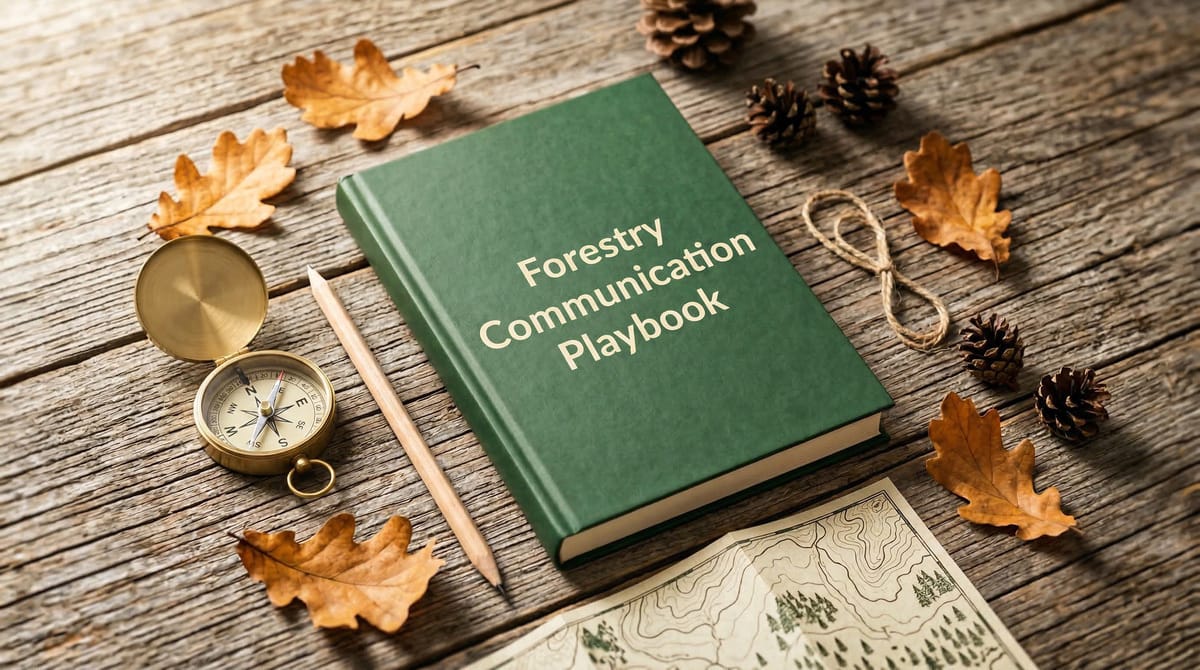
4. 📕 Playbook Part 3 is out. This one is about the organisation, not the person.
The third and final part of the Forestry Communication Playbook Trilogy is published. 166 pages, ten chapters, ten printable tools.
Parts 1 and 2 were built for the individual. How to handle the ambush question. How to read a term sheet.
Part 3 is about everything around that person.
Most forestry communication failures are not failures of knowledge. Somebody in the building already knows the right answer. It arrives late. Or it arrives from the wrong person. Or it never clears approval.
That is a structural problem. Structural problems need structural fixes.
The tools go straight at it. The Approval Chain Audit. The Coordination Layer Builder. The Budget Case With No Benchmark, for arguing for money in a field where nobody publishes comparisons. The Board Objection Sheet, for the questions you get asked before you are allowed to speak at all.
Full disclosure: this one is ours. ForestryBrief publishes it, so read it as an announcement rather than as independent intelligence. Everything else in this issue is third-party sourced and linked.
The takeaway: If your organisation has ever been slow to answer a story about forestry, the problem is usually not the person who got asked. It is the distance between that person and the approval. Part 3 measures that distance and gives you a way to shorten it. Get it: The Forestry Communication Playbook Part 3 — The Organization
📅 The Weeks Ahead
Ongoing: EUDR Information System virtual training sessions — new dates published on the Commission implementation page
Closed 13 September 2026: The EUDR Delegated Act scrutiny period ended without objection from the European Parliament or the Council. The act now awaits publication in the Official Journal
Expected Q3 2026: European Commission adoption of the revised EU Taxonomy Climate and Environmental Delegated Acts (advisory target, not a binding deadline)
Tuesday–Thursday, September 15–17, 2026: Wood Awards 2026 shortlist exhibition at Material Matters, UNLOCKED Shoreditch — London
Wednesday–Friday, September 16–18, 2026: EFI Annual Conference — Växjö, Sweden (European Forest City 2026). Conference 16th, scientific seminar 17th, field trip 18th
Thursday, September 17, 2026: Luke publishes next roundwood trade release (Finland) | Blue Catalyst Fund applicant Q&A (Fair Carbon / Finance Earth)
Monday, September 21, 2026: Isometric low-carbon cement protocol consultation closes
Tuesday, September 22, 2026: CINEA LIFE Calls 2026 — Standard Action Projects deadline | SoEF 2025 webinar — "How much deadwood is enough? Biodiversity and forest management in Europe", 12:00–13:00 CEST
Wednesday, September 23, 2026: The Nature Hub at Climate Week NYC — first Forest Finance Roadmap Progress Report launches | Singapore Article 6 second-stage tender briefing (at least 12 million credits sought)
Thursday–Saturday, September 24–26, 2026: APF Exhibition 2026 — Ragley Estate, Warwickshire, UK
Sunday, September 27, 2026: EU EmpCo Directive applies — generic green claims become unlawful
Wednesday, September 30, 2026: Laurus Network 6th webinar — "Wildfire management: lessons learned and future challenges. The experience of Castilla y León (Spain)"
Wednesday–Thursday, September 30 – October 1, 2026: Forisk Timber Market Analysis class — virtual
Thursday, October 1, 2026: Japan Ministry of the Environment nature-finance guidelines pilot closes for applications | Blue Catalyst Fund second call closes, 19:00 BST
🔴 Sunday–Tuesday, October 4–6, 2026: WAN-IFRA World Printers Summit — Rotterdam (I present on October 5)
Monday, October 5, 2026: Verra VM0033 blue-carbon consultation closes
Wednesday–Thursday, October 7–8, 2026: 19th European Congress (FOGE) — Cologne, Germany | RFSI Forum — Denver
Friday, October 9, 2026: PEFC consultation on the revised Vietnam Forest Certification Scheme closes
🔴 Tuesday–Wednesday, October 13–14, 2026: CIFB London: Corporate Investments into Forestry & Biodiversity — London, UK
Thursday, October 15, 2026: Metsä Group campaign closes
Thursday–Sunday, October 15–18, 2026: INTERFORST 2026 — Munich (quadrennial forestry technology trade fair)
During October 2026: Article 6.4 Supervisory Body decision on reversal risk expected
Tuesday–Wednesday, October 20–21, 2026: Global Bioeconomy Summit 2026 — Dublin, Ireland
Tuesday, November 3, 2026: Bergslagets Skogar Capital Markets Day — Stockholm
Wednesday, November 4, 2026: TDUK Global Market Conference — London
🌳 Thursday–Friday, November 5–6, 2026: 11th International Hardwood Conference — Antwerp (ATIBT)
Tuesday, November 10, 2026: BiodivFuture mandatory pre-proposals due (Biodiversa+, around €40 million, 25 countries plus the Commission)
📌 Wednesday, November 11, 2026: European Commission deadline for a final decision on the UPM/Sappi joint venture (Case M.12270)
Wednesday–Thursday, November 11–12, 2026: Puupäivä — Helsinki (Puuinfo)
Wednesday, November 25, 2026: FBIA 2026 final event, EIB Brussels (by invitation)
Wednesday, December 30, 2026: EUDR applies to large and medium operators, and to all timber-sector operators
End 2026 / early 2027: Revised German climate-adapted forest management guideline expected (Natura 2000 "Lebensraumtyp-Synergiemodul", BMUKN)
Friday, January 1, 2027: Revised EU Taxonomy technical screening criteria expected to apply
Friday, April 16, 2027: BiodivFuture full proposals due
During 2027: Commission guidance and portal on integrated wildfire risk management due
Wednesday, June 30, 2027: EUDR applies to micro and small operators outside the timber sector
Thursday, July 17, 2031: FRM Regulation (EU) 2026/1392 applies
💡 One Thing to Try This Week
Find the end date of every commitment on your land.
Not the ones you remember. All of them.
Make a list of every scheme, grant, subsidy or agreement your forest is enrolled in. Include the ones your father signed.
For each one, find two dates. The date the commitment started. The date it ends.
For each one, write down what happens if the funding stops. Does the obligation end with the money, or does it continue? The answer is in the document, not in your memory.
For each one, write down what happens if you sell. Same rule. Find it in the document.
Anything you cannot answer from paperwork goes on a short list. That list is your homework.
Most owners can do steps 1 and 2 from memory and get stuck on step 3. That is exactly the point of the exercise.
Buying rather than owning? Ask the seller for this list. What comes back, and how fast, tells you a great deal before you ever walk the stand.
📖 The Forestry Communication Playbook
"So the taxpayer pays you to own trees. Nice work."
You will hear this one. At a family dinner, in a comment thread, or from a journalist who already has their angle.
The facts are on your side and they will not help you. Explaining a payment rate makes you sound like you are justifying it. Getting annoyed makes you sound like you have something to justify. There is a good answer. It does not start with the money.
Thirty seconds. No notes. What do you say? If the answer isn't ready, the Playbook is.
📗 The Forest-Investment Dictionary
An obligation with a conditional end date is not a line in a model. It is a range.
Most valuations treat a management commitment as a fixed cost for a fixed period. When the end date depends on a budget decision somebody else makes each year, that is a range of outcomes wearing a single number. Price the range.
I wrote the Forest-Investment Dictionary with Danish forest economist Anders Tærø Nielsen. It has 151 pages, 11 chapters, 14 printable tools, and 3 calculators. Investors learn to read a forest. Foresters learn to read a term sheet.
When the market turns, the people who can read the numbers make the better calls. The price is €99. Get yours below.

📘 The Organization — Playbook Part 3
The third and final part of the Forestry Communication Playbook Trilogy is published.
Parts 1 and 2 were built for the individual. How to handle the ambush question. How to read a term sheet. Part 3 is about everything around that person.
I wrote The Organization, Part 3 of the Playbook. It has 165 pages, 10 chapters, 10 printable tools, and a survey. It shows what it takes to be heard, and who does the work.
Almost nobody in European forestry publishes what communication costs. The survey inside starts the count. The price is €149. Get yours below.

🤝 ForestryBriefing
The brief is free. The briefing is not.
ForestryBrief publishes verified intelligence — free, three times a week, in 25+ countries. When you need that intelligence applied to your specific situation, that's a ForestryBriefing.
Intelligence — Investment due diligence, market intelligence, EUDR compliance, cross-sector risk analysis, background verification in three languages.
Communication — Strategy, trade publication articles, stakeholder messaging, newsletters that people actually open. EN | DE | HU.
Live — Conference presentations, panel moderation, keynotes. Next: WAN-IFRA World Printers Summit, Rotterdam, October 2026.
First briefing guarantee: if it doesn't deliver intelligence you can act on, you don't pay.
Until Thursday!
Wish you all the best: Peter
🤝 Need help with forestry communication, intelligence, or due diligence? See what we offer → ForestryBriefing
📩 Got this email forwarded to you? Subscribe to ForestryBrief here.
📚 Missed an issue? Browse the ForestryBrief archive
P.S. What’s the biggest challenge you’re facing in forestry right now?
Hit reply and let me know — I read every message personally.
P. P. S. Know a forest professional who’s drowning in EUDR complexity or missing out on timber market shifts? Forward this email to them!
Shauna Matkovich's Forest Invest Podcast is one of the best resources for understanding where forest finance is heading. If you are interested in Forest Investments, start there.
If you like FB be sure to subscribe to Boreal Tech Brief, a newsletter of my friend Axel covering tech in forestry with a Nordic angle:
