
Hello,
This is issue 100.
It started small — a handful of inboxes. Today it reaches more than 500 forest owners, investors and foresters in more than 25 countries, three times a week. Every number still traces to a primary source. That part will never change.
Thank you for reading. Whether you joined at issue 1 or issue 99, you made this. I read every reply, and they shape what I cover next.
A quick word on what's coming. In October I'll be on stage in Rotterdam, talking forestry and paper to the people who print the world's newspapers. A few more things land this year. One is a live tool you'll log into for forestry intelligence built around you. The other is a companion to the Playbook, written for the people who put capital into forests.
Now, to issue 100. Fittingly, the Big Story is about a new door opening for forest owners.
Here's what's moving European forestry this week:
🔍 The Big Story
A new carbon path opens: get paid to grow your trees longer
A carbon model that rewards longer rotations just reached Europe at scale. It does not lock a single hectare away.
What happened
An Estonian developer named Ecobase has registered a major forest carbon project. The registry is Verra. The project number is 5315.
It covers about 570,000 hectares. The land sits across Sweden, Finland, Estonia and Latvia.
It is the first European project to use Verra's VM0003 method. That method is called Improved Forest Management, or IFM.
The idea is simple. You let stands grow older before you harvest. The extra growing years store extra carbon. That stored carbon becomes credits.
The first credits are due by the end of 2026. The initial issue is about 900,000 credits, called Verified Carbon Units.
Owners keep managing the forest as a working asset. The trees still get harvested — just later.
Why this matters
For years, forest carbon in Europe meant one of two things. Plant new trees, or lock forests away. IFM is a third path. It pays for better management of forests you already work.
That fits European forestry far better. Most of Europe's forests are managed and harvested. A model that rewards a longer rotation, not a locked gate, speaks their language.
The timing is no accident. We reported private money for nature hitting $14 billion a year in EFP #97. And the SBTi gave high-quality removals a formal, paid job, covered in EFP #95. The demand was building. Now a boreal-and-Baltic supply route has opened to meet it.
One caution. The credits still have to be issued and verified. A registration is the start line, not the finish.
What this means for you
If you own or manage forest in the Nordics or Baltics: a new revenue option just appeared. Extending rotation on some stands may now pay twice — in carbon now, and in larger logs later. Worth modelling.
If you invest in or fund forests: this is the methodology fit the region has waited for. Watch how the first issuance lands. Real credits, on time, would prove the model.
If you talk to the public or policymakers: here is the clean message. This is not forests locked away. It is forests managed for longer, storing more carbon while still producing wood. Growth and storage in the same stand.
On issue 100, that feels right. The sector keeps finding new ways to be paid for what it already does well. The asset is not just holding its ground. It is opening new ground. Sources: Carbon Pulse — Voluntary Carbon Market News, 15–21 June 2026 (subscription) | Ecobase — project developer
📊 Quick Hits
1. 🇪🇺 EU ministers call nature "strategic infrastructure"
Europe's environment ministers met on 25 June. They put nature at the centre of the economy, not the edge of it.
Several member states called nature-based solutions "strategic infrastructure." That is the language used for roads, grids and ports. The ministers also backed "nature credits" — market tools to pull private money into ecosystems.
Why it matters: This is the policy side catching up with the money side. Private capital is already flowing into nature, as the Big Story shows. Now ministers are building the frame to channel it.
The takeaway: If you manage forests or sell ecosystem services, watch the nature-credits file. A recognised market is how your standing forest earns beyond timber. Source: Carbon Pulse — Nature & Biodiversity Pulse, 29 June 2026 (subscription)
2. 🇫🇮 UPM buys the recipe to turn wood sugars into a plastic replacement
UPM keeps pushing wood up the value chain. In May, it bought the Ray Technology patents from Dutch firm Avantium for about €2.7 million.
The technology turns plant-based sugars into bio-based glycols. Those glycols replace fossil ones in packaging and bottles. UPM is starting its first large biorefinery at Leuna, in Germany. UPM called the price not material to its size.
Why it matters: This is the fibre story from a new angle. Wood is not just lumber and pulp. It is becoming a feedstock for chemicals people use every day.
The takeaway: If you grow wood, your raw material gains end-markets each year. New demand for fibre supports long-term log and pulpwood value. Source: Renewable Carbon News — UPM acquires Ray Technology IP from Avantium
3. 🌍 A free tool to see the raw commodity behind a product
The European Forest Institute (EFI) has launched a free, open-access tool. It is called the Commodity Converter.
You enter a processed product. The tool estimates the raw commodity behind it, and the planted area it needed.
Why it matters: EUDR pushes the whole supply chain to understand the land behind a product. A free, public tool that estimates that footprint lowers the barrier for everyone.
The takeaway: Treat it as a transparency tool, not a compliance checker. It helps you speak the same quantitative language as buyers and auditors. The EFI Annual Conference in September (see below) is where work like this advances. Source: EFI — Commodity Converter
📅 The Weeks Ahead
Thu, 2 July 2026 — UK Timber Design Conference, London
Thu, 16 July 2026 — ATIBT Carbon & Biodiversity webinar (online)
Wed, 22 July 2026 — RFSI Forum early-bird registration deadline
Mon, 27 July 2026 — Verra next-generation registry go-live (with S&P Global)
Wed–Fri, 16–18 September 2026 — EFI Annual Conference, Växjö, Sweden
Tue, 22 September 2026 — CINEA LIFE Calls 2026 deadline | SoEF 2025 Webinar: Biological Diversity
Sun, 27 September 2026 — EU EmpCo Directive applies. Generic green claims become unlawful.
🔴 Sun–Tue, 4–6 October 2026 — WAN-IFRA World Printers Summit, Rotterdam. I'm presenting on 5 October on forestry and paper supply.
Wed–Thu, 7–8 October 2026 — RFSI Forum, Denver | 19th European Congress (FOGE), Cologne
🔴 Tue–Wed, 13–14 October 2026 — CIFB London
Thu–Sun, 15–18 October 2026 — INTERFORST 2026, Munich (quadrennial)
Tue–Wed, 20–21 October 2026 — Global Bioeconomy Summit, Dublin
Tue, 3 November 2026 — Bergslagets Skogar Capital Markets Day, Stockholm
Wed, 4 November 2026 — TDUK Global Market Conference, London
Thu–Fri, 5–6 November 2026 — 11th International Hardwood Conference, Antwerp (ATIBT)
Wed, 25 November 2026 — FBIA 2026 final event, EIB Brussels (by invitation)
Wed, 30 December 2026 — EUDR application date. Large, medium, and all timber-sector operators.
Wed, 30 June 2027 — EUDR application date. Non-timber micro and small operators only.
💡 One Thing to Try This Week
Run a "longer rotation" thought experiment on one stand. It takes about 20 minutes.
The Big Story shows a carbon model that pays you to grow trees longer. You can test the idea on your own ground, before any project.
Pick one stand close to its planned harvest age.
Ask what 10 or 15 more years would add. More volume, bigger logs, more stored carbon.
Weigh that against the cost of waiting. Deferred income, plus added risk from storm, pests or fire.
Write one line: would a carbon payment tip the balance toward waiting?
By the weekend you will know if longer rotations are worth a serious look on part of your holding. That is the first question any IFM project asks.
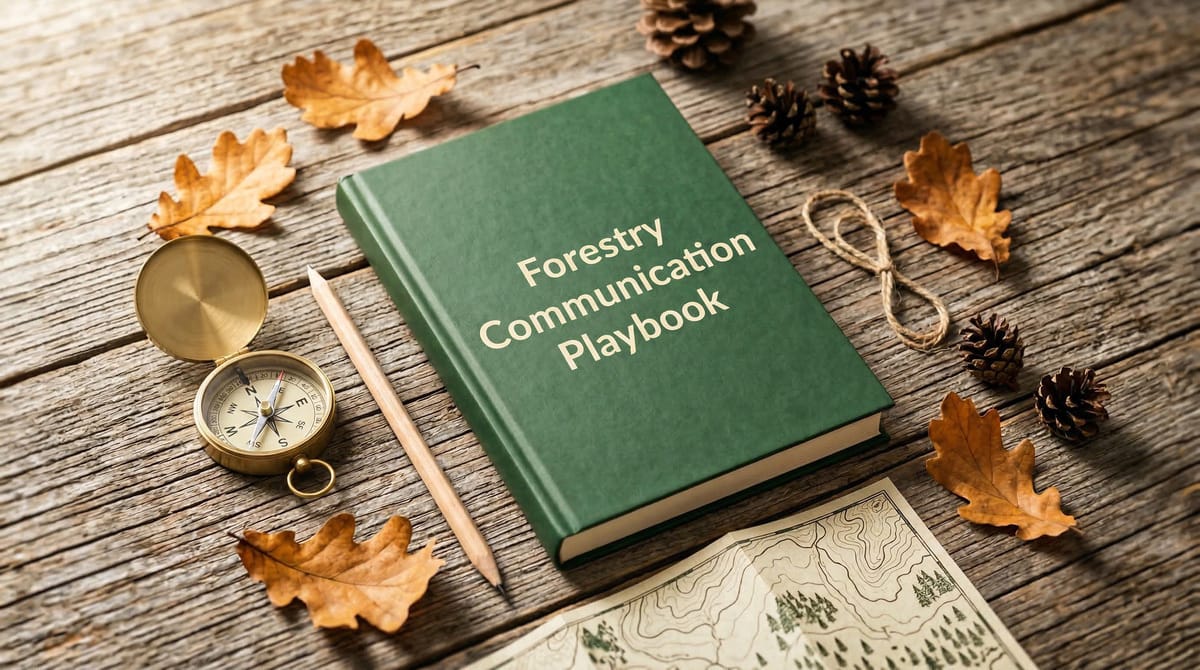
📖 The Forestry Communication Playbook
The next time someone asks how a forest pays beyond the sawlog, you'll have thirty seconds to answer.
Right now — what do you say?
If the answer isn't ready, the Playbook is.
And tomorrow’s Professional issue gives you something you wish you had before and you will be glad you have it now. Let me give you a hint: forests and capital…
🤝 ForestryBriefing
The brief is free. The briefing is not.
ForestryBrief publishes verified intelligence — free, three times a week, in 25+ countries. When you need that intelligence applied to your specific situation, that's a ForestryBriefing.
Intelligence — Investment due diligence, market intelligence, EUDR compliance, cross-sector risk analysis, background verification in three languages.
Communication — Strategy, trade publication articles, stakeholder messaging, newsletters that people actually open. EN | DE | HU.
Live — Conference presentations, panel moderation, keynotes. Next: WAN-IFRA World Printers Summit, Rotterdam, October 2026.
First briefing guarantee: if it doesn't deliver intelligence you can act on, you don't pay.
Until Tomorrow!
Wish you all the best: Peter
🤝 Need help with forestry communication, intelligence, or due diligence? See what we offer → ForestryBriefing
📩 Got this email forwarded to you? Subscribe to ForestryBrief here.
📚 Missed an issue? Browse the ForestryBrief archive
P.S. What’s the biggest challenge you’re facing in forestry right now?
Hit reply and let me know — I read every message personally.
P. P. S. Know a forest professional who’s drowning in EUDR complexity or missing out on timber market shifts? Forward this email to them!
Shauna Matkovich's Forest Invest Podcast is one of the best resources for understanding where forest finance is heading. If you are interested in Forest Investments, start there.
If you like FB be sure to subscribe to Boreal Tech Brief, a newsletter of my friend Axel covering tech in forestry with a Nordic angle:
