
Hello,
A lot of small timber sellers have circled June 2027 on the calendar. It's the wrong date.
Here's what's moving European forestry this week:
🔍 The Big Story
EUDR is the floor, not the finish line
Brussels gave the timber world a clear date. Many people are reading it wrong.
What's actually true
The European Commission published its EUDR simplification package on 4 May 2026. The core rules did not change. The application dates did not move.
Large and medium operators must comply by 30 December 2026. Micro and small operators in the timber sector face the same date. Only micro and small operators outside timber get until 30 June 2027.
So if you sell timber and you are a small operator, your date is December 2026. Not June 2027. That gap is the mirage.
The Commission says the package cuts annual compliance costs by roughly 75%. Penalties stay heavy. Fines reach up to 4% of EU turnover. Goods can be seized. Public contracts can be blocked.
Why this matters
The legal minimum is smaller than the headlines suggest. For a small forest owner, the core duty is a one-off declaration. You provide location, quantity, country, and a signature. You can do it in a few hours a year.
But the law is the floor. Your buyers answer to their own customers, banks, and EU regulators. So they ask for more than the regulation requires.
Sawmills want to know which assortment came from which sub-area. Sustainability reporting rules (CSRD) push audit-ready data up the chain. Reliable delivery windows decide who gets the next contract. None of that is in the EUDR. The market wants it anyway.
Falk Steiner runs AARI Forest, a German digital forest-management firm. He put it plainly:
„Die EUDR ist beherrschbar, sobald die Daten stehen. Aber wir sehen jeden Tag, dass die Verordnung nur die regulatorische Untergrenze setzt, was der Markt parallel verlangt, lässt sich nicht mit Ordnern und Excel-Tabellen lösen."
"The EUDR is manageable once your data is in place. But we see every day that the regulation only sets the floor — what the market asks for alongside it can't be solved with folders and spreadsheets."
— Falk Steiner, Managing Director, AARI Forest GmbH
What this means for you
If you sell timber as a small operator: Your clock runs to December 2026. Map your supply chain now.
If you let a forester, buyer, or association file for you: You can delegate the paperwork. You cannot delegate the liability. It stays with you. (Want this mapped for your exact supply chain? See below.)
If you buy or process wood: Build the data flow that buyers reward. Clean origin and assortment data is becoming a price advantage, not just a compliance task.
AARI has published a free, no-form German guide for private forest owners. It walks through the floor and the market reality in plain language.
Sources: European Commission — EUDR simplification package (IP/26/941) | European Commission — Deforestation Regulation | AARI Forest — EUDR-Leitfaden
📊 Quick Hits
1. 🌍 FSC closes its final chain-of-custody consultation
The Forest Stewardship Council ran its third and final public consultation on revised chain-of-custody standards. It closed on 15 June 2026.
Why it matters: Chain of custody is the system that tracks certified wood through the supply chain. It is also the backbone many operators lean on for EUDR claims.
The takeaway: If you hold FSC certification, watch the final standard closely. Your audit steps may change before December. Source: FSC — Chain of Custody consultation (FSC-STD-40-004 V4-0)
2. 🇫🇷 France shows the softwood-hardwood split in one report
France Bois Forêt published its 2025 standing-timber prices on 26 May 2026. The average price fell 4% to €86/m³. But conifers rose 8% to €69/m³, the highest since the index began in 2004. Norway Spruce jumped 28%. Oak fell 17%, chestnut 18%.
Why it matters: This is a structural split, not noise. The market is paying record premiums for softwood while hardwood corrects.
The takeaway: If you manage mixed stands, the data favours bringing softwood forward and holding hardwood. Source: France Bois Forêt — Prix des bois sur pied 2025
3. 🌳 SBTi gives carbon credits a clear, paid job
The Science Based Targets initiative published version 2.0 of its Net-Zero Standard. It came out on 11 June 2026. It creates a formal role for high-integrity credits. Companies can use them for ongoing emissions beyond net zero. Credits still cannot offset value-chain emissions. Companies can submit targets under V2.0 from early 2027. Version 1 closes at the end of 2027.
Why it matters: This is a demand signal for forest carbon. Big buyers now have a sanctioned reason to buy quality removals.
The takeaway: If you are exploring carbon projects, build for high integrity. That is where the structured demand is heading. Source: SBTi — Corporate Net-Zero Standard
4. 🛰️ The data that proves Europe harvests, it doesn't deforest
A 2025 dataset from WRI and Google DeepMind maps forest-loss drivers in detail. It is still the most detailed available. It finds about 34% of this century's tree-cover loss is likely permanent. That is 177 million hectares. Permanent farming drives 95% of it. In Europe, 91% of tree-cover loss comes from timber harvesting. Much of it sits in managed forests.
Why it matters: Harvesting is not deforestation. Managed European forests are cut and replanted. This data draws the line clearly.
The takeaway: Keep it handy when someone calls a clear-cut "forest loss." The numbers answer for you. Source: WRI — Drivers of forest loss (2025)
📅 The Weeks Ahead
17 June 2026 — FOREST EUROPE bioeconomy webinar. Details
19 June 2026 — ATIBT Annual General Meeting. EUDR panel details
7–8 October 2026 — RFSI Forum, Denver. Details
🔴 5 October 2026 — WAN-IFRA World Printers Summit, Rotterdam. I'm presenting on forestry and paper supply.
30 December 2026 — EUDR application date. Large, medium, and all timber-sector operators.
30 June 2027 — EUDR application date. Non-timber micro and small operators only.
💡 One Thing to Try This Week
Confirm your real EUDR clock. It takes about 20 minutes.
Ask one question: do you sell timber commercially? If yes, you are likely a timber-sector operator.
If you are micro or small in timber, mark 30 December 2026. Not June 2027.
Write down who files your due diligence statement. You, your forester, your buyer, or your association.
Confirm in writing that the legal liability stays with you, even when someone else files.
Want the full picture on three pages? Grab our free EUDR Quick Reference. For German private forests, AARI's guide pairs well.
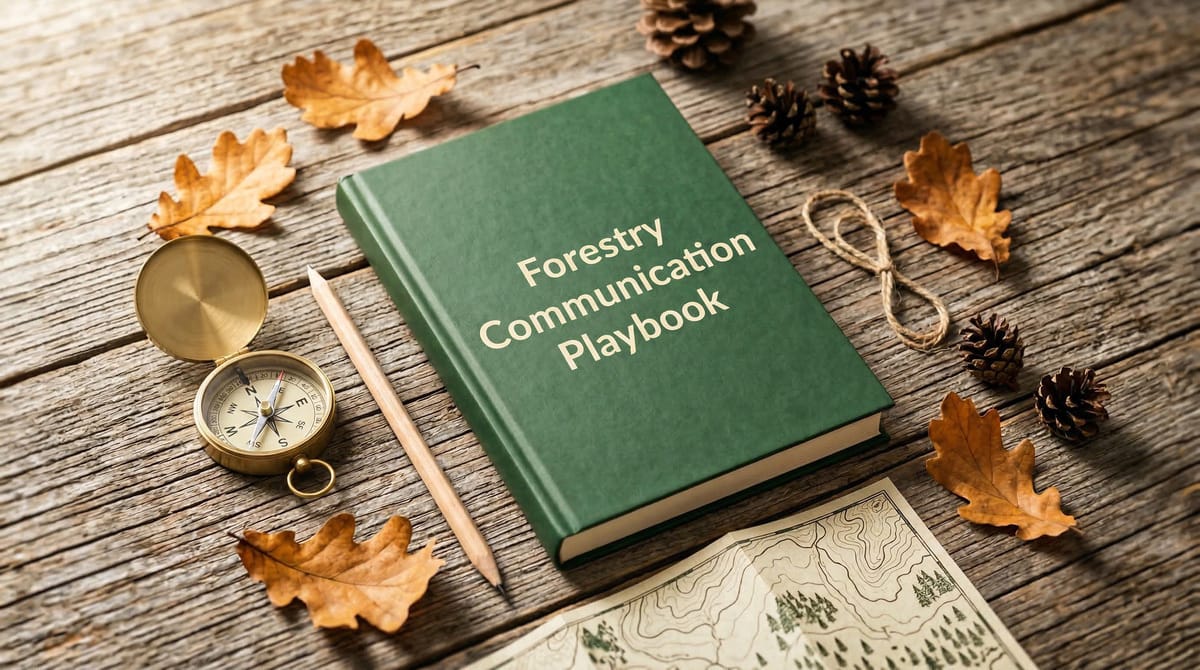
📖 The Forestry Communication Playbook
The next time someone asks why you cut trees, you'll have thirty seconds to answer.
Right now — what do you say?
If the answer isn't ready, the Playbook is.
🤝 ForestryBriefing
The brief is free. The briefing is not.
ForestryBrief publishes verified intelligence — free, three times a week, in 25+ countries. When you need that intelligence applied to your specific situation, that's a ForestryBriefing.
Intelligence — Investment due diligence, market intelligence, EUDR compliance, cross-sector risk analysis, background verification in three languages.
Communication — Strategy, trade publication articles, stakeholder messaging, newsletters that people actually open. EN | DE | HU.
Live — Conference presentations, panel moderation, keynotes. Next: WAN-IFRA World Printers Summit, Rotterdam, October 2026.
Until Thursday!
Wish you all the best: Peter
🤝 Need help with forestry communication, intelligence, or due diligence? See what we offer → ForestryBriefing
📩 Got this email forwarded to you? Subscribe to ForestryBrief here.
📚 Missed an issue? Browse the ForestryBrief archive
P.S. What’s the biggest challenge you’re facing in forestry right now?
Hit reply and let me know — I read every message personally.
P. P. S. Know a forest professional who’s drowning in EUDR complexity or missing out on timber market shifts? Forward this email to them!
Shauna Matkovich's Forest Invest Podcast is one of the best resources for understanding where forest finance is heading. If you are interested in Forest Investments, start there.
If you like FB be sure to subscribe to Boreal Tech Brief, a newsletter of my friend Axel covering tech in forestry with a Nordic angle:
