
Hello,
For years the sector has been promised a wave of green capital. This week we got the receipt. The money is real, it is growing fast, and forests sit right in its path.
Here's what's moving European forestry this week:
🔍 The Big Story
Private money for nature hits $14 billion a year — and forests are in the front row
A new report puts a hard number on a trend we have tracked for months. Private capital is pouring into nature. The figure is bigger than most people expect.
What happened
The Nature Conservancy, with Forest Trends, published Gaining Ground: State of Private Investment in Nature 2026 on the 22nd of June.
The headline number is $14 billion. That is the private capital invested in nature in 2025. It is a fivefold rise since 2016, up from $2.8 billion.
More than half of that money goes to "working landscapes." That means land that earns its keep. Sustainable forestry sits inside that group, alongside farming.
The report also tracks money waiting on the sidelines. More than $180 billion in private capital is committed for future deployment.
The same pattern showed up in a separate move this month. On the 15th of June, manager New Forests launched a new global fund. It targets A$1 billion (about $707 million) for forests, farmland, carbon and nature markets. Between 60% and 80% is aimed at developed markets, Europe included.
Why this matters
This is the proof behind the slogan. Nature is now a real asset class, not a feel-good extra.
For forests, the timing is good. Forests are the clearest working landscape there is. They grow wood every year. They store carbon while they grow. They do not move with the stock market. That is exactly what this capital is looking for.
But more money attracts more noise. We said it in our last Professional issue. Green money also draws green pretenders. A weak carbon project or a planting scheme with no aftercare can look the same as the real thing on a slide. The capital is real. So are the traps.
What this means for you
If you own or manage forest: the asset class you are in is attracting record money. Get your file in order now. Clean location, species, certification and management data is what serious buyers ask for first.
If you advise or fund forest owners: the flow is real, but the due diligence is everything. The gap between a sound nature investment and an expensive mistake is the specific deal in front of you. Knowing which is which is exactly what a ForestryBriefing delivers (see below).
If you talk to the public or policymakers: use the number. Private investors put $14 billion into nature last year. This is not charity. It is capital choosing living systems. Forests lead that list. Sources: The Nature Conservancy — Gaining Ground: State of Private Investment in Nature 2026 | New Forests — launches first global natural capital strategy
📊 Quick Hits
1. 🇪🇺 Europe's hardwood exports turn back up
EU hardwood sawn-timber exports rose in the first quarter of 2026. Export value reached €250.6 million, up from €233.6 million in the prior quarter. That is a 7.3% rise. Volume grew 6.7% to 678,606 cubic metres.
Beech and oak together made up nearly 80% of the value. The top buyers outside the EU were the UK (€54.4M), China (€50.5M) and Egypt (€23.3M). Germany was the largest EU exporter by value, at €48.4 million.
Why it matters: Hardwood was the weak side of the market. We reported French oak and chestnut standing prices falling in EFP #95. Now export demand is rising. The trade is recovering even as standing prices correct.
The takeaway: If you grow or sell beech and oak, watch export demand, not just the price at the stump. The buyers are coming back. Source: Fordaq — EU hardwood sawn timber exports rise 7.3% in Q1
2. 🇪🇺 Europe's sawmills set their line to Brussels
The European sawmill industry body, EOS, held its General Assembly in Brussels on the 17th of June. It put hard numbers on the sector. Europe's sawmills are about 32,000 companies, more than 220,000 jobs, and over €51 billion in turnover.
The meeting was about the next rulebook. The European Commission's climate team presented on the LULUCF Regulation and the framework after 2030. Its environment team presented on the stress test of the Birds and Habitats Directives. EOS also flagged a tight hardwood supply, with log shortages and falling domestic demand.
Why it matters: This is the sector setting its own position before the rules are written. All of it points back to one thing: how much wood will be available, and on what terms.
The takeaway: If your national association has not told you its position on LULUCF or the Nature Directives, ask this week. The hardwood-shortage point pairs with the export jump above. Hardwood is getting tight. Source: EOS — European sawmill industry calls for policies that strengthen competitiveness and raw material supply
3. 🇫🇮 A sawmill that is building, not cutting
While much of the pulp world trims output, one Finnish sawmiller is expanding. Koskisen has switched on new drying kilns at its Järvelä mill. Drying capacity rises about 15%.
The move supports lifting annual output from 400,000 cubic metres toward a target of 450,000. The CEO said the company has invested close to €90 million at Järvelä over five years. A district-heating link finished at the end of 2025 powers the new kilns with little extra cost. Group revenue was €355 million in 2025.
Why it matters: Capacity expansions are rare in this market. A mill that invests is a buyer that stays. That underpins local log demand for years.
The takeaway: If you sell sawlogs within haulage range of a mill like this, an investing buyer is a durable buyer. Those are the contracts to lock in. Source: Koskisen Corporation press release
📅 The Weeks Ahead
Thu, 2 July 2026 — UK Timber Design Conference, London
Wed–Fri, 16–18 September 2026 — EFI Annual Conference, Växjö, Sweden
Tue, 22 September 2026 — CINEA LIFE Calls 2026 deadline | SoEF 2025 Webinar: Biological Diversity
Sun, 27 September 2026 — EU EmpCo Directive applies. Generic green claims become unlawful.
🔴 Mon, 5 October 2026 — WAN-IFRA World Printers Summit, Rotterdam. I'm presenting on forestry and paper supply.
Wed–Thu, 7–8 October 2026 — RFSI Forum, Denver | 19th European Congress (FOGE), Cologne
🔴 Tue–Wed, 13–14 October 2026 — CIFB London
Thu–Sun, 15–18 October 2026 — INTERFORST 2026, Munich (quadrennial)
Tue–Wed, 20–21 October 2026 — Global Bioeconomy Summit, Dublin
Tue, 3 November 2026 — Bergslagets Skogar Capital Markets Day, Stockholm
Thu–Fri, 5–6 November 2026 — 11th International Hardwood Conference, Antwerp (ATIBT)
Wed, 25 November 2026 — FBIA 2026 final event, EIB Brussels (by invitation)
Wed, 30 December 2026 — EUDR application date. Large, medium, and all timber-sector operators.
Wed, 30 June 2027 — EUDR application date. Non-timber micro and small operators only.
💡 One Thing to Try This Week
Build a one-page "investability sheet" for your forest. It takes about 30 minutes.
The Big Story shows record money looking for good forest assets. The owners who win it are the ones with clean data ready. So get yours ready.
On one page, write down the basics a buyer asks for first: location, total area, and species mix.
Add your status on three things: certification (FSC, PEFC, or none), recent management records, and any carbon scheme you are in.
Note one gap. Maybe a missing map, an old inventory, or no certificate. Write the single next step to fix it.
By the weekend you will have the sheet a serious buyer or partner expects. Clean data is becoming a price advantage, not just paperwork.
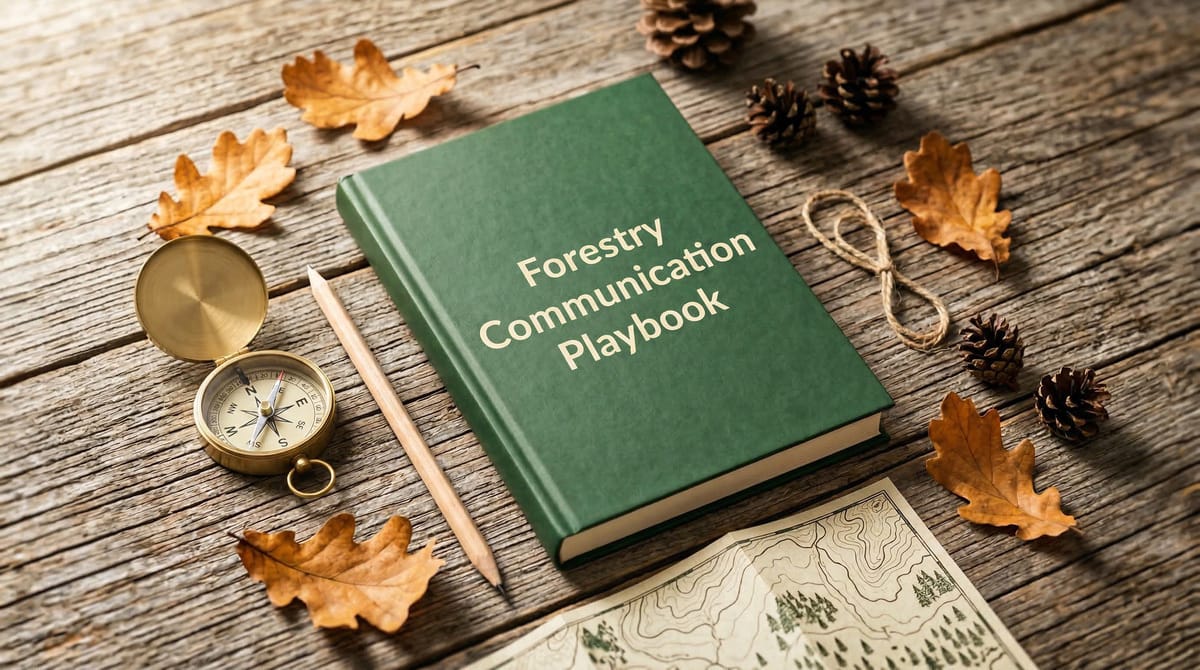
📖 The Forestry Communication Playbook
The next time someone asks why invest in forests, you'll have thirty seconds to answer.
Right now — what do you say?
If the answer isn't ready, the Playbook is. And by the way, something big is coming soon answering the above question in more detail…
🤝 ForestryBriefing
The brief is free. The briefing is not.
ForestryBrief publishes verified intelligence — free, three times a week, in 25+ countries. When you need that intelligence applied to your specific situation, that's a ForestryBriefing.
Intelligence — Investment due diligence, market intelligence, EUDR compliance, cross-sector risk analysis, background verification in three languages.
Communication — Strategy, trade publication articles, stakeholder messaging, newsletters that people actually open. EN | DE | HU.
Live — Conference presentations, panel moderation, keynotes. Next: WAN-IFRA World Printers Summit, Rotterdam, October 2026.
Until Thursday!
Wish you all the best: Peter
🤝 Need help with forestry communication, intelligence, or due diligence? See what we offer → ForestryBriefing
📩 Got this email forwarded to you? Subscribe to ForestryBrief here.
📚 Missed an issue? Browse the ForestryBrief archive
P.S. What’s the biggest challenge you’re facing in forestry right now?
Hit reply and let me know — I read every message personally.
P. P. S. Know a forest professional who’s drowning in EUDR complexity or missing out on timber market shifts? Forward this email to them!
Shauna Matkovich's Forest Invest Podcast is one of the best resources for understanding where forest finance is heading. If you are interested in Forest Investments, start there.
If you like FB be sure to subscribe to Boreal Tech Brief, a newsletter of my friend Axel covering tech in forestry with a Nordic angle:
