
Hello,
Last week we watched Europe build its fire line. This week, the first recovery cheques are being written. And the numbers point to a cheaper fix.
Here's what's moving European forestry this week:
🔍 The Big Story
€120 million for recovery — and the fix that costs far less
Spain's 2025 fire season was its worst on record. Now the recovery money is moving. But the bigger lesson sits in the forest itself.
What happened
The EU has approved €120.55 million from the EU Solidarity Fund for Spain. The money helps Spain recover from its 2025 wildfires. It is the largest share of a wider €144 million package. That package also covers floods in Romania and fires in Cyprus.
Spain's share is about 84% of the total. An advance of €30.13 million can be released quickly.
The scale tells the story. Spain's 2025 wildfire wave was the most destructive on record. It began on the 8th of August. There were 243 separate fires. They hit 16 of Spain's regions. Eight people lost their lives.
Why this matters
The fires have not stopped. In mid-June, Catalonia went on red alert across about 30 municipalities. One fire near Cervià de les Garrigues burned 46 hectares. Eight people were evacuated and 144 were confined indoors.
Here is the number that matters most. The GRAF, Catalonia's specialist wildfire unit, has tracked the forest fuel load. Over 40 years, it rose from 35% to 71%. The forests now hold roughly twice as much material to burn.
Why? Farms and pastures were abandoned. Land that people once grazed and cleared is now dense scrub and young trees. More fuel means bigger, hotter, faster fires.
About 60% of Catalan forests are privately owned. So this is not only a state problem. It lands on forest owners directly.
What this means for you
Recovery money treats the symptom. It pays for the damage after the fire. Forest management treats the cause. It removes the fuel before the fire starts.
Thinning, grazing and firebreaks are the cheapest fire policy we have. They are also work foresters already do. The Catalonia data shows what happens when that work stops. The fuel builds, and the bill grows. Prevention costs a fraction of what recovery does.
If you own forest in a fire-risk region: treat active management as fire protection. It is a core cost, not an optional one.
If you advise or fund forest owners: ask where the fuel-reduction budget sits. A managed stand is a lower-risk asset.
If you talk to policymakers: make the economic case. The Catalonia fuel data is your evidence. Prevention is far cheaper than recovery. Sources: La Moncloa — EU Solidarity Fund to fight forest fires | European Commission — EU Solidarity Fund for Spain, Romania and Cyprus (IP/26/1092) | Diari ARA — Three fires burn in Catalonia
📊 Quick Hits
1. 🇮🇪 Ireland makes timber the "first choice" in public building
Ireland just moved from talk to policy. On the 9th of June, the government brought a major report to Cabinet. It comes from the Timber in Construction Steering Group. It sets seven recommendations to scale up wood in building.
The centerpiece is a public "wood-first" approach. Public bodies would consider timber as the primary material for new buildings and big refurbishments. The exception is a clear technical or cost reason to choose something else. The plan also creates a Timber Knowledge Development and Innovation facility.
Why it matters: Public procurement is guaranteed demand. Softwood is about 70% of Ireland's growing stock. A wood-first rule turns that supply into a market.
The takeaway: If you grow or sell softwood, watch wood-first procurement spread. The report points to France and Scotland as models. Coillte called it a shift from debate to delivery. Source: Coillte — welcomes publication of the Timber in Construction Steering Group final report | World Construction Today — Ireland backs timber in construction with new roadmap
2. 🇨🇭 Switzerland brings wood-fibre insulation back home
Swiss sawmiller Schilliger Holz is starting to make wood-fibre insulation boards. The plant is at Küssnacht am Rigi. The product carries the label "Lignatherm." It uses around 50,000 tonnes of wood chips a year.
Why it matters: This restores Swiss capacity to make natural insulation at home. It also turns sawmill chips into a higher-value product. The insulation stores carbon instead of releasing it.
The takeaway: Watch the by-product economics. Chips that become insulation earn more than chips sold for fuel. That is margin moving up the chain. Source: Schilliger Holz — Lignatherm | Global Wood Markets Info — Schilliger Holz starts wood-fibre insulation boards
3. 🌲 Nordic mills trim hard — and that is discipline, not decline
Three Nordic updates landed in one week. Each shows cost control in a soft market.
Metsä Wood finished its staff talks. It is cutting about 100 positions in Finland and Estonia. Stora Enso will pause pine-lumber production at its Veitsiluoto sawmill in Kemi. The halt runs from early August to early October, citing weak demand. Sveaskog reported a first-quarter operating profit of SEK 678M. That is down 19% from a year earlier, on roughly 8% lower delivery prices.
Why it matters: This is the supply side adjusting. Producers are matching output to demand and protecting margins. It is not a market in collapse. It is a market being managed.
The takeaway: Pair this with the capital still flowing in (below). The disciplined owners hold the pricing power. Clean data and the right species win the next cycle. Source: Metsä Group — Metsä Wood statutory negotiations completed | Global Wood Markets Info — Stora Enso to suspend production at Finnish sawmill | Sveaskog — financial information
4. 🇺🇸 Big money keeps buying forests
Institutional capital is still moving into timberland. BTG Pactual TIG just bought about 90,000 acres of US forest from Jamestown. The deal was announced on 10 June. It adds 50,000 acres of pine in Georgia and Alabama. It adds 40,000 acres of hardwood in Indiana, Pennsylvania and New York. All of it is SFI-certified.
Why it matters: The buyer's US portfolio now tops 1.7 million acres. Jamestown called it a "tailored fund transition," not a forced sale. That is orderly consolidation, not distress.
The takeaway: Forests remain a real asset investors want. Even in a flat lumber market, the long-term money keeps buying. Demand for the asset class is intact. Source: BTG Pactual TIG — acquires Jamestown's timberland platform | Yahoo Finance — BTG Pactual TIG acquires Jamestown timberland
📅 The Weeks Ahead
19 June 2026 — ATIBT Annual General Meeting. EUDR panel details
🔴 4–6 October 2026 — WAN-IFRA World Printers Summit, Rotterdam. I'm presenting on 5 October on forestry and paper supply.
7–8 October 2026 — RFSI Forum, Denver. Details
🔴 13–14 October 2026 — CIFB London — London
30 December 2026 — EUDR application date. Large, medium, and all timber-sector operators.
30 June 2027 — EUDR application date. Non-timber micro and small operators only.
💡 One Thing to Try This Week
Check what your forest insurance actually pays if fire hits. It takes about 20 minutes.
The Big Story shows recovery money landing for whole countries. Your own recovery starts with your policy.
Pull your current forest insurance policy. If you are in a cooperative, find the group cover terms.
Check three things: which perils are covered (fire, storm, drought, pests), what the payout is based on, and what is excluded.
Ask your insurer one question. Does documented management — thinning, firebreaks, grazing — lower your premium or raise your cover?
By the weekend you will know what your policy pays before the season peaks. That beats finding out afterwards.
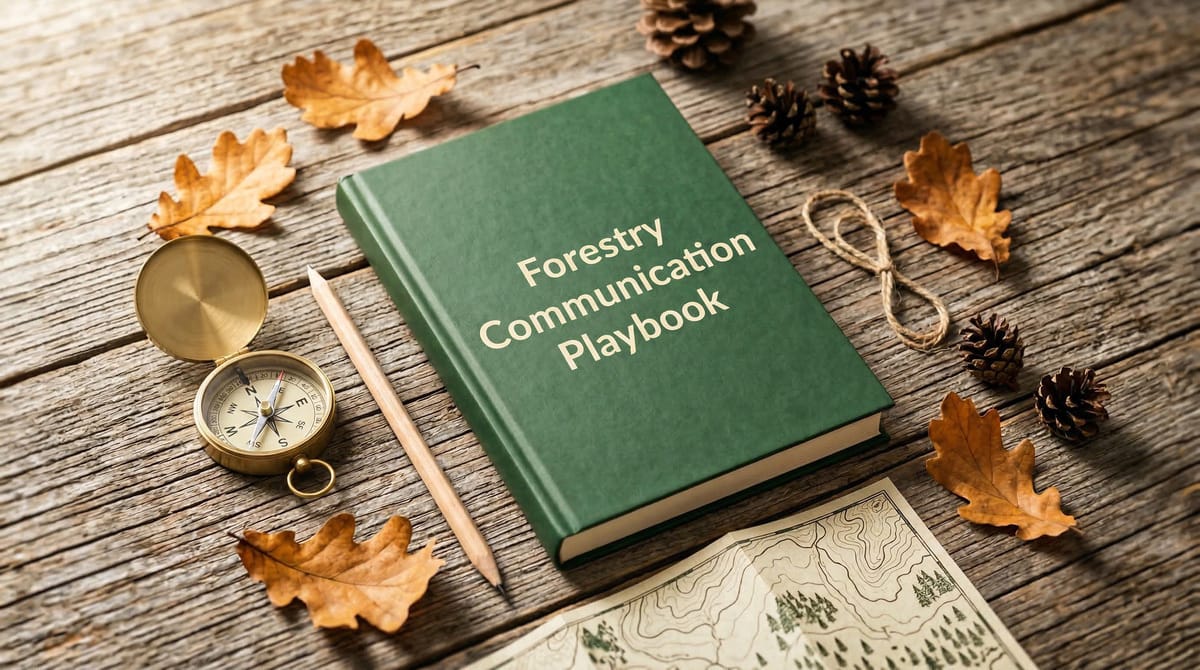
📖 The Forestry Communication Playbook
The next time someone asks why you cut trees, you'll have thirty seconds to answer.
Right now — what do you say?
If the answer isn't ready, the Playbook is.
🤝 ForestryBriefing
The brief is free. The briefing is not.
ForestryBrief publishes verified intelligence — free, three times a week, in 25+ countries. When you need that intelligence applied to your specific situation, that's a ForestryBriefing.
Intelligence — Investment due diligence, market intelligence, EUDR compliance, cross-sector risk analysis, background verification in three languages.
Communication — Strategy, trade publication articles, stakeholder messaging, newsletters that people actually open. EN | DE | HU.
Live — Conference presentations, panel moderation, keynotes. Next: WAN-IFRA World Printers Summit, Rotterdam, October 2026.
Until Tuesday!
Wish you all the best: Peter
🤝 Need help with forestry communication, intelligence, or due diligence? See what we offer → ForestryBriefing
📩 Got this email forwarded to you? Subscribe to ForestryBrief here.
📚 Missed an issue? Browse the ForestryBrief archive
P.S. What’s the biggest challenge you’re facing in forestry right now?
Hit reply and let me know — I read every message personally.
P. P. S. Know a forest professional who’s drowning in EUDR complexity or missing out on timber market shifts? Forward this email to them!
Shauna Matkovich's Forest Invest Podcast is one of the best resources for understanding where forest finance is heading. If you are interested in Forest Investments, start there.
If you like FB be sure to subscribe to Boreal Tech Brief, a newsletter of my friend Axel covering tech in forestry with a Nordic angle:
