
Hello,
Paper is supposed to be a sunset industry. Someone forgot to tell the people writing the cheques.
This week, two of the world's largest paper companies committed major new capital. One in Europe. One in North America. Both are spending to modernise and cut carbon.
Here's what's moving European forestry this week:
🔍 The Big Story
The Paper Giants Are Spending Through the Gloom
Graphic-paper demand has fallen for years. The headlines say decline. But the biggest players are not retreating. They are investing. And capex is where real confidence shows.
What happened
Two large commitments landed in the same week.
Smurfit Westrock will invest about €600 million across its operations in France. The money runs over the next three to five years. It covers modernisation and decarbonisation across 50 sites. The group employs about 6,000 people in France. This builds on more than €500 million already spent there in the last five years. The company tied the plan to decarbonisation. Its European CEO pointed to "innovation, quality, and decarbonisation" as the focus. The timing was deliberate. It came just before the French government's Choose France investment summit.
Across the Atlantic, International Paper completed a $360 million purchase. It bought North Pacific Paper Company, known as NORPAC. The mill sits in Longview, Washington. It makes lightweight recycled packaging papers. The site runs three paper machines. It produces about one million tons a year. The deal closed on 4 June.
Why this matters
Notice what both companies are buying. Not graphic paper. Packaging.
Packaging is the growth side of the paper world. E-commerce drives it. It also replaces plastic in many uses. So this is fibre demand with a structural tailwind.
Now notice what both are spending on. Modernisation and lower carbon. Smurfit Westrock already runs four net-zero plants in France. International Paper is adding capacity for lightweight, high-performance grades.
This is not the first capex signal in a weak paper market. Two weeks ago it was tissue. Metsä doubled a Swedish mill (EFP #92). Now it is packaging, and the cheques are bigger. The pattern is widening across grades and across the Atlantic.
This is the real signal. A flat market is not a dying market. It is a market being modernised. The operators doing it plan to own the next cycle. Capex is a vote. Two more of the biggest names just voted yes.
What this means for you
If you grow and sell pulpwood or sawmill residues: these mills are long-term fibre buyers. A mill that invests is a buyer that stays. That underpins your demand for years, not months.
If you invest in or analyse forest assets: treat capex as a confidence indicator. Watch which mills expand and which go quiet. The investors signal where fibre demand will hold.
If you talk to the public or to policymakers: here is a clean message. Paper is not dying. It is decarbonising. Packaging made from wood is replacing fossil-based plastic. Say it plainly. Sources: Smurfit Westrock — €600 million France investment | International Paper — completes $360M NORPAC acquisition | Lesprom — IP / NORPAC Longview
📊 Quick Hits
1. 🌲 31 ministers just backed your certification
Europe's forest ministers met in Stockholm on 2–3 June. It was the 10th FOREST EUROPE Ministerial Conference. EFP #91 covered the run-up. Now the outcome is in. 31 signatories signed the Stockholm Ministerial Declaration. They reaffirmed sustainable forest management. The text also backs voluntary certification schemes. It names them as part of the forest-policy toolkit. Albania becomes the incoming chair of the process.
Why it matters: This is political cover you can use. The declaration treats certification as a recognised tool. That helps in procurement, ESG, and EUDR talks.
The takeaway: If your forest is PEFC- or FSC-certified, cite this backing. If south-east Europe matters to you, watch Albania's agenda — expect wildfire and restoration priorities. Source: FOREST EUROPE — Stockholm conference report | PEFC — at the 10th FOREST EUROPE Ministerial Conference
2. 🇨🇦 Canada puts C$130 million into forest-sector transformation
Canada announced C$130 million for 56 forest-sector projects. The money targets low-carbon wood technology and mass-timber housing. It also supports Indigenous participation and export diversification.
Why it matters: This is a move up the value chain. Canada is funding advanced wood products, not just raw output. It comes while Canadian producers face US trade pressure.
The takeaway: Expect more Canadian mass-timber and engineered-wood supply. European producers in the same segment should track this competition. Source: Lesprom — Canada announces C$130 million for 56 forest-sector projects
3. 🇫🇮 Kesla launches its next-generation F-series forwarder cranes
Finnish manufacturer Kesla has launched a new forwarder crane line. The F-series comes in four model classes. Gross lifting moment runs from 120 to 180 kNm. The single-extension F-version reaches 8.2 metres. The double-extension FT-version reaches 10.07 metres. Internal hose routing inside the boom is a patented design.
Why it matters: Kesla cranes are widely used across Central and Eastern Europe. Better geometry and control mean more productive forwarding.
The takeaway: If you run or spec forwarders, put the F-series on your list. INTERFORST in Munich (15–18 October) is the place to see it. Source: Forestry Journal — Kesla launches F-series forwarder cranes
📅 The Weeks Ahead
Fri, June 12: German Innovation Award 2026 ceremony — Berlin | FBIA 2026 application deadline (EIB Group + EFI forest-bioeconomy accelerator)
Sun, June 15: Verra VM0045 v1.3 consultation closes
Tue, June 16, 13:00 BST: TDUK / One Click LCA — EPD Masterclass (online, free)
Wed, June 17: SoEF 2025 Webinar — Bioeconomy
Mon–Fri, June 22–26: 8th European Agroforestry Conference (EURAF 2026) — Neuchâtel, Switzerland
Thu, July 2: UK Timber Design Conference — London
Wed–Fri, September 16–18: EFI Annual Conference — Växjö, Sweden
Tue, September 22: CINEA LIFE Calls 2026 deadline | SoEF 2025 Webinar — Biological Diversity
Sun, September 27: EU EmpCo Directive applies — generic green claims become unlawful
🔴 Mon, October 5: WAN-IFRA World Printers Summit — Rotterdam (ForestryBrief presenting)
Wed–Thu, October 7–8: 19th European Congress (FOGE) — Cologne, Germany
🔴 Tue–Wed, October 13–14: CIFB London — London
Thu–Sun, October 15–18: INTERFORST 2026 — Munich (quadrennial)
Tue–Wed, October 20–21: Global Bioeconomy Summit — Dublin
Thursday, October 22: SoEF 2025 Webinar — Green Jobs
Tue, November 3: Bergslagets Skogar Capital Markets Day — Stockholm
Wed, November 4: TDUK Global Market Conference — London
Thu–Fri, November 5–6: 11th International Hardwood Conference — Antwerp (ATIBT)
Wed, November 25: FBIA 2026 final event — EIB Brussels (by invitation)
Wed, December 30: EUDR application date for large and medium operators
Mon, January 18, 2027: Frontiers Planet Prize International Champions announced — Davos
💡 One Thing to Try This Week
Map your fibre buyers — and check who is investing.
The Big Story shows the biggest mills betting on the next cycle. The same logic works on your ground. A mill that invests is a buyer that stays.
List the pulp, panel, and packaging mills within haulage distance of your forest.
Spend ten minutes on each one's recent news. Look for expansions, capex, or closures.
Mark which are investing and which are quiet. The investors are your most durable demand.
By the weekend you will know which buyers are building for the future. Those are the contracts worth locking in.
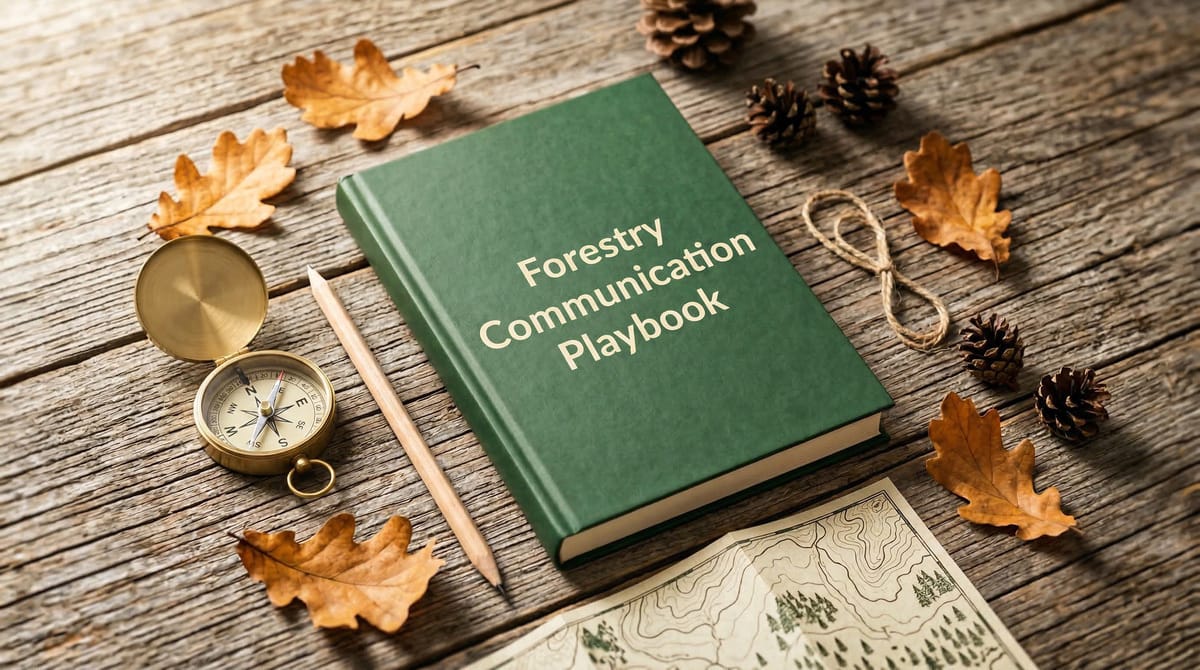
📖 The Forestry Communication Playbook
The next time someone asks why you cut trees, you'll have thirty seconds to answer.
Right now — what do you say?
If the answer isn't ready, the Playbook is.
🤝 ForestryBriefing
The brief is free. The briefing is not.
ForestryBrief publishes verified intelligence — free, three times a week, in 25+ countries. When you need that intelligence applied to your specific situation, that's a ForestryBriefing.
Intelligence — Investment due diligence, market intelligence, EUDR compliance, cross-sector risk analysis, background verification in three languages.
Communication — Strategy, trade publication articles, stakeholder messaging, newsletters that people actually open. EN | DE | HU.
Live — Conference presentations, panel moderation, keynotes. Next: WAN-IFRA World Printers Summit, Rotterdam, October 2026.
First briefing guarantee: if it doesn't deliver intelligence you can act on, you don't pay.
Until Thursday!
Wish you all the best: Peter
🤝 Need help with forestry communication, intelligence, or due diligence? See what we offer → ForestryBriefing
📩 Got this email forwarded to you? Subscribe to ForestryBrief here.
📚 Missed an issue? Browse the ForestryBrief archive
P.S. What’s the biggest challenge you’re facing in forestry right now?
Hit reply and let me know — I read every message personally.
P. P. S. Know a forest professional who’s drowning in EUDR complexity or missing out on timber market shifts? Forward this email to them!
Shauna Matkovich's Forest Invest Podcast is one of the best resources for understanding where forest finance is heading. If you are interested in Forest Investments, start there.
If you like FB be sure to subscribe to Boreal Tech Brief, a newsletter of my friend Axel covering tech in forestry with a Nordic angle:
