
Hello,
2025 was the worst wildfire season in Europe since records began. Over one million hectares burned. Damage to property and infrastructure costs the EU around €2.5 billion every year. Foresters have been saying for years that this is not just a firefighting problem. It's a forest management problem.
On March 25, the European Commission agreed.
Brussels published its first integrated wildfire risk management strategy. It covers prevention, preparedness, response, and recovery. And for the first time, it names active forest management as the foundation of resilience.
The Confederation of European Forest Owners (CEPF) welcomed it the same week. Here's what's moving European forestry this week:
🔍 The Big Story
After Europe's Worst Fire Year, Foresters Got a Seat at the Table
The European Commission published its first integrated wildfire risk management strategy on March 25, 2026. It is the most comprehensive EU position on wildfire ever produced. And it places forest management at the centre.
For European forest owners who have been pushing this point for a decade, that's a big shift.
What changed
Until now, EU wildfire policy was fragmented. Civil protection handled response. Climate policy handled prevention narratives. Forest policy handled the trees themselves. Nobody owned the whole picture.
The new strategy connects all four phases — prevention, preparedness, response, and recovery — into one framework. Commissioners Hadja Lahbib and Jessika Roswall presented it as a whole-of-society response built on the Preparedness Union Strategy adopted exactly one year earlier.
The headline numbers tell you why:
2025: worst wildfire season in European history. Over 1 million hectares burned.
€2.5 billion in annual damage to property and infrastructure across the EU.
rescEU fleet expansion: 12 new firefighting planes and 5 helicopters confirmed. The first helicopter was delivered to Romania in January 2026.
A new firefighting hub is being established in Cyprus for training, exercises, and seasonal readiness.
The line that matters for foresters
Buried in the technical text is the sentence European forest owners have waited years to read. The Commission promotes "sustainable forest management and diverse forest structures, where possible, including the use of alternatives to monocultural plantations of highly flammable species."
In plain English: planting one tree species across thousands of hectares is part of the wildfire problem. Mixed forests, managed actively, are part of the solution.
This is not radical. It's been the consensus among forest scientists for years. But now it's in a Commission strategy document. That changes the policy gravity.
CEPF's response
The Confederation of European Forest Owners reacted within days. Their April newsletter welcomed the strategy and noted that CEPF intervened at the high-level EU roundtable on wildfire risk management. They urged the Commission to recognise active sustainable forest management as the foundation of wildfire resilience.
The Commission did. CEPF stated in its April newsletter that the recognition of active forest management as essential is welcome.
This is what successful policy advocacy looks like. Years of engagement. A clear technical case. A moment when the data and the political will line up.
What it actually means on the ground
The strategy proposes more than warm words. Real instruments include:
Strengthened EFFIS — the European Forest Fire Information System — with Copernicus satellites and standardised pan-European risk modelling.
AI-assisted wildfire decision-making tools for member state authorities.
A new Council Recommendation on integrated wildfire risk management.
CAP support for active forest management to be maintained and strengthened.
Better data on firefighter health risks and exposure to toxic substances.
For foresters, the most important piece is the CAP linkage. Wildfire prevention is being framed as a public good that justifies public payment. That changes the funding conversation.
The honest part
A strategy is not yet a regulation. The Council Recommendation will need member state buy-in. The CAP money has to actually reach forest owners — and as we documented in EFP #74, that's where European forest policy keeps stumbling.
But the framing has shifted. For the first time, Brussels is treating forest management as wildfire infrastructure. Not as an afterthought.
If you've been arguing this case to your local authority, your insurance company, or your investors, the Commission just gave you a citable document. Use it. Sources: European Commission — IP/26/698, March 25, 2026 | COM(2026) 330 final — Communication on Integrated Wildfire Risk Management | Council Document ST-7652-2026 | CEPF Newsletter — April 2026
📊 Quick Hits
1. 🇮🇪 Ireland Shows What Drone-Led Wildfire Detection Looks Like
While Brussels was writing strategy, Ireland was running operations. Coillte and the National Parks and Wildlife Service (NPWS) have been deploying drones and aerial monitoring for wildfire detection and response since 2021.
The numbers Coillte has now made public: since 2021, more than 300 fires on Coillte lands, causing damage to over 2,500 hectares. That's the operational baseline a small country with limited resources can produce when forest managers and civil authorities share data.
Why it matters: The new EU wildfire strategy talks about technology integration. Ireland is already doing it. The combination of drone overflight, satellite data, and ground-based response coordination is the model the rest of Europe will copy.
The takeaway: If you manage forests in a fire-prone region, the question is no longer whether to invest in monitoring technology. It's which mix of drone, satellite, and ground sensor data fits your landscape and your budget. Ireland just showed it's possible at the national level. Sources: Irish Farmers Journal — Coillte and NPWS to use drones for faster detection of forest fires, 1 April 2026 | Coillte — Coillte and NPWS using drones to fight forest fires | Government of Ireland — Coillte and the NPWS deploy drones
2. 🇫🇮 Finland Is Quietly Pivoting Away from Forest Chips for Energy
Luke Finland published its provisional 2025 wood energy data on March 20. The headline number is small but the structural shift behind it is large.
Heat and combined heat-and-power plants consumed 20.8 million m³ of solid wood fuels in 2025. That's 40.8 TWh of energy. Down 5% from 2024.
Inside that total, two trends are pulling in opposite directions:
Forest chips fell 13% to 9.1 million m³. Roundwood chips alone dropped 17%. This is wood that came directly from forests for burning.
Forest industry by-products rose to 10.4 million m³. Bark was up 7%. Sawdust was up 2%. Wood pellets and briquettes jumped 15% to 460,000 tonnes.
Finland is moving from burning trees to burning leftovers. The energy is still there. The source has changed.
Why it matters: Finland is the European reference market for wood energy. About 28% of Finnish energy comes from wood. When the structural mix shifts here, it signals where EU bioenergy policy is heading. Burning primary wood for electricity faces tightening political pressure. Burning residuals from sawmills and pulp mills does not.
The takeaway: If you sell forest residues or operate a sawmill in the Nordic or Baltic region, the residual stream is the growth market. If you sell roundwood for energy, the long-term trend is against you. Source: Luke Finland — Wood in Energy Generation 2025 (provisional), 20 March 2026
3. 🇪🇺💰 EU Carbon Market Hits a Milestone — and Forest Owners Should Be Watching
The EU Emissions Trading System benchmark settled around €72 per tonne in early April 2026. EU Carbon Permits were recorded at €71.69 on April 3 on a CFD tracking the benchmark market. Today, April 7, the European Commission is publishing the first weekly Carbon Border Adjustment Mechanism (CBAM) certificate price under the regime that took full effect on January 1.
This is not just a number for traders. It is a price signal that ripples into every forest carbon conversation in Europe.
Why it matters: The CRCF carbon farming methodology is still in consultation. CEPF has just submitted its response (we'll cover that on Thursday). But the underlying carbon price environment has firmed up. €70+ per tonne for ETS is the level at which corporate buyers start treating high-quality removals as a serious procurement category, not a side bet.
For European forest owners, this is the second piece of the puzzle. The first was the legal framework. The second is the price floor.
The takeaway: If you're exploring carbon revenue as a complement to timber income, this is the moment to understand the difference between ETS allowances, voluntary credits, and CRCF-certified units. They are not the same thing. They will not trade at the same price. And the buyers are different. Sources: TradingEconomics — EU Carbon Permits (CFD tracking the benchmark market, recorded €71.69 on April 3, 2026) | European Commission CBAM Implementing Regulation — first certificate price publication scheduled for April 7, 2026.
🇩🇪🇨🇦 CAN YOU HELP THIS YOUNG FORESTER?
Constantin Peters is 23. He grew up on a farm in Münsterland, Germany. He finished his Bachelor in Forestry at Göttingen last summer. Now he's doing his Master's in Erfurt.
In September 2026, he's heading to Canada on a Working Holiday visa. He already has a forestry contractor placement lined up in Nova Scotia.
But he wants more. From February 2027, he's looking for a placement in the sawmill, timber trade, or wood products industry — ideally in British Columbia.
He has hands-on experience from a veneer/sawmill internship. He organized his own visa, his own first job, and reached out to ForestryBrief to find the next one. That kind of initiative is rare at any age.
If you work in the Canadian wood industry — or know someone who does — and can help Constantin find a placement, please reply to this email. I'll make the connection.
I spent the autumn semester of 2008 at Vancouver Island University in Nanaimo on a scholarship. It is still one of the most significant lines in my CV. I know what this kind of experience does for a young forester.
📅 The Weeks Ahead
April 14, 2026: EFI Bioregions Investment Readiness Webinar 3 — online
April 14–17, 2026: Pulp & Beyond — Helsinki, Finland
April 16, 2026: Karelia Symposium — Joensuu, Finland
April 21, 2026: 🔴 SoEF 2025 Webinar — Forest Health & Vitality (FOREST EUROPE)
April 22, 2026: PEFC SFM Working Group nomination deadline | Nordic Forest Summit 2026 — Stockholm
April 23, 2026: Forests for Resilient Water — Brussels
April 28–29, 2026: CIFB Europe — Corporate Investments into Forestry & Biodiversity — Frankfurt, Germany
April 30, 2026: EUDR simplification review package due | EFI Young Leadership Programme application deadline
May 14, 2026: PEFC Forest Forum — Istanbul
May 22, 2026: SoEF 2025 Webinar — Forest Resources and Carbon (FOREST EUROPE)
June 2–4, 2026: Carrefour International du Bois — Nantes, France
June 9–10, 2026: FAIS — Forestry & Agriculture Investment Summit — London, UK
June 17, 2026: SoEF 2025 Webinar — Bioeconomy (FOREST EUROPE)
September 16–18, 2026: EFI Annual Conference — Växjö, Sweden
October 5, 2026: WAN-IFRA World Printers Summit — Rotterdam (ForestryBrief presenting)
October 7–8, 2026: 19th European Congress (FOGE) — Cologne, Germany
October 13–14, 2026: CIFB London — London, UK
October 20–21, 2026: Global Bioeconomy Summit 2026 — Dublin, Ireland
November 5–6, 2026: 11th International Hardwood Conference — Antwerp (ATIBT)
December 30, 2026: EUDR deadline for large and medium operators
💡 One Thing to Try This Week
Read the EU wildfire strategy. Find the one paragraph that supports your work.
The full Commission communication is COM(2026) 330 final, published March 25. It's about 30 pages.
Fifteen minutes:
Open the Commission communication PDF
Search for the section on "fire-resilient landscapes" and "sustainable forest management"
Find the sentence that best supports what you already do — mixed species, active thinning, fuel management, whatever it is
Save it. Use it. Cite it next time someone questions your management approach.
The Commission just handed every European forester a citable source. Most will never read it. The ones who do will own the conversation for the next two years.
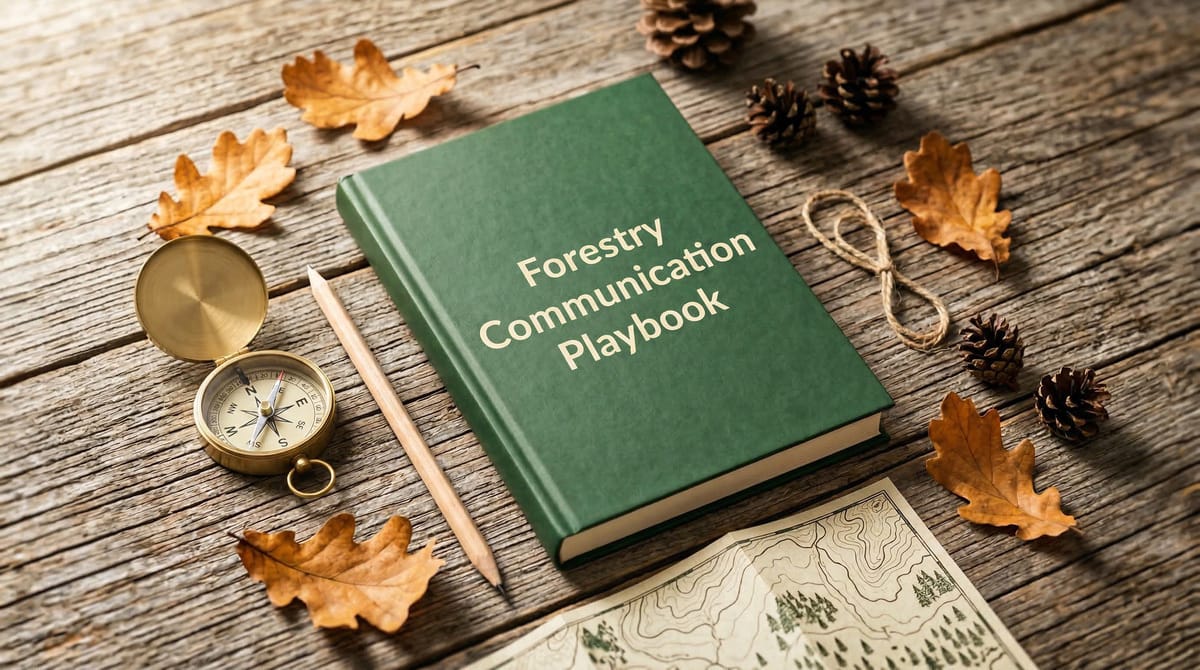
📖 The Forestry Communication Playbook
Ten chapters. Fifteen tools. €29.
Today's Big Story is about a policy win that took years of patient communication. CEPF didn't get "active forest management" into a Commission strategy by accident. They built the case, showed up at every roundtable, and translated technical reality into political language.
That's the work most forestry organisations don't do well. Chapter 7 of the Playbook gives you the eleven core messages that work. Chapter 9 shows you how to structure stakeholder engagement that actually moves policy.
🤝 ForestryBriefing
The brief is free. The briefing is not.
ForestryBrief publishes verified intelligence — free, three times a week, in 25+ countries. When you need that intelligence applied to your specific situation, that's a ForestryBriefing.
Intelligence — Investment due diligence, market intelligence, EUDR compliance, cross-sector risk analysis, background verification in three languages.
Communication — Strategy, trade publication articles, stakeholder messaging, newsletters that people actually open. EN | DE | HU.
Live — Conference presentations, panel moderation, keynotes. Next: WAN-IFRA World Printers Summit, Rotterdam, October 2026.
First briefing guarantee: if it doesn't deliver intelligence you can act on, you don't pay.
Until Thursday!
Wish you all the best: Peter
🤝 Need help with forestry communication, intelligence, or due diligence? See what we offer → ForestryBriefing
📩 Got this email forwarded to you? Subscribe to ForestryBrief here.
📚 Missed an issue? Browse the ForestryBrief archive
P.S. What’s the biggest challenge you’re facing in forestry right now?
Hit reply and let me know — I read every message personally.
P. P. S. Know a forest professional who’s drowning in EUDR complexity or missing out on timber market shifts? Forward this email to them!
Shauna Matkovich's Forest Invest Podcast is one of the best resources for understanding where forest finance is heading. If you are interested in Forest Investments, start there.
If you like FB be sure to subscribe to Boreal Tech Brief, a newsletter of my friend Axel covering tech in forestry with a Nordic angle:
