
Hello,
Today, Stora Enso's Swedish forests meet investors in Stockholm. They are about to become a company of their own.
That company has published rules for its debt and its dividends. In the same week, Sweden's biggest forest owner reported lower prices from its own forest.
Plus Finnish forest returns, a reader's lesson on beech, and cheaper energy wood in Finland.
Here's what's moving European forestry this week:
One question for you
What's the one forest-market question your team must answer before 2027 budgets close?
Hit reply with one line. I read every answer and never name who asked.
Want the answer for your own business? Add "briefing" to your reply, and I'll send a one-page outline.
🔍 The Big Story
🇸🇪 Stora Enso's Swedish forests get their own company, and their own rulebook
What happened
On 30 October, Stora Enso's board approved a plan to split off its Swedish forests. Under the plan, they would move into a new company, Bergslagets Skogar.
The plan is to list it in Stockholm and Helsinki. Stora Enso says it would be "the largest listed pure-play forest company in Europe."
Pure-play means mainly one business: owning and managing forest, without mills. It would also keep paint and colour-pigment production, and renewable-energy project management.
Today, 3 November, Bergslagets Skogar holds its first Capital Markets Day in Stockholm. CEO Tuomas Hallenberg and CFO Martin Ros present.
It is not done yet
Stora Enso's shareholders vote at an extraordinary meeting, on or about 15 December.
Holders of 69.9% of the votes have promised to vote yes, subject to customary conditions. They hold 28.6% of the shares.
Completion is planned for on or about 31 March 2027.
Sweden's Tax Agency has appealed an advance tax ruling that favoured the plan. The case is at the Supreme Administrative Court.
Stora Enso's board can still decide not to complete it.
The rules it set itself
Bergslagets Skogar published these targets and policies:
Dividend: it intends to pay out 80–100% of adjusted net income.
Debt: net loan-to-value between 0 and 20%. It compares net debt with the value of the assets.
Growth: the standing stock grows by 1% a year on average.
Cash: a free cash flow return of 2% a year, over the long term.
Nature: biodiversity benefit and climate benefit shall increase.
These are targets, not results.
The numbers so far
Stora Enso gave figures for the 12 months to 30 September. It calls them preliminary, unaudited and illustrative.
Forest assets: SEK 63,750 million
Total net sales: SEK 2,119 million
Free cash flow: SEK 984 million
Free cash flow return: 1.6% (1.7% in 2025)
Free cash flow is the cash left after running costs and investments. The figures include no adjustment for the costs of running alone. Net debt should be about SEK 9.1 billion shortly after completion.
The same week, from the forest
On 29 October, Sveaskog reported its third quarter. The Swedish state owns Sveaskog, the country's biggest forest owner.
Average prices on deliveries from its own forest: −16% on a year earlier.
Operational operating profit: SEK 242 million, down 37% from SEK 386 million.
Net sales: SEK 1,585 million, down 10%.
Sveaskog says lower timber prices explain most of the fall. Higher volumes made up part of it.
Why this matters
Forest land changes hands rarely. Each deal is different, so a fair price is hard to find.
A listed forest company would carry a price on every trading day. Bergslagets Skogar also publishes its cash return: 1.6% in the 12 months to September. The long-term goal is 2%.
Sveaskog's report is the same week's reality. Timber prices fell, and its operating profit fell with them.
My read, and it is a read rather than a finding: Swedish forest is leaving the industrial group. It is becoming an asset with its own rules. The dividend and debt rules may matter as much as the hectares.
What this means for you
If you own forest: Compare your own cash yield with that 1.6%. See One Thing to Try below.
If you sell wood in Sweden: Sveaskog's −16% is one company's own-forest price. It is not a national index. My advice: check your buyer's latest price list.
If you invest: Read the targets as targets. The vote, the tax case and the listing are still ahead. An information brochure is due by 24 November.
If you work in a forest company: As reported in #134, Holmen split its forest business in two. Now Stora Enso splits off its forests completely. Owning forest and buying wood are drifting apart. Sources: Stora Enso — Board approves demerger plan to separate Bergslagets Skogar (30 Oct 2026) | Bergslagets Skogar — Capital Markets Day 2026 | Sveaskog — Interim report January–September 2026 (29 Oct 2026, Swedish) | prior ForestryBrief coverage: EFP #134
📊 Quick Hits
1. 🇫🇮 Finnish forests: a weak month, a steadier long view
Finnish forest owners had a weak September. Timber and land prices both slipped. Indufor's monthly index puts the 12-month return at −5.9%. September alone was −2.8%.
Pulpwood: −0.9% in the month, −9.7% on the year
Sawlogs: −0.2% in the month, +0.3% on the year
Spruce sawlogs: the only grade that didn't fall in September
Forest property prices: −7.4% in the month, −9.5% on the year (based on 371 sales in September)
The longer view is calmer. The year so far is still up 1.1%. Over three years, the index returned 5.0% a year on average.
Indufor notes two pressures. Timber is below its June 2025 peak. Euribor, the benchmark rate behind many euro loans, has risen.
Why it matters: An earlier Indufor study looked at 2005–2025. Counting land prices cut the swings in Finnish returns by 20%. Sources: Indufor Oy — Finnish Forest Investment Return at −5.9% in September 2026 (STT Info, 29 Oct 2026) | Indufor, email to ForestryBrief, 29 Oct 2026 (sales count) | Indufor Oy — Timber vs. Land (STT Info, 2 Oct 2026, Finnish)
2. 🇩🇪 A reader pushed back: beech is its own market
In #132, I put UPM's new Leuna plant next to Germany's industrial wood index. Industrial wood is the lower grade. It goes to pulp, panel and energy plants.
The index rose 1.9% from July to August, Destatis reports. A reader wrote back. Tobias Cremer is professor of forest use and timber markets at Eberswalde University (HNEE). His point: split the index by species. Leuna buys beech, and beech moves on its own.
He is right. Here is the August 2026 index by species. It covers German state forests only, with 2015 = 100.
Spruce: 135.6
Pine: 131.4
All species: 124.7
Beech: 118.4
Oak: 98.0
Douglas fir: 97.4
Spruce industrial wood prices are about 36% above their 2015 level. Beech prices are about 18% above.
Why it matters: These are two different markets, Tobias explains. Softwood goes mostly to board and pulp mills. Beech goes mostly to energy: power plants, and above all private households.
The context: Will Leuna lift beech prices? Full output is now further away. On 28 October, UPM said it now expects integrated production from Q2 2027. That is about six months later than planned. Full capacity should follow in early 2028.
Tobias doubts a big effect anyway. He thinks households will still pay more for firewood than UPM will. So the beech index may rise slightly, but "probably not too significant".
One more series for context. Hardwood firewood is about 43% above its 2015 level. Index changes do not show which buyer pays more today.
The takeaway: Read wood prices by species and by grade, not as one number. If you sell beech near Leuna, you have more than one kind of buyer. My advice: ask for both prices before you sell. Thank you, Tobias, for the close reading. Sources: Destatis — GENESIS-Online table 61231-0002, producer price indices for logging products from state forests (August 2026, German) | Destatis — Erzeugerpreise der Produkte des Holzeinschlags (14 Oct 2026, German) | Prof. Tobias Cremer (HNEE), email to ForestryBrief, 26 Oct 2026 | UPM — Interim Report Q3 2026 (28 Oct 2026) | UPM — Q3 2026 CEO presentation
3. 🇫🇮 Energy wood got cheaper in Finland
On 29 October, Luke published Finland's energy wood trade for July to September. Luke is Finland's Natural Resources Institute.
Energy wood is wood sold to burn for heat and power. Over half of the recorded volume was logging residues: tops and branches.
Volume: 647,000 m³, 10% more than a year earlier
But still one third below the five-year average
Standing sales: real prices −24% on a year earlier
Delivery sales: real prices −20%
"Real" means adjusted for inflation. Average prices were €12.42/m³ in standing sales and €29.67/m³ in delivery sales.
Why it matters: As reported in #134, German wood fuel producer prices were 38.5% above a year earlier. That is a different measure. Still, Finland moved the other way.
The context: Luke records part of the trade, not all of it. In 2022–2024, its data covered about 65% of energy wood bought from private forests. In 2026, Luke expanded its data collection.
The takeaway: Wood fuel is not one European market. My advice: check your own region's price before you sign an energy wood deal. Source: Luke — Trade of energy wood, 3rd quarter 2026 (29 Oct 2026) | Destatis — producer prices, September 2026 (20 Oct 2026, German)
📅 The Weeks Ahead
Today, Tue 3 Nov: Bergslagets Skogar Capital Markets Day — Stockholm. See the Big Story | Commission EUDR Information System training for upstream operators, 14:00 CET
November: Commission EUDR Information System trainings, all at 14:00 CET. Upstream operators: 3, 10, 17 and 24 November. Micro and small primary operators: 12, 19 and 26 November. Register here
Wed 4 Nov: TDUK Global Market Conference — London | Rayonier third-quarter results
Thu 5 Nov: WRI webinar: agriculture and forests in the Congo Basin, 14:00 CET — online, in French with English interpretation
Thu–Fri 5–6 Nov: 🌳 11th International Hardwood Conference — Antwerp
Mon–Thu 9–12 Nov: ITTC 62 — Yokohama (ITTO)
Mon 9 – Fri 20 Nov: COP31 UN Climate Change Conference — Antalya, Türkiye
Tue 10 Nov: BiodivFuture pre-proposals due, 12:00 CET (Biodiversa+)
Tue–Fri 10–13 Nov: FIMMA + Maderalia — Valencia
Wed–Thu 11–12 Nov: Puupäivä — Helsinki (Puuinfo)
Thu 12 Nov: ATIBT and UICCB workshop on assessing EUDR deforestation risk with WHISP and forest management documents
Wed–Thu 18–19 Nov: German Timber Congress 2026 (DeSH) — Wiesbaden
Thu 19 Nov: Luke's October roundwood trade statistics (Finland)
Tue 24 Nov: Latest date for Stora Enso's information brochure on Bergslagets Skogar. See the Big Story
Wed 25 Nov: Forest Bioeconomy Investment Accelerator (FBIA) 2026 final event — EIB, Brussels (by invitation)
Fri 27 Nov: Timber and Circular Economy CPD — online and free (PEFC via TDUK)
Mon 30 Nov: Södra's temporary birch premium window closes. See #126 | Södra's browsing-damage challenge closes
Tue 1 Dec: SMURF Carbon Standard consultation closes, 17:00 CET
Wed 2 Dec: FOREST Partnership first joint call: pre-proposals due, 13:00 CET (up to €40 million)
Thu 3 Dec: 30th International Wood Construction Forum (IHF) — Innsbruck
Wed 9 Dec: 📌 European Commission deadline for a decision on the UPM/Sappi joint venture (Case M.12270). See #128
Tue 15 Dec: Stora Enso extraordinary general meeting on the Bergslagets Skogar demerger (on or about) — Helsinki
Wed 30 Dec: EUDR applies to large and medium operators, and to micro and small operators for products the EU Timber Regulation covered
Mon 1 Feb 2027: GHG Protocol request for information on forest carbon accounting closes. See #132
Wed 31 Mar 2027: Planned completion of the Bergslagets Skogar demerger (on or about)
Wed 30 Jun 2027: EUDR applies to other natural persons and micro or small operators established by 31 December 2024
💡 One Thing to Try This Week
Work out your forest's cash yield.
Bergslagets Skogar published a 1.6% free cash flow return. Here is a rough way to look at your own forest.
Add up last year's cash in from the forest. Wood sales, hunting leases, grants.
Subtract last year's cash out. Contractors, planting, roads, fees.
Divide what is left by what the forest is worth today. Use a recent valuation or local sale prices.
Treat it as your own rough measure. Bergslagets' 1.6% uses a different calculation.
Remember what it leaves out: changes in land and timber values. Indufor's index above counts those too.
A cash yield and a total return are different numbers. Know which one you are quoting. This is a rough check, not a valuation.
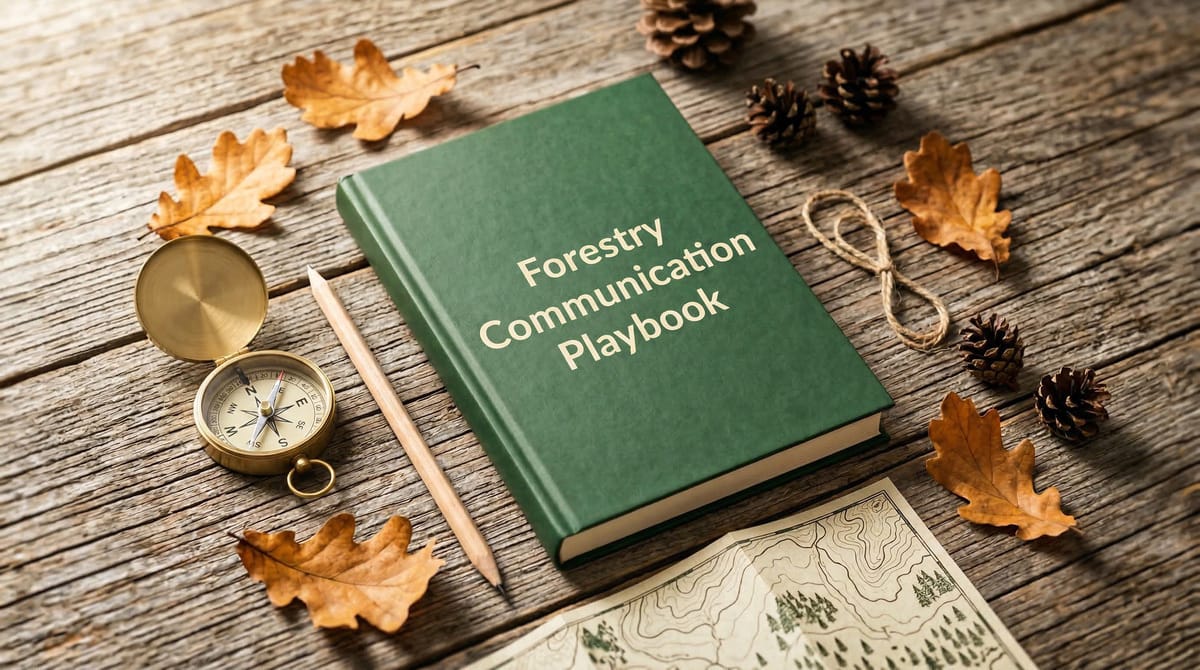
📖 The Forestry Communication Playbook
"So what is our forest worth now?"
A board member may ask after a headline like today's. Or a family member, or a local reporter. The honest answer has two parts: what it earns, and what it would sell for. Saying both calmly takes practice. Part 1 covers the questions that arrive without warning.
📗 The Forest-Investment Dictionary
Loan-to-value. Payout ratio. Free cash flow return.
Today, those words describe a forest. A forester may meet them at a board meeting. Or across the table from a buyer.
I wrote the Forest-Investment Dictionary with Danish forest economist Anders Tærø Nielsen. It has 151 pages, 11 chapters, 14 printable tools, and 3 calculators. Investors learn to read a forest. Foresters learn to read a term sheet.
When the market turns, the people who can read the numbers make the better calls. The price is €99. Get yours below.

📘 The Organization — Playbook Part 3
A new forest company must explain itself to investors, staff and neighbours. Someone has to do that work.
I wrote The Organization, Part 3 of the Playbook. It has 165 pages, 10 chapters, 10 printable tools, and a survey. It shows what it takes to be heard, and who does the work.
Almost nobody in European forestry publishes what communication costs. The survey inside starts the count. The price is €149. Get yours below.

🤝 ForestryBriefing
The brief is free. The briefing is not.
ForestryBrief publishes verified intelligence — free, three times a week, in 25+ countries. When you need that intelligence applied to your specific situation, that's a ForestryBriefing.
Intelligence — Investment due diligence, market intelligence, EUDR compliance, cross-sector risk analysis, background verification in three languages.
Communication — Strategy, trade publication articles, stakeholder messaging, newsletters that people actually open. EN | DE | HU.
Live — Conference presentations, panel moderation, keynotes. Most recent: WAN-IFRA World Printers Summit, Rotterdam, October 2026.
First briefing guarantee: if it doesn't deliver intelligence you can act on, you don't pay.
Until Thursday!
Wish you all the best: Peter
🤝 Need help with forestry communication, intelligence, or due diligence? See what we offer → ForestryBriefing
📩 Got this email forwarded to you? Subscribe to ForestryBrief here.
📚 Missed an issue? Browse the ForestryBrief archive
P.S. What’s the biggest challenge you’re facing in forestry right now?
Hit reply and let me know — I read every message personally.
P. P. S. Know a forest professional who’s drowning in EUDR complexity or missing out on timber market shifts? Forward this email to them!
Independent since issue one. Read the charter.
Shauna Matkovich's Forest Invest Podcast is one of the best resources for understanding where forest finance is heading. If you are interested in Forest Investments, start there.
If you like FB be sure to subscribe to Boreal Tech Brief, a newsletter of my friend Axel covering tech in forestry with a Nordic angle:
