
Hello,
Sales rules are boring. Until they decide your next two years.
Poland's State Forests just wrote theirs. Buyers now know the terms for 2027 and 2028.
Here's what's moving European forestry this week:
One question for you
What's the one forest-market question your team must answer before 2027 budgets close? Hit reply with one line. I read every answer and never name who asked.
Want the answer for your own business? Add "briefing" to your reply, and I'll send a one-page outline.
🔍 The Big Story
🇵🇱 Poland's State Forests adopt timber sales rules for 2027–2028
What happened
On 5 October, the Director General of Poland's State Forests (Lasy Państwowe) signed a new sales package. Order No. 67 sets the timber sales rules for 2027 and 2028. Three decisions signed the same day fill in the 2027 details.
The old rules stay valid until the end of 2026.
The annual plan has 37.7 million m³ of timber planned for sale in 2027. The 2026 plan was 37.2 million m³. The main offer pool is 30.8 million m³. That is 26.4 million m³ of conifer and 4.4 million m³ of broadleaf.
75% goes through offer sales. 25% goes through system auctions. The split is unchanged.
Sales run in two periods: January to June, and July to December.
The retail pool shrinks 3.6%, to 4.0 million m³. It serves individuals who buy from forest-district price lists.
What changed
The basic system stays the same, says the trade portal drewno.pl. Three things move.
One portal for everything. System auctions move to the Portal Leśno-Drzewny, the State Forests' timber portal. From 2027, logging in also needs a one-time code from an authenticator app.
Failed audits cost sooner. Buyers can win extra points for processing wood locally. They must prove it in an audit. A failed or refused audit now removes that option for one sales period. A repeat within two years removes it for two. Before, the toughest sanction needed a final court ruling first.
Prices start inside a band. 2027 base prices start from late-2026 prices plus an inflation forecast. They must sit between −2% and +5% of the national average.
The line that works both ways
The quantity tolerance stays at −10% to +5%. Below 90% delivery, a penalty applies. It is 10% of the net value of the missing wood.
Here is the detail worth reading twice. The text says "the party" pays. It covers wood "not collected" and wood "not prepared."
The wording appears to cover both sides. My read, and it is a read rather than a finding: A buyer who fails to collect would pay. So would a seller who fails to prepare the wood.
Confirm how it applies in your own sales contract before you rely on it.
What is not in it
drewno.pl reports that the four 5 October acts contain no explicit EUDR reference. That includes passing geolocation data to buyers. The EUDR applies to large and medium operators from 30 December 2026. That is two days before these rules start.
Why this matters
Poland chose stability. Volume barely moves. The offer and auction split does not move at all. What changes is the paperwork and the checks. For a planner, that is good news. You can build two years on known terms.
What this means for you
If you buy Polish timber: Your first-stage offer is capped at 0.75 times your average yearly purchases. The basis is your buying from 1 July 2024 to 30 June 2026. Check that number now. Then set up the authenticator app before January.
If you sell timber anywhere: Look at your own penalty clause. Does it bind both sides? Poland's wording appears to.
If you invest: Steady volume and two-year rules make Polish supply easier to model. Watch the price band. It limits how far base prices can move.
If you handle EUDR compliance: Ask your State Forests unit how geolocation data will come with each purchase. The sales rules do not say. Sources: drewno.pl — Lasy Państwowe: nowe zasady sprzedaży drewna na lata 2027–2028 (6 Oct 2026) | Lasy Państwowe — Order No. 67 of 5 October 2026 | prior ForestryBrief EUDR coverage: EFP #126
📊 Quick Hits
1. 🇸🇰 A forest grant goes to court. The tractor did farm work.
On 8 October, the European Public Prosecutor's Office (EPPO) filed an indictment in Slovakia. The case concerns a 2018 application under Slovakia's Rural Development Programme. The grant paid for forestry machinery.
EPPO says the applicant claimed forestry made up 100% of his company's 2017 turnover. The scheme required at least 70%. Investigators found the company had no revenue that year. They also found fictitious contracts for forestry and harvesting services.
The forestry tractor was allegedly lent to another company and used for farm work. EPPO puts the damage at €192,639. The EU paid 75% (€144,479). Slovakia paid 25% (€48,159). The accused is presumed innocent until a court decides.
Why it matters: The case shows what enforcement looks at. Eligibility declarations. Supporting contracts. Proof of how a subsidised machine is used.
The context: In EFP #126, Finland's Forest Centre used satellite checks. It found about 1,500 ha that got aid without grounds. It reclaimed about €200,000.
The takeaway: My advice, not EPPO's. If you hold a forestry grant, keep proof of forestry use. Work logs, invoices, and dated photos of the machine at work. Source: EPPO — Slovakia: EPPO indicts suspect for fraud involving forest development (8 Oct 2026)
2. 🇫🇮 Seven Finnish groups put a number on nature restoration
On 7 October, seven organisations sent a joint appeal to Finland's government. MTK, the farmers' and forest owners' union, issued it. The sawmill association Sahateollisuus and the Paper Workers' Union signed too.
The appeal concerns how Finland applies the EU Nature Restoration Regulation. The signatories cite estimates made during the plan's preparation.
Their harshest scenario is stark. The impact would equal a year of wood for 1–2 pulp mills and 15 industrial sawmills. By their estimate, costs could reach about €1.2 billion. The yearly funding gap would be about €400 million.
They ask for voluntary measures and fair pay on private land. They also want active forestry kept in the solution. MTK chair Tero Hemmilä put it simply (translated from Finnish). Restoration "cannot succeed over the heads of landowners, only together with them." The release says Finland will hold bilateral talks with the Commission "in the near future." It gives no date.
Why it matters: The restoration debate has moved from Brussels to national capitals. Each country decides how much flexibility it uses.
The takeaway: Find out who drafts your country's restoration plan. Ask how private forest land is treated. Source: MTK via STT Info — Ennallistamisen lasku voi nousta 1,2 miljardiin (7 Oct 2026, Finnish)
3. 🌍 Higher-rated ARR credits averaged 83% more than lower-rated ones in Sylvera's Q3 data
Sylvera, a firm that rates carbon credits, published its Q3 2026 data on 5 October. Credits from afforestation, reforestation and revegetation (ARR) rated BBB+ averaged $23.47. ARR credits rated BB or lower averaged $12.80. That is a 1.83x premium.
Across all credit types, the average retired price was $6.92. A year earlier it was $5.66. Retirements fell 9% year on year, to 30.6 million credits. ARR made up 40% of the offtake volume announced in 2026, or 13.2 million tonnes. These are Sylvera's aggregated market data. They are not prices from individual European forest-carbon deals.
Why it matters: Fewer credits are being retired. Higher-rated credits still sell at higher average prices. Note that Sylvera sells ratings, so it has a stake in this story.
The context: Portugal added reforestation and improved forest management methods (EFP #127). The SMURF Carbon Standard for small forest owners is open for comment until 1 December.
The takeaway: Our advice: if you plan a forest carbon project, design for a good rating from day one. Source: Sylvera — Q3 2026 carbon data snapshot (5 Oct 2026)
📅 The Weeks Ahead
October: Commission EUDR Information System training sessions. Upstream operators: 13 and 22 October, 14:00 CEST. Micro and small primary operators: 15 October, 14:00 CEST, and 27 October, 14:00 CET. Register here
Tue–Wed 13–14 October: CIFB London: Corporate Investments into Forestry & Biodiversity — London
Tue 13 October: Timber in Construction 101: Onsite Excellence — Timber Development UK, online
Wed 14 October: Laurus Network webinar: The SMURF Carbon Standard — online, 11:00–12:30. See Quick Hit 3 | Verra expands its project review prioritization pilot
Thu 15 October: EUDR statements start going to the authority of the operator's home Member State (Regulation (EU) 2026/1565) | Metsä Group's commercial offer to owner-members closes (one-year pulpwood price guarantee)
Thu–Sun 15–18 October: INTERFORST 2026 — Munich
Sun 18 – Fri 30 October: COP17 Biodiversity — Yerevan, Armenia (opening ceremony Sunday evening, sessions from Monday)
Mon 19 October: SLU and Skogsstyrelsen webinar on the new forest age and site index maps.
Tue–Wed 20–21 October: Global Bioeconomy Summit 2026 — Dublin
Tue–Fri 20–23 October: SICAM — Pordenone
Thu 22 October: US Softwood Lumber Board rule takes effect for net-size lumber imports. See #125 | UK Forestry Statistics 2026 (Forest Research)
Fri 23 October: SCA third-quarter report
Wed–Thu 28–29 October: International Softwood Conference — Malahide, Dublin
Thu 29 October: Weyerhaeuser third-quarter results
Fri 30 October: Stora Enso third-quarter report
Tue 3 November: Bergslagets Skogar Capital Markets Day — Stockholm
Wed 4 November: TDUK Global Market Conference — London
Thu–Fri 5–6 November: 🌳 11th International Hardwood Conference — Antwerp
Mon–Thu 9–12 November: ITTC 62 — Yokohama (ITTO)
Tue 10 November: BiodivFuture pre-proposals due, 12:00 CET (Biodiversa+)
Tue–Fri 10–13 November: FIMMA + Maderalia — Valencia
Wed–Thu 11–12 November: Puupäivä — Helsinki (Puuinfo)
Wed 25 November: Forest Bioeconomy Investment Accelerator (FBIA) 2026 final event — EIB, Brussels (by invitation)
Fri 27 November: Timber and Circular Economy CPD — online and free (PEFC via TDUK)
Mon 30 November: Södra's temporary birch premium window closes. See #126
Tue 1 December: SMURF Carbon Standard consultation closes, 17:00 CET
Wed 2 December: FOREST Partnership first joint call: pre-proposals due, 13:00 CET (up to €40 million)
Wed 9 December: 📌 European Commission deadline for a decision on the UPM/Sappi joint venture (Case M.12270). See #128
Wed 30 December: EUDR applies to large and medium operators, and to micro and small operators already covered by the EU Timber Regulation
Wed 30 June 2027: EUDR applies to the remaining micro and small operators
💡 One Thing to Try This Week
Read the two lines of your timber contract that nobody reads.
Poland's new rules make the tolerance and penalty lines easy to see. Most private contracts bury them. Take ten minutes and find yours.
Pull your current timber sale or purchase contract.
Find the quantity tolerance. Poland uses −10% to +5%.
Find the penalty for short delivery. Who pays, and on what value?
Check whether it binds both sides. Wood not collected. Wood not prepared.
Write down one line you want to change at the next renewal.
Ten minutes now saves an argument in March.
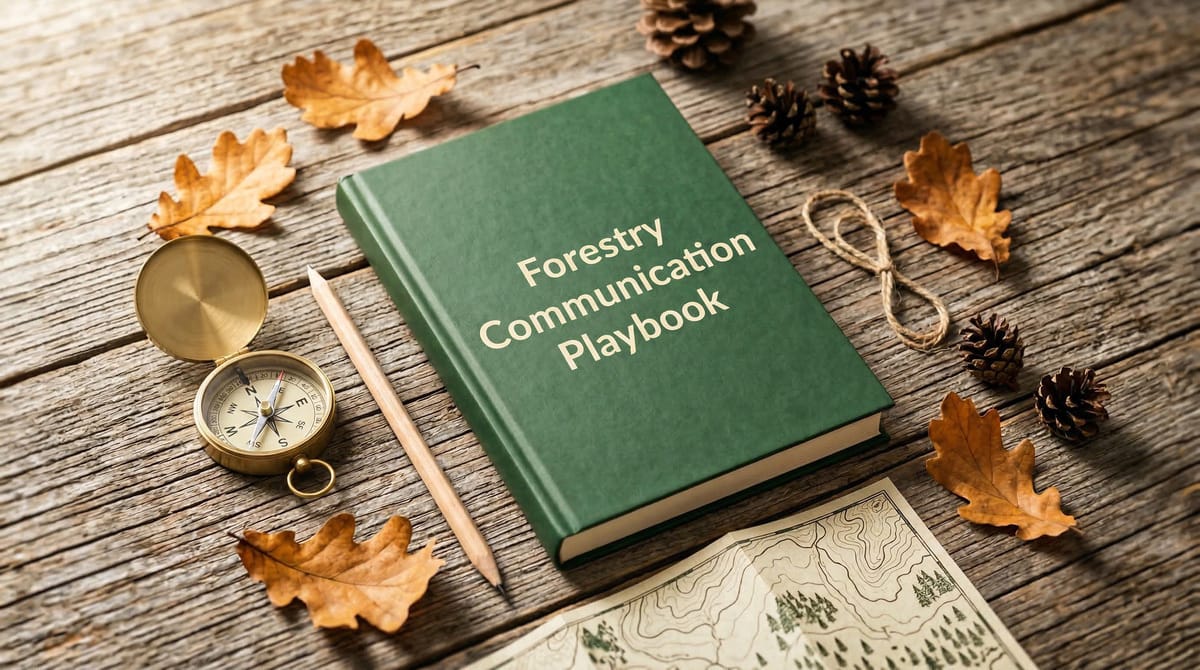
📖 The Forestry Communication Playbook
"So foresters take EU money for tractors that plough fields?"
You may hear it after a headline like this week's. From a neighbour, a council member, or a reporter. The honest answer is short. One case is going to court. Everyone is presumed innocent until a judge decides.
Saying that calmly, without defending or blaming anyone, takes practice.
Part 1 covers the questions that arrive without warning.
📗 The Forest-Investment Dictionary
A contract is a price and a promise. Both have a value.
A tolerance band and a penalty clause change what a timber contract is worth. Investors call it counterparty risk. Foresters call it a bad March. Same line, two languages.
I wrote the Forest-Investment Dictionary with Danish forest economist Anders Tærø Nielsen. It has 151 pages, 11 chapters, 14 printable tools, and 3 calculators. Investors learn to read a forest. Foresters learn to read a term sheet.
When the market turns, the people who can read the numbers make the better calls. The price is €99. Get yours below.

📘 The Organization — Playbook Part 3
Seven organisations, one letter. Someone had to write it.
A joint appeal looks simple from outside. Inside, someone drafts it, checks the numbers, and collects seven sign-offs. Part 3 is about who in your organisation does that work. And whether they have the time.
I wrote The Organization, Part 3 of the Playbook. It has 165 pages, 10 chapters, 10 printable tools, and a survey. It shows what it takes to be heard, and who does the work.
Almost nobody in European forestry publishes what communication costs. The survey inside starts the count. The price is €149. Get yours below.

🤝 ForestryBriefing
The brief is free. The briefing is not.
ForestryBrief publishes verified intelligence — free, three times a week, in 25+ countries. When you need that intelligence applied to your specific situation, that's a ForestryBriefing.
Intelligence — Investment due diligence, market intelligence, EUDR compliance, cross-sector risk analysis, background verification in three languages.
Communication — Strategy, trade publication articles, stakeholder messaging, newsletters that people actually open. EN | DE | HU.
Live — Conference presentations, panel moderation, keynotes. Most recent: WAN-IFRA World Printers Summit, Rotterdam, October 2026.
First briefing guarantee: if it doesn't deliver intelligence you can act on, you don't pay.
Until Thursday!
Wish you all the best: Peter
🤝 Need help with forestry communication, intelligence, or due diligence? See what we offer → ForestryBriefing
📩 Got this email forwarded to you? Subscribe to ForestryBrief here.
📚 Missed an issue? Browse the ForestryBrief archive
P.S. What’s the biggest challenge you’re facing in forestry right now?
Hit reply and let me know — I read every message personally.
P. P. S. Know a forest professional who’s drowning in EUDR complexity or missing out on timber market shifts? Forward this email to them!
Independent since issue one. Read the charter.
Shauna Matkovich's Forest Invest Podcast is one of the best resources for understanding where forest finance is heading. If you are interested in Forest Investments, start there.
If you like FB be sure to subscribe to Boreal Tech Brief, a newsletter of my friend Axel covering tech in forestry with a Nordic angle:
