
Hello,
I'm writing this from Rotterdam. Yesterday I spoke at the WAN-IFRA World Printers Summit. Rotterdam or Tata, the Pulse goes out on Tuesday.
Last week, a Swedish land sale went around the world. Headlines called it forest, and cheap. The seller calls it mostly bare mountain and forest near the mountains. Both can be true. It depends on how you count.
Here's what's moving European forestry this week:
🔍 The Big Story
15,000 hectares changed hands in Sweden. Read the land before the price.
What happened
Swedish forest company SCA has sold about 15,000 hectares of land. It lies near Storsjö Kapell, in Bergs kommun, Jämtland county. That is about 2.6% of the whole municipality, SVT reports.
The buyer is Cladonia Skog AB. Its beneficial owner is Alex Karp, CEO of the US software company Palantir. A beneficial owner is the person who really owns a company.
SVT puts the price at 240 million kronor, citing SCA. Other media reported 235 million. The local paper Tidningen Härjedalen was first to report it, SVT says. Within days it was in Fortune.
What the land is
SCA press officer Robert Östholm described the land to SVT. It is "mostly bare mountain and forest near the mountains" (my translation). SCA wrote to the hunting teams in July. It gave its reason for selling, SVT reports. The forest was not seen as "optimal from a forestry point of view" (my translation).
The productive share has not been disclosed, Dagens PS notes. Skogsstyrelsen sets the bar. Productive forest land can grow at least 1 m³ of wood per hectare a year. I found no published standing volume either.
The arithmetic, and the trap
240 million kronor over 15,000 hectares is about 16,000 kronor per hectare. One Swedish business site set its own figure against Skogsstyrelsen's 2025 average for Södra Norrland. That region includes Jämtland. The average was 62,700 kronor per hectare. So the deal looked like a quarter of the regional average.
The arithmetic is fine. The two numbers measure different land.
Skogsstyrelsen's average covers productive forest land without harvesting limits. The deal price divides by every hectare sold, bare mountain included.
Swedish forest is also priced by standing volume. Ludvig & Co, a Swedish forest estate agency, tracks that price. Northern Sweden stood at 329 kronor per m³sk in the first half of 2026. That is 4.1% down on the previous year. m³sk measures the stem above the stump, with bark and top but without branches.
How the permit worked
In parts of rural Sweden, buying land needs a permit. The county board grants it. The county board in Jämtland granted the permit on 9 September, SVT reports. SVT also gives the grounds.
The sale was between two companies, SVT explains. The land purchase law protects a balance between land owned by people and by companies. A sale between two companies does not shift it. The board found no negative effect on jobs or housing.
The board posted the application online for three weeks. No one filed an interest in buying the land.
The deal also needed a permit from ISP, Sweden's foreign-investment screening agency, SVT reports. ISP cites secrecy and will not even confirm it has the case.
Two hunting teams lost their hunting rights this autumn, SVT reports. SCA's Östholm told Fortune: "we can of course no longer grant hunting rights on it."
Why this matters for European forestry
In #119 we covered Sweden's land price series. The national average was about 92,000 kronor per hectare in 2025.
Averages are useful. They only work when you compare like with like. A hectare is a unit of area. It is not a unit of value.
My read, and it is a read rather than a finding: without the standing volume, the public figures cannot show if it was cheap. This price per hectare tells you about the land mix. It tells you little about the market.
What this means for you
If you own forest: know your split. Productive land, poor land, open land. Know the standing volume too.
If you invest: ask for productive area and standing volume first. Then look at the price per hectare (I can help you with that, see below).
If you sell land: say up front what each hectare holds. It makes your price easier to read.
If you speak for forestry: expect "Was it cheap?" The honest answer: it depends what grows there.
The useful part
Part of the process was public. A county permit, three weeks of public notice, and no other interest filed. The foreign-investment check is confidential. The number to read carefully is the price per hectare. Read the land first. Sources: SVT Jämtland, 28 September 2026 | SVT Jämtland, 29 September 2026 | Fortune, 30 September 2026 | Dagens PS, 27 September 2026 | Skogsstyrelsen, quality declaration (method), forest land prices 2025 | Skogsstyrelsen, definitions | Ludvig & Co, 2 July 2026 | prior ForestryBrief coverage: EFP #119
📊 Quick Hits
1. 🇸🇪 Stora Enso plans to stop making CLT at Gruvön. Nothing is decided yet.
On 29 September, Stora Enso announced change negotiations at its Gruvön site in Sweden. If the plan goes ahead, CLT production there ends by the end of 2026. CLT is cross-laminated timber. Board layers are glued crosswise into large building panels.
About 220 employees are covered by the talks. The plan would affect at most 80 positions. The company says no decisions come before the talks end.
Stora Enso names three reasons. Market growth was slower than expected. Wood costs rose. CLT has relatively high fixed costs.
The sawmill keeps running. Nordic CLT customers would get panels from Ždírec in Czechia, and Ybbs and Bad St. Leonhard in Austria.
On 5 October, Woodnet reported the talks under way. It quoted Håkan Johansson, chair of the GS union. He said Stora Enso's proposal now affects fewer positions. No new figure was published.
The context: In #123 I covered Stora Enso closing its Veitsiluoto sawmill in Finland. That was a sawmill. This plan is about a product line after the saw.
Why it matters: Wood costs are one of the reasons Stora Enso gives. The company says the plan does not change wood use in its Skoghall business unit.
The takeaway: Buying CLT in the Nordics? Ask where your 2027 panels will come from. Stora Enso reports its third quarter on 30 October. Source: Stora Enso, 29 September 2026 | Woodnet, 5 October 2026 | Stora Enso, financial calendar
2. 🇵🇹 Portugal's environment ministry says it approved two more forest carbon methods.
On 4 October, Portuguese media reported a decision by the Ministry of Environment and Energy. It approved two new methodologies for the national Voluntary Carbon Market. A methodology is the rulebook for counting a project's carbon. One covers reforestation, meaning forest re-established on land that had forest before. The other covers improved forest management.
The market already had one for new afforestation. Now it has three for forests. The ministry also gave figures. Two afforestation projects are registered. A third is in initial validation.
977 credits are offered for sale. The market has 29 registered users and 10 qualified verifiers.
Minister Maria da Graça Carvalho explained the goal. More owners and companies should be able to invest in forests and climate action. The ministry wants to "create conditions" for that (my translation).
Why it matters: The improved forest management method is meant to reach existing forests, not only new planting. No price or completed sale has been disclosed. The official platform still lists both methods as in consultation. That ran from 5 May to 3 June. No final approved document is posted there yet.
The takeaway: Managing forest in Portugal? Ask a qualified verifier what validation costs before you plan a project. Source: Dinheiro Vivo, 4 October 2026 | Jornal Económico, 5 October 2026
3. 🇦🇹 Austria's sawlog index eased again. It is still above last year's record.
The Austrian sawlog price index fell for the second quarter in a row. Timber-Online reported it on 2 October. It stood at 178.8 points in the third quarter of 2026. The base is 100 points, in the first quarter of 2009.
In the fourth quarter of 2025, it hit 177.6 points. That was a record at the time, in a series running since 1973. After two quarterly falls, it is still 1.2 points above that former record.
The Vienna University of Economics and Business calculates it for Land&Forst Betriebe Österreich.
Tirol also publishes monthly prices. Spruce sawlogs, grade B/C, size 2a–3b, averaged €125.15 per solid cubic metre in September. That came from 3,193 m³ in 21 sales.
August was €124.55. September 2025 was €117.82.
The context: In #120 I reported Carinthia's spruce sawlog guide prices at €121 to €125 in August. Those are guide prices, not sale averages.
Why it matters: An index easing from a record is still a high index. Tirol's September price is above a year ago.
The takeaway: Selling spruce logs in Austria? Check an offer against your province's latest monthly price, not the quarterly headline. Source: Timber-Online, 2 October 2026 | Timber-Online, 8 January 2026 | Timber-Online, January 2025 (index base) | Fordaq, 2 October 2026 (Land Tirol data) | Land Tirol, monthly index | Land Tirol, price method
📅 The Weeks Ahead
October: EUDR Information System training. Upstream operators: 6, 13 and 22 October, 14:00 CEST. Micro and small primary operators: 8 and 15 October, 14:00 CEST, and 27 October, 14:00 CET. Register here
Until Fri 9 October: Article 6.4 Supervisory Body, 23rd meeting — Bonn
Wed–Thu 7–8 October: 19th European Congress EBH, efficient building with wood — Cologne | RFSI Forum — Denver
Thu 8 October: German Bundestag plans to refer the EUDR implementing bill to its agriculture committee. See #126
Mon 12 October: ATIBT call for service providers closes, 17:00 (EU-funded, Congo domestic timber)
Tue–Wed 13–14 October: CIFB London: Corporate Investments into Forestry & Biodiversity — London
Tue 13 October: Timber in Construction 101: Onsite Excellence — Timber Development UK, online
Wed 14 October: Verra expands its project review prioritization pilot to registration and all verification requests
Thu 15 October: Metsä Group owner-member campaign closes (one-year pulpwood price guarantee)
Thu–Sun 15–18 October: INTERFORST 2026 — Munich
Mon–Fri 19–30 October: COP17 Biodiversity — Yerevan, Armenia
Tue–Wed 20–21 October: Global Bioeconomy Summit 2026 — Dublin
Thu 22 October: US Softwood Lumber Board rule takes effect for net-size lumber imports. See #125
Wed–Thu 28–29 October: International Softwood Conference — Malahide, Dublin
Fri 30 October: Stora Enso third-quarter report. See Quick Hit 1
Tue 3 November: Bergslagets Skogar Capital Markets Day — Stockholm
Wed 4 November: TDUK Global Market Conference — London
Thu–Fri 5–6 November: 🌳 11th International Hardwood Conference — Antwerp
Mon–Thu 9–12 November: ITTC 62 — Yokohama (ITTO)
Tue 10 November: BiodivFuture pre-proposals due, 12:00 CET (Biodiversa+)
Wed 11 November: 📌 European Commission deadline for a final decision on the UPM/Sappi joint venture (Case M.12270)
Wed–Thu 11–12 November: Puupäivä — Helsinki (Puuinfo)
Wed 25 November: Forest Bioeconomy Investment Accelerator (FBIA) 2026 final event — EIB, Brussels (by invitation)
Fri 27 November: Timber and Circular Economy CPD — online and free (PEFC via TDUK)
Mon 30 November: Södra's temporary birch premium window closes. See #126
Tue 1 December: SMURF Carbon Standard consultation closes, 17:00 CET
Wed 2 December: FOREST Partnership first joint call: pre-proposals due, 13:00 CET (up to €40 million)
Wed 30 December: EUDR applies to large and medium operators, and to micro and small operators already covered by the EU Timber Regulation
Wed 30 June 2027: EUDR applies to the remaining micro and small operators
💡 One Thing to Try This Week
Split your hectares before you price them.
A price per hectare only means something when you know what the hectares are. Do this once for your own land.
Open your forest plan or property register.
Sort the area into three groups. Productive forest. Poor or low-yield land. Open land, such as bog, rock or mountain.
Write down the standing volume on the productive part.
Divide any price or valuation by productive hectares. Then divide it by cubic metres.
Compare only with averages that count the same thing. Check what your national statistic includes.
Your country may use different land classes. The idea works anywhere.
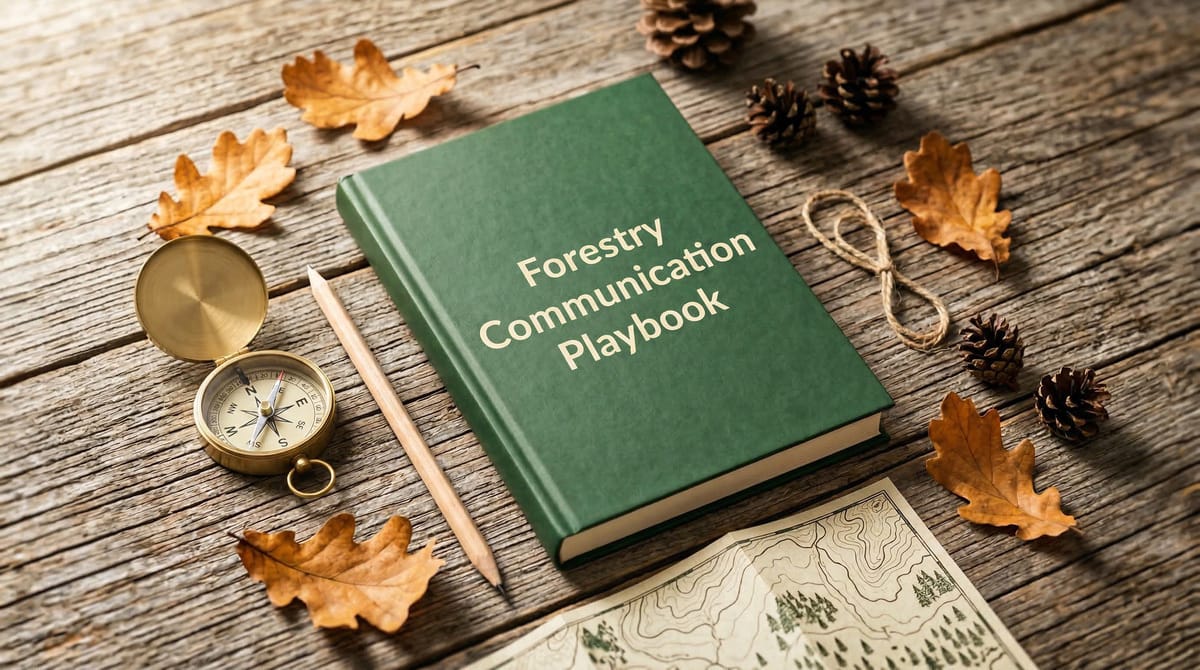
📖 The Forestry Communication Playbook
"So a billionaire bought our forest for a quarter of the price?"
You may hear it this week. At the shop, at a council meeting, or from a reporter. The honest answer is short. Much of the land is bare mountain. The county board checked jobs and housing. Nobody else filed an interest in buying.
Saying that calmly, without defending anyone, takes practice. Part 1 covers the questions that arrive without warning.
📗 The Forest-Investment Dictionary
A price per hectare is only as good as the hectare.
Area is the container. The value sits in what grows on it. Price the productive land and the standing volume first. Then look at the hectares.
I wrote the Forest-Investment Dictionary with Danish forest economist Anders Tærø Nielsen. It has 151 pages, 11 chapters, 14 printable tools, and 3 calculators. Investors learn to read a forest. Foresters learn to read a term sheet.
When the market turns, the people who can read the numbers make the better calls. The price is €99. Get yours below.

📘 The Organization — Playbook Part 3
A plan is announced. The decision comes weeks later. Who speaks in between?
Negotiations leave a gap. Staff, buyers and neighbours ask questions before anyone can answer them. Part 3 is about who in your organisation carries that gap. And whether anyone planned for it.
I wrote The Organization, Part 3 of the Playbook. It has 165 pages, 10 chapters, 10 printable tools, and a survey. It shows what it takes to be heard, and who does the work.
Almost nobody in European forestry publishes what communication costs. The survey inside starts the count. The price is €149. Get yours below.

🤝 ForestryBriefing
The brief is free. The briefing is not.
ForestryBrief publishes verified intelligence — free, three times a week, in 25+ countries. When you need that intelligence applied to your specific situation, that's a ForestryBriefing.
Intelligence — Investment due diligence, market intelligence, EUDR compliance, cross-sector risk analysis, background verification in three languages.
Communication — Strategy, trade publication articles, stakeholder messaging, newsletters that people actually open. EN | DE | HU.
Live — Conference presentations, panel moderation, keynotes. Next: WAN-IFRA World Printers Summit, Rotterdam, October 2026.
First briefing guarantee: if it doesn't deliver intelligence you can act on, you don't pay.
Until Thursday!
Wish you all the best: Peter
🤝 Need help with forestry communication, intelligence, or due diligence? See what we offer → ForestryBriefing
📩 Got this email forwarded to you? Subscribe to ForestryBrief here.
📚 Missed an issue? Browse the ForestryBrief archive
P.S. What’s the biggest challenge you’re facing in forestry right now?
Hit reply and let me know — I read every message personally.
P. P. S. Know a forest professional who’s drowning in EUDR complexity or missing out on timber market shifts? Forward this email to them!
Independent since issue one. Read the charter.
Shauna Matkovich's Forest Invest Podcast is one of the best resources for understanding where forest finance is heading. If you are interested in Forest Investments, start there.
If you like FB be sure to subscribe to Boreal Tech Brief, a newsletter of my friend Axel covering tech in forestry with a Nordic angle:
