
Hello,
Sweden's forest agency published two price series this year. One reached the highest level in the history of the series. The other fell across every single assortment.
Both are correct. They measure two different things. The gap between them is the most useful number in European forestry right now.
Here's what's moving European forestry this week:
🔍 The Big Story
Sweden's own forest agency published two price series. They point in opposite directions.
What happened
Skogsstyrelsen, the Swedish Forest Agency, published its forest land price statistics for 2025. The national average reached SEK 92,000 per hectare. That is up SEK 4,500 on 2024, or just over 5%. It is the second yearly rise in a row. Prices fell in 2023, then recovered in 2024, then rose again.
It also passes the previous high of the series. That was SEK 90,700 in 2022. The series runs back to 1999. The same agency also publishes roundwood prices. Its second quarter 2026 figures went the other way.
Assortment | SEK per m³sub | Change on Q1 2026 |
|---|---|---|
Scots pine sawlogs | 855 | −12% |
Norway spruce sawlogs | 1,059 | −9% |
Coniferous pulpwood | 566 | −8% |
Broadleaved pulpwood | 561 | −6% |
Fuelwood | 450 | −5% |
Delivery timber fell too. Sawlogs dropped 7% and pulpwood 8%, nationally.
Read the small print first
Four things belong with those numbers. Skip them and you will draw the wrong conclusion.
The periods are different. The land price covers calendar year 2025. The roundwood price covers the second quarter of 2026. These are not the same moment. Do not read them as one.
Both are calculated figures. The agency states plainly that its roundwood prices do not represent the prevailing market price during the quarter.
The land price is not a forest-only sale price. It is the purchase price, multiplied by the forestry share of assessed value, divided by the forest land area.
The property mix changes every year. The agency warns that area, number of sales and forest condition all vary. That alone moves the average.
Nobody here is hiding anything. Two honest official series measure two different things. That is the whole point.
The proof is in the size classes
The strongest number is not the national average. It is the spread by property size.
Properties of 1 to 5 hectares average SEK 124,400 per hectare.
Properties over 100 hectares average SEK 49,900 per hectare.
Per hectare, the smallest properties cost about two and a half times the largest.
Small properties do not grow better trees. They do not have lower costs. Per hectare, they usually have higher ones. Whoever pays SEK 124,400 a hectare for four hectares is not buying cash flow. They are buying something else. Access to a neighbouring block. A place to hunt. A house with woods behind it. A place to put money.
The regional spread says the same thing. Götaland in the south averages SEK 144,500. Northern Norrland averages SEK 42,700. Since 1999, Götaland has gained around SEK 110,000 per hectare. Northern Norrland has gained around SEK 33,000. That gap has widened for 26 years. Most purchases happen in Götaland, then Svealand. Fewest happen in Southern Norrland.
What this means for you
If you own forest: your balance sheet and your income statement are moving apart. One is not a proxy for the other.
If you are selling: the buyer for four hectares and the buyer for 400 hectares are different people doing different maths. Price the block for the buyer it will actually attract.
If you are buying: a falling timber price is a cash flow event. It is not automatically a discount on land.
If you value or lend against forest: ask which series the valuation leans on, and over what period. Two defensible numbers can sit a long way apart.
The part nobody says out loud
Timber income and land value have never been the same thing. We just usually get to pretend they are, because they move together. Sweden has now shown a year where they did not. Same country. Same agency. Opposite directions.
That is a good problem to have. Forest land is being priced as an asset, not just a wood factory. More reasons to own forest means more owners, and more capital coming in. The work now is different. It is making sure the people who grow the wood get paid properly for it. Sources: Skogsstyrelsen — Price of forest land in 2025 | Skogsstyrelsen — Lower prices on roundwood during second quarter of 2026 | Skogsstyrelsen — Facts on the statistics on prices for productive forest land
📊 Quick Hits
1. 🇪🇺 The EUDR system got a new release. Grouping is now live.
The European Commission has deployed release 8.2.1 of the EUDR Information System. Its Deforestation Team announced it in a newsletter on 4 September.
The release is live on both the acceptance and the production servers.
Four things are new:
a voluntary grouping function, in the interface and through the API
versioning for Simplified Declarations, in the interface and through the API
new functionality for all user roles
stronger multi-operator authentication through the API
Why it matters: This is the plumbing, not the policy. Most EUDR coverage argues about the rules. The system is where you will actually spend your hours.
Both new functions are workload items. Grouping lets you handle declarations together instead of one at a time. Versioning means a Simplified Declaration can be corrected rather than replaced.
The takeaway: EUDR applies to large and medium operators, and to all timber-sector operators, on 30 December 2026. Log in well before then. Find out what your role can and cannot do in release 8.2.1. Deadlines are met in software, not in press releases. Sources: European Commission — ENV Deforestation newsletter, 4 September 2026 | European Commission — EUDR Release Notes 8.2.1 (PDF)
2. 🇩🇪 German wood industry wants transition relief before EmpCo lands.
Two German trade bodies have asked for clearer transition treatment under the EU EmpCo Directive. They are DHWR and GD Holz.
Their concern is stacking. EmpCo, EUDR and PPWR all land on the same companies. The specific request is about goods that were already produced before the rules apply. EmpCo applies on 27 September 2026, later this month. From that date, generic green claims become unlawful.
Why it matters: "Generic green claims" is broader than it sounds. It covers words like environmentally friendly, climate neutral or eco, used without proof. Wood sells on exactly that ground. A lot of packaging, labels and brochures were written before this rule existed.
The takeaway: Pull your last three brochures and your product pages this week. Circle every environmental word. If you cannot show the evidence behind a word, you have until 27 September to change it or prove it. Source: Fordaq — German wood industry seeks changes to EmpCo transition rules
3. 🇫🇮 Swine fever blocked 600,000 m³ of Finnish harvesting. Most of it is moving again.
On 1 September, African swine fever controls stopped forestry work in southeastern Finland. Around 600,000 cubic metres of harvesting was at risk. Metsälehti estimated nearly €30 million of forest-owner stumpage revenue at risk.
On 8 September the restrictions were eased. Finland now allows forestry work outside the core zone. Logging can restart across much of the controlled zone. One condition stays. Forestry machines leaving the area must be washed and disinfected.
Why it matters: African swine fever is an animal disease. It has nothing to do with trees. It still stopped the harvest. That is the lesson here. The whole arc took eight days.
The takeaway: Your risk register probably lists storms, fire, beetles and price. Add the category this belongs to: rules written for a neighbouring sector that stop your machines. Then ask your contractor what their washing and disinfection capability actually is, before you need it. Sources: Fordaq — African swine fever disrupts forestry operations in Finland | Fordaq — Finland eases restrictions to allow forestry operations
📅 The Weeks Ahead
Until Friday, September 11, 2026: Drema — Poznań, Poland
Until Friday, September 11, 2026: Article 6.4 methodology panel — Bonn (reversal-risk assessment tool on the agenda)
Thursday, September 10, 2026: IUCN WCPA survey on AI in conservation closes | ART TREES Validation and Verification Standard v3.0 introductory webinar
Ongoing: EUDR Information System virtual training sessions — new dates published on the Commission implementation page
Ongoing to late September: EUDR Delegated Act two-month scrutiny period (European Parliament and Council)
Expected Q3 2026: European Commission adoption of the revised EU Taxonomy Climate and Environmental Delegated Acts (advisory target, not a binding deadline)
Wednesday–Friday, September 16–18, 2026: EFI Annual Conference — Växjö, Sweden (European Forest City 2026)
Thursday, September 17, 2026: Luke publishes next roundwood trade release (Finland)
Monday, September 21, 2026: Isometric low-carbon cement protocol consultation closes
Tuesday, September 22, 2026: CINEA LIFE Calls 2026 — Standard Action Projects deadline | SoEF 2025 webinar — "How much deadwood is enough? Biodiversity and forest management in Europe", 12:00–13:00 CEST
Thursday–Saturday, September 24–26, 2026: APF Exhibition 2026 — Ragley Estate, Warwickshire, UK
Sunday, September 27, 2026: EU EmpCo Directive applies — generic green claims become unlawful
Wednesday–Thursday, September 30 – October 1, 2026: Forisk Timber Market Analysis class — virtual
Thursday, October 1, 2026: Japan Ministry of the Environment nature-finance guidelines pilot closes for applications
🔴 Sunday–Tuesday, October 4–6, 2026: WAN-IFRA World Printers Summit — Rotterdam (I present on October 5)
Monday, October 5, 2026: Verra VM0033 blue-carbon consultation closes
Wednesday–Thursday, October 7–8, 2026: 19th European Congress (FOGE) — Cologne, Germany | RFSI Forum — Denver
Friday, October 9, 2026: PEFC consultation on the revised Vietnam Forest Certification Scheme closes
🔴 Tuesday–Wednesday, October 13–14, 2026: CIFB London: Corporate Investments into Forestry & Biodiversity — London, UK
Thursday, October 15, 2026: Metsä Group campaign closes
Thursday–Sunday, October 15–18, 2026: INTERFORST 2026 — Munich (quadrennial forestry technology trade fair)
During October 2026: Article 6.4 Supervisory Body decision on reversal risk expected
Tuesday–Wednesday, October 20–21, 2026: Global Bioeconomy Summit 2026 — Dublin, Ireland
Tuesday, November 3, 2026: Bergslagets Skogar Capital Markets Day — Stockholm
Wednesday, November 4, 2026: TDUK Global Market Conference — London
🌳 Thursday–Friday, November 5–6, 2026: 11th International Hardwood Conference — Antwerp (ATIBT)
📌 Wednesday, November 11, 2026: European Commission deadline for a final decision on the UPM/Sappi joint venture (Case M.12270)
Wednesday–Thursday, November 11–12, 2026: Puupäivä — Helsinki (Puuinfo)
Wednesday, November 25, 2026: FBIA 2026 final event, EIB Brussels (by invitation)
Wednesday, December 30, 2026: EUDR applies to large and medium operators, and to all timber-sector operators
Friday, January 1, 2027: Revised EU Taxonomy technical screening criteria expected to apply
During 2027: Commission guidance and portal on integrated wildfire risk management due
Wednesday, June 30, 2027: EUDR applies to micro and small operators outside the timber sector
Thursday, July 17, 2031: FRM Regulation (EU) 2026/1392 applies
💡 One Thing to Try This Week
Value your land and your standing timber separately. Then look at the gap.
Take one property. Write down its area in hectares.
Find a land price benchmark for your region and your size class. Your national agency, a land agent, or a recent local sale will do. Multiply by your hectares. That is your land number.
Now value the trees. Volume by assortment, times today's price, minus harvesting cost. That is your timber number.
Write both numbers side by side. Write the date of each one next to it.
Look at the gap.
If the land number is much bigger, you own an asset that happens to grow wood. If the timber number is much bigger, you own a crop that happens to sit on land.
Those two things need different decisions, different timing and different buyers. Most owners have never separated them.
Ten minutes. Two numbers. It changes what you do next.
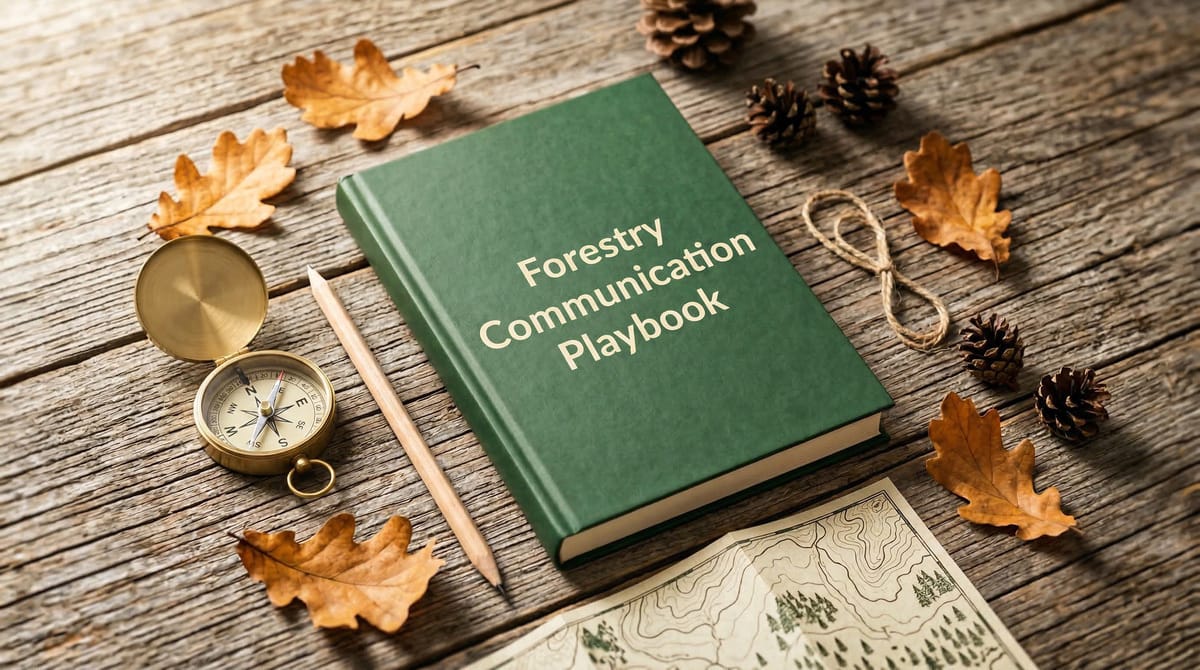
📖 The Forestry Communication Playbook
"Forest land is at a record price. So why do you keep saying forestry doesn't pay?"
Someone will put this to you. A journalist, a councillor, or your brother-in-law over Sunday lunch. The hard part is that both halves of the question are true. The land is worth more. The wood is worth less. Saying so without sounding evasive is a skill.
You have thirty seconds and no notes. What do you say?
📗 The Forest-Investment Dictionary
Land value and timber value are two separate inputs. A falling timber price does not automatically mean a falling asset.
Most valuations blend the two into one number. That works fine until they move apart. Sweden has just published a year where they did.
I wrote the Forest-Investment Dictionary with Danish forest economist Anders Tærø Nielsen. It has 151 pages, 11 chapters, 14 printable tools, and 3 calculators. Investors learn to read a forest. Foresters learn to read a term sheet.
When the market turns, the people who can read the numbers make the better calls. The price is €99. Get yours below.

🤝 ForestryBriefing
The brief is free. The briefing is not.
ForestryBrief publishes verified intelligence — free, three times a week, in 25+ countries. When you need that intelligence applied to your specific situation, that's a ForestryBriefing.
Intelligence — Investment due diligence, market intelligence, EUDR compliance, cross-sector risk analysis, background verification in three languages.
Communication — Strategy, trade publication articles, stakeholder messaging, newsletters that people actually open. EN | DE | HU.
Live — Conference presentations, panel moderation, keynotes. Next: WAN-IFRA World Printers Summit, Rotterdam, October 2026.
First briefing guarantee: if it doesn't deliver intelligence you can act on, you don't pay.
Until Thursday!
Wish you all the best: Peter
🤝 Need help with forestry communication, intelligence, or due diligence? See what we offer → ForestryBriefing
📩 Got this email forwarded to you? Subscribe to ForestryBrief here.
📚 Missed an issue? Browse the ForestryBrief archive
P.S. What’s the biggest challenge you’re facing in forestry right now?
Hit reply and let me know — I read every message personally.
P. P. S. Know a forest professional who’s drowning in EUDR complexity or missing out on timber market shifts? Forward this email to them!
Shauna Matkovich's Forest Invest Podcast is one of the best resources for understanding where forest finance is heading. If you are interested in Forest Investments, start there.
If you like FB be sure to subscribe to Boreal Tech Brief, a newsletter of my friend Axel covering tech in forestry with a Nordic angle:
