
Hello,
On Monday, a French banking group opened a new division. Forests come first.
It also launched a forest fund. Its target is €200 million. Two small words sit right after it.
Before we get there, one note about this newsletter.
ForestryBrief now has a published Editorial Independence Charter. It sets out how I earn money. It also says what that money does not buy.
Rule 5 says corrections run in the next issue. Here is one that predates the charter. In issue #122, a Quick Hit said Part 3 of the Playbook has 166 pages. It has 165. The product block in the same issue had it right.
Here's what's moving European forestry this week:
🔍 The Big Story
A French bank put forests first. The €200 million is a goal, "over time".
What happened on Monday
On 28 September, Crédit Agricole launched a new division. It is called Crédit Agricole Capital Naturel.
It pulls together the group's business lines and retail banks. It offers advice, financing, insurance and investment. It also helps structure projects. Forests come first. In the bank's words, "the forest sector will be the first active vertical for this new division."
A vertical is a business line built around one sector. Timothée Jaulin heads the division.
The bank says it will widen the scope to water and biodiversity from 2027.
Why the bank says it is doing this
The release gives its reasons in two numbers.
"In France, nearly 670,000 hectares of forests are affected by decay phenomena, while the carbon absorption capacity of French forests has decreased by 24 million tonnes per year over the past two decades."
Those are the bank's own figures.
Grégory Erphelin is Deputy General Manager of Crédit Agricole S.A. He put the bigger idea in one line. "Natural capital is the foundation of economic activity and regional resilience."
The fund, and the two words after the number
Amundi, the group's asset manager, launched a fund called Amundi Arbora Nova. It is for institutional investors. These are large investors such as pension funds and insurers.
It will invest in forest restoration and reforestation projects in France and Europe. It covers afforestation: planting trees on land bare for at least ten years. It also covers reforestation: replanting severely degraded plots.
Now the sentence that matters. "The fund's objective is to mobilise €200 million over time."
Over time. An objective is a goal. It is not money raised.
The release names no investors and no first close. A first close is when a fund's first investor commitments become binding.
EcoTree: talks, not a deal
The division "will draw on the expertise of EcoTree". The bank describes EcoTree as a developer and operator of nature-based solutions. Crédit Agricole S.A. "has entered into exclusive negotiations with a view to acquiring a majority stake." The release does not announce a signed or completed deal.
Why this matters for European forestry
Forests are the first focus of a new natural-capital division at a large European bank. That is a real signal. One large bank group now has a team, a leader and a fund for forests.
It is also early. Today there is a division, a named leader, a fund with a goal, and talks. Both things are true. Read the launch for what it is.
What this means for you
If you own forest in Europe: the division says it will support forest owners. The release gives no terms for landowners yet. Ask for them first.
If you invest in forests: read fund news in three steps. Target, committed, deployed. The release discloses a target, but no committed or deployed money. Checking the step is basic due diligence (I can help you with that, see below).
If you run a nursery or a planting crew: restoration projects need both. This is a name to watch.
If you speak for a forestry organisation: expect questions about banks and forests. Keep the answer precise. A division launched. A fund has a goal. Talks are under way.
The useful part
Three things will show whether this becomes real money for forests. A first close for Arbora Nova. A first named project. The outcome of the EcoTree talks. The division, the leader and the fund launch are in place. The release names no committed or deployed amount.
Forests are first in line at a new natural-capital division. That is good news, as long as we all read the numbers the same way. Sources: Crédit Agricole, press release, 28 September 2026 | ESG Today, 28 September 2026
📊 Quick Hits
On 23 September, Dutch police and the authority NVWA reported a seizure. NVWA oversees food and product safety. They took more than 375 tonnes of azobé, a tropical hardwood. That is 16 truckloads.
The wood came in two shipments for an importer in the north of the Netherlands. Belgian Customs held both in the port of Antwerp, at the Dutch prosecutor's request. NVWA says the importer is suspected of bringing in hardwood from Gabon. The suspicion is that the wood cannot be shown to be legally cut.
In May, investigators searched two business premises and a home. A criminal investigation is under way, led by the Dutch prosecutor's office. The company is not named. The release reports no conviction or final finding. NVWA places the case under the EU Timber Regulation.
Why it matters: The EUDR applies from 30 December. Until then, the EU Timber Regulation is enforced. NVWA notes that the Timber Regulation passes into the EUDR on that date.
The takeaway: If you import tropical hardwood, your due diligence file is evidence today. Not in December. Source: NVWA, 23 September 2026
2. 🇺🇸 From 22 October, the US lumber levy counts European boards differently.
The US Department of Agriculture published a final rule on 22 September. It takes effect on 22 October. It concerns the Softwood Lumber Board levy. This is a US industry promotion fee, not a tariff.
The rate stays at $0.41 per thousand board feet, counted on nominal size. The rule clarifies how volume is counted. Nominal size is a board's size when first cut, before drying and planing. Net size is what is left after.
Lumber declared in net size gets a conversion factor of 1.503. That works out at $0.62 per thousand board feet. The rule says it plainly. "Importers of softwood lumber from European countries will primarily be affected."
Why it matters: European lumber is often measured in net size. The cost per board is small. No importer pays on its first 15 million board feet a year. Smaller importers are fully exempt.
The takeaway: If you ship lumber to the US, check how your invoices state volume. Talk to your importer before 22 October. Source: Federal Register, final rule 2026-19389, 22 September 2026
3. 🇪🇺 EU area burned: below 2025, but 91% above the 20-year average.
By 23 September, fires had burned 678,978 hectares in the EU this year. That is the count from the EU's Joint Research Centre. It covers fires larger than 30 hectares. EFFIS counts prescribed and controlled burns too. The JRC may refine the figures as better satellite images arrive.
By the same date in 2025, the figure was 1,026,104 hectares. The JRC calls 2025 the worst year on record. This year still "exceeds the long-term average of the last 20 years (2006–2025) of 355 397 ha." By my arithmetic, that is 91% above it.
In issue #104, I reported 155,569 hectares burned by 8 July.
Why it matters: Burned area is an early signal. Salvage, replanting and insurance questions follow it. A better year than 2025 is still well above the long-run average.
The takeaway: When someone calls 2026 a quiet fire year, show them the 20-year average. Source: JRC, Current wildfire situation in Europe, updated 24 September 2026
4. 🇫🇮 In Finland, young-stand work now comes with a fixed price.
On 11 September, Metsä Group announced fixed pricing for young stand management across Finland. The rollout runs nationwide during September.
It covers early cleaning and pre-commercial thinning. That is the work of thinning young, crowded stands so the best trees can grow. An AI application sets the price. It uses satellite images, map data and data from sites already completed. It calculates the workload for each site. The price "will not change after the work has been carried out."
Olli Leino, SVP Development, Wood Supply and Forest Services, sums it up. "The customer experience remains good when the final price of the work is known from the offer stage onwards."
Why it matters: Metsä says the owner gets the final price at the offer stage. By Metsä's count, its cooperative has about 90,000 forest owners. They own about half of Finland's private forests.
The context: In #99 I covered Metsä's AI in wood buying. This one prices forest work, not wood.
The takeaway: Wherever you own forest, ask for a fixed price before young-stand work. If the answer is no, ask what the price depends on. Source: Metsä Group, press release, 11 September 2026
📅 The Weeks Ahead
October: EUDR Information System virtual training. Upstream operators: 6, 13 and 22 October, 14:00 CEST. Micro and small primary operators: 8 and 15 October, 14:00 CEST. And 27 October, 14:00 CET. Dates and registration on the Commission training page
In force 18 September 2026: EUDR product-scope Delegated Regulation (EU) 2026/2102. The three newly added product groups apply from 30 December 2027
Tuesday–Thursday, September 29 – October 1, 2026: FinnBuild — Helsinki
Wednesday–Thursday, September 30 – October 1, 2026: Produrable — Paris
Thursday, October 1, 2026: Japan Ministry of the Environment nature-finance pilot applications close, 17:00 JST | Blue Catalyst Fund call closes, 19:00 BST
🔴 Sunday–Tuesday, October 4–6, 2026: WAN-IFRA World Printers Summit — Rotterdam (I present on October 5)
Monday, October 5, 2026: Verra VM0033 blue-carbon consultation closes
Monday–Friday, October 5–9, 2026: Article 6.4 Supervisory Body, 23rd meeting — Bonn. Reversal-risk documents are on the agenda
Wednesday–Thursday, October 7–8, 2026: 19th European Congress EBH, efficient building with wood — Cologne | RFSI Forum — Denver
Monday, October 12, 2026: ATIBT call for service providers closes, 17:00 (EU-funded, Congo domestic timber)
Tuesday–Wednesday, October 13–14, 2026: CIFB London: Corporate Investments into Forestry & Biodiversity — London, UK
Tuesday, October 13, 2026: Timber Development UK online — Timber in Construction 101: Onsite Excellence, 13:00–14:00
Thursday, October 15, 2026: Metsä Group owner-member campaign closes (one-year pulpwood price guarantee)
Thursday–Sunday, October 15–18, 2026: INTERFORST 2026 — Munich (quadrennial forestry technology trade fair)
Monday–Friday, October 19–30, 2026: COP17 Biodiversity — Yerevan, Armenia
Tuesday–Wednesday, October 20–21, 2026: Global Bioeconomy Summit 2026 — Dublin, Ireland
Thursday, October 22, 2026: US Softwood Lumber Board rule takes effect — net-size lumber imports assessed at $0.62 per thousand board feet. See Quick Hit 2
Wednesday–Thursday, October 28–29, 2026: International Softwood Conference — Malahide, Dublin
Tuesday, November 3, 2026: Bergslagets Skogar Capital Markets Day — Stockholm
Wednesday, November 4, 2026: TDUK Global Market Conference — London
🌳 Thursday–Friday, November 5–6, 2026: 11th International Hardwood Conference — Antwerp
Monday–Thursday, November 9–12, 2026: ITTC 62 — Yokohama (ITTO)
Tuesday, November 10, 2026: BiodivFuture mandatory pre-proposals due, 12:00 CET (Biodiversa+, over €40 million, 25 countries plus the Commission)
📌 Wednesday, November 11, 2026: European Commission deadline for a final decision on the UPM/Sappi joint venture (Case M.12270)
Wednesday–Thursday, November 11–12, 2026: Puupäivä — Helsinki (Puuinfo)
Wednesday, November 25, 2026: Forest Bioeconomy Investment Accelerator (FBIA) 2026 final event, EIB Brussels (by invitation)
Friday, November 27, 2026: Timber and Circular Economy CPD — online and free (PEFC via TDUK)
Tuesday, December 1, 2026: SMURF Carbon Standard public consultation closes, 17:00 CET — see One Thing to Try
Wednesday, December 2, 2026: FOREST Partnership first joint call — pre-proposals due, 13:00 CET (up to €40 million, including a timber and wood-products topic)
🔴 Wednesday, December 30, 2026: EUDR applies to large and medium operators, and to micro and small operators already covered by the EU Timber Regulation
End 2026 / early 2027: Revised German climate-adapted forest management guideline expected (Natura 2000 "Lebensraumtyp-Synergiemodul", BMUKN)
Wednesday–Thursday, March 3–4, 2027: RFSI Europe — Brussels
Friday, April 16, 2027: BiodivFuture full proposals due
Monday–Friday, May 10–14, 2027: Ligna — Hannover
Wednesday, June 30, 2027: EUDR applies to the remaining micro and small operators
Thursday, December 30, 2027: EUDR newly added products apply — soluble coffee, palm oil derivatives, frozen cattle tongues
Thursday, July 17, 2031: FRM Regulation (EU) 2026/1392 applies
💡 One Thing to Try This Week
Read a carbon standard written for small forests. Then tell its authors what would stop you.
Today's Big Story is about money looking for forest projects. Standards decide who gets to take part.
The SMURF project has opened a public consultation on its carbon standard. It is written for small forest holdings. It is designed to align with the CRCF. That is the EU's framework for certifying carbon removals.
Open the consultation page.
Read who the standard is for, and which activities it covers.
Write down the one thing that would stop you joining. Cost, paperwork, contract length or measurement.
Send it in before 1 December, 17:00 CET.
Consultations are where the rules can still move. After that, you only get to read them.
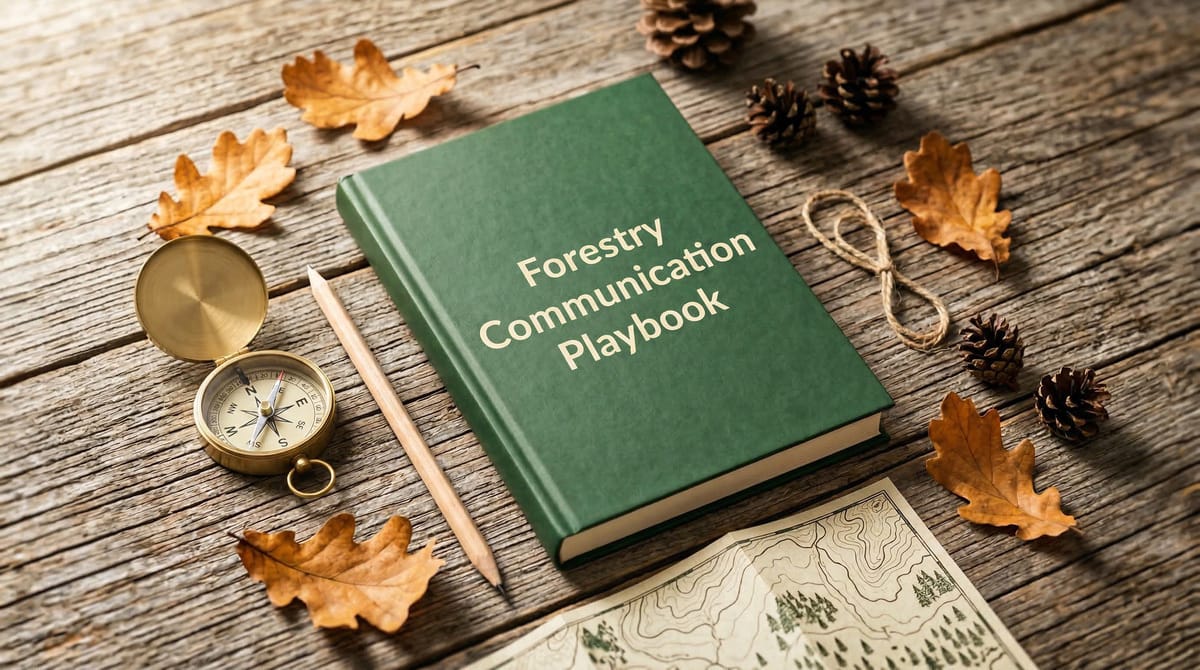
📖 The Forestry Communication Playbook
"So the banks own the forests now?"
After this week, you may hear it. At dinner. At a council meeting. From a neighbour who saw a headline. The true answer is short. A bank launched a division and a fund. The fund has a goal, not a pot. The bank did not buy a forest on Monday.
Saying that calmly, in one breath, takes practice.
Part 1 covers the questions that arrive without warning.
📗 The Forest-Investment Dictionary
A fund target is a sentence about the future. A first close is a fact.
Read every fund headline in three steps. Target. Committed. Deployed. Most headlines stop at step one. A valuation should not.
I wrote the Forest-Investment Dictionary with Danish forest economist Anders Tærø Nielsen. It has 151 pages, 11 chapters, 14 printable tools, and 3 calculators. Investors learn to read a forest. Foresters learn to read a term sheet.
When the market turns, the people who can read the numbers make the better calls. The price is €99. Get yours below.

📘 The Organization — Playbook Part 3
Every organisation has rules for what it says. Few write them down.
This week I linked mine. It says how ForestryBrief earns money, and what that money does not buy. Writing rules down forces two questions. Who decides? Who checks?
Part 3 asks the same two questions of a whole organisation.
I wrote The Organization, Part 3 of the Playbook. It has 165 pages, 10 chapters, 10 printable tools, and a survey. It shows what it takes to be heard, and who does the work.
Almost nobody in European forestry publishes what communication costs. The survey inside starts the count. The price is €149. Get yours below.

🤝 ForestryBriefing
The brief is free. The briefing is not.
ForestryBrief publishes verified intelligence — free, three times a week, in 25+ countries. When you need that intelligence applied to your specific situation, that's a ForestryBriefing.
Intelligence — Investment due diligence, market intelligence, EUDR compliance, cross-sector risk analysis, background verification in three languages.
Communication — Strategy, trade publication articles, stakeholder messaging, newsletters that people actually open. EN | DE | HU.
Live — Conference presentations, panel moderation, keynotes. Next: WAN-IFRA World Printers Summit, Rotterdam, October 2026.
First briefing guarantee: if it doesn't deliver intelligence you can act on, you don't pay.
Until Thursday!
Wish you all the best: Peter
🤝 Need help with forestry communication, intelligence, or due diligence? See what we offer → ForestryBriefing
📩 Got this email forwarded to you? Subscribe to ForestryBrief here.
📚 Missed an issue? Browse the ForestryBrief archive
P.S. What’s the biggest challenge you’re facing in forestry right now?
Hit reply and let me know — I read every message personally.
P. P. S. Know a forest professional who’s drowning in EUDR complexity or missing out on timber market shifts? Forward this email to them!
Independent since issue one. Read the charter.
Shauna Matkovich's Forest Invest Podcast is one of the best resources for understanding where forest finance is heading. If you are interested in Forest Investments, start there.
If you like FB be sure to subscribe to Boreal Tech Brief, a newsletter of my friend Axel covering tech in forestry with a Nordic angle:
