
Hello,
The most-shared forestry number this month is bright red. Finnish forests returned minus 13.2% over the past year. It looks like an asset class in trouble.
It isn't. The fresher number in the same report already turned positive. Let me show you.
Here's what's moving European forestry this week:
🔍 The Big Story
The scariest number in European forestry — and why it's a rear-view mirror
What happened
Indufor published its Forest Investment Return Index for May. The headline is red. Finnish private forests returned −13.2% over the past 12 months. That sits close to April (−13.0%) and March (−13.2%).
The five-year figure cooled too. Over the 2021–2026 holding period, forests returned 5.5% per year. A year ago, that same five-year number was 10.2%.
At first glance, this looks like an asset class in trouble. It isn't. Here's why.
Why the headline misleads
The −13.2% is a rear-view mirror. It measures the last 12 months against the year before. And that year held the timber price correction we tracked all spring.
Now look at the fresher number. The 2026 year-to-date return turned positive in May. It reached +2.3%, up from +0.8% in April. The reason is simple. Wood prices climbed again through spring. Sawlog and pulpwood both rose.
So the trailing number reflects old pain. The year-to-date number reflects a turn. Two different stories sit in one release.
The five-year drop tells a similar tale. Returns did not break. They normalised. That 10.2% figure was lifted by an exceptional run in 2021–2022. As that window rolls forward, the average settles toward its long-run level. A real asset returning 5.5% a year is not a collapse. It is a reset.
The other half: capital keeps arriving
If forests were a bad bet, big money would leave. It is not leaving. It is repositioning.
Last week, Gresham House completed its Molpus deal (EFP #101). That created the world's third-largest timberland manager. This week, Campbell Global named a new Head of Global Acquisitions. Campbell Global is J.P. Morgan's timberland arm. You do not hire someone to buy forests when you plan to sell them.
Finnish forests make up about 20% of the EU's timber market. So this index is a useful gauge far beyond Finland.
What this means for you
If you own forest: Do not price your land off a rear-view number. The spring wood-price turn matters more for your next sale.
If you hold forest in a fund: The five-year reset is normalisation, not alarm. But your exposure depends on country, species, and market mix. Want to know what it means for your allocation? See below.
If you are waiting to buy: Institutional buyers are moving now. The window where returns look "bad" on paper is often the window smart capital uses. Sources: Indufor Oy / STT Info — Finland: Forest Investment Return at −13.2% over twelve months and 5.5% over five years (May 2026) | Indufor Group
📊 Quick Hits
1. 🇱🇻 Latvia buys its forest back
Latvia's state forest company just bought 5,800 hectares from Swedish owners. The price was €26 million — about €4,500 per hectare. The land sits in the Ludza region, near the eastern border.
LVM — Latvijas Valsts meži — runs the deal. The government approved it on 30 June. About 4,800 hectares are productive forest. The mix is mostly spruce, birch, and pine.
Why it matters: A state forest manager is expanding, not shrinking. Capital is staying in Baltic forests — and moving into public hands.
The takeaway: The Baltic timber base keeps attracting buyers. Watch who is buying. Right now, it is the state. Source: LSM — Latvia buys back forest from Swedish owners for 26 million euros
2. 🇫🇮 Ponsse builds through the downturn
Finnish forest-machine maker Ponsse is investing while the market is soft. Construction has started on its Vieremä factory extension. The investment is worth about €10 million. The work expands its welding facilities.
There is a second move too. Ponsse is setting up a "Refactory" in Iisalmi. It will rebuild used machines to extend their life. The EU LIFE programme helps fund it.
Why it matters: Equipment makers are the early warning system for the sector. Ponsse spending big is a bet on recovery.
The takeaway: When a harvester maker builds new capacity mid-slump, it sees demand ahead. That is a quiet confidence signal. Source: Forest Machine Magazine — Construction starts on Ponsse's Vieremä factory
3. 🇸🇪 A Swedish biofuel deal locks up forest residue
VAROPreem has bought Sunpine outright. The deal closed on 9 July. Sunpine runs the world's largest crude tall oil biorefinery. It sits in Piteå, in northern Sweden.
Crude tall oil is a leftover from the pulp industry. Sunpine turns it into feedstock for renewable diesel and jet fuel. The Piteå plant processes about 400,000 tonnes a year.
Three owners sold their stakes: Sveaskog, Södra, and chemicals firm Lawter Europe. Sveaskog and Södra are both forest-sector players. VAROPreem — a merger of VARO Energy and Preem — now owns 100%.
Why it matters: A forest by-product is now a strategic energy asset. Whoever controls the residue controls part of the biofuel chain.
The takeaway: Sawmill and pulp residues keep gaining value. If you sell low-grade wood or by-products, that market is deepening. Source: Biofuels International — VAROPreem completes Sunpine acquisition
4. 🔥 An early fire season — and a month's head start
Europe's 2026 fire season started early. By 8 July, fires had burned 155,569 hectares across the EU. That figure comes from EFFIS, the EU's satellite fire monitor.
Here is the perspective. That total is below the same point in 2025 — the worst year on record. Fire-related CO₂ is also below the long-term average. But fire danger is rated "very extreme" this week across France, Spain, northern Italy, and the Alpine arc.
Why it matters: The early start is both a warning and an opening. Danger is highest now across France, Spain, and the Alpine arc into northern Italy. Managers further east get time to prepare before the risk climbs.
The takeaway: Review your fire plans, access routes, and salvage logistics this week — not in August. Preparation is the cheapest insurance you will buy this year. Source: EFFIS / EU Joint Research Centre — Current wildfire situation in Europe
📅 The Weeks Ahead
Wednesday, July 22, 2026: RFSI Forum early-bird registration deadline (rfsi-forum.com)
Friday, July 24, 2026: Luke publishes June roundwood trade data for Finland (Luke statistics) | Valmet publishes its Half-Year Financial Review, January–June 2026
Monday, July 27, 2026: Verra's next-generation registry goes live
Ongoing to late September: EUDR Delegated Act two-month scrutiny period (European Parliament and Council)
Thursday, July 30, 2026: Weyerhaeuser Q2 results, call on July 31 (Announcement)
Tuesday, August 5, 2026: Rayonier Q2 results (first full quarter as the merged Rayonier–PotlatchDeltic entity)
Wednesday–Friday, September 16–18, 2026: EFI Annual Conference — Växjö, Sweden (European Forest City 2026)
Tuesday, September 22, 2026: CINEA LIFE Calls 2026 — Standard Action Projects deadline | SoEF 2025 webinar — Biological Diversity, 12:00–13:00 CEST
Sunday, September 27, 2026: EU EmpCo Directive applies — generic green claims become unlawful
🔴 Sunday–Tuesday, October 4–6, 2026: WAN-IFRA World Printers Summit — Rotterdam (I present on October 5)
Wednesday–Thursday, October 7–8, 2026: 19th European Congress (FOGE) — Cologne, Germany | RFSI Forum — Denver
🔴 Tuesday–Wednesday, October 13–14, 2026: CIFB London: Corporate Investments into Forestry & Biodiversity — London, UK
Thursday–Sunday, October 15–18, 2026: INTERFORST 2026 — Munich (quadrennial forestry technology trade fair)
Tuesday–Wednesday, October 20–21, 2026: Global Bioeconomy Summit 2026 — Dublin, Ireland
Wednesday, November 4, 2026: TDUK Global Market Conference — London
Thursday–Friday, November 5–6, 2026: 11th International Hardwood Conference — Antwerp (ATIBT)
Wednesday, December 30, 2026: EUDR applies to large and medium operators, and all timber-sector operators
💡 One Thing to Try This Week
Benchmark your own forest against the Indufor number.
Estimate your forest's total return over the last five years. Include timber sales and value change.
Compare it to Indufor's 5.5% per year for Finnish private forests.
Ask why you are above or below. Species? Region? Timing of sales?
Ten minutes. You will know whether your forest beat the Nordic benchmark — and why.
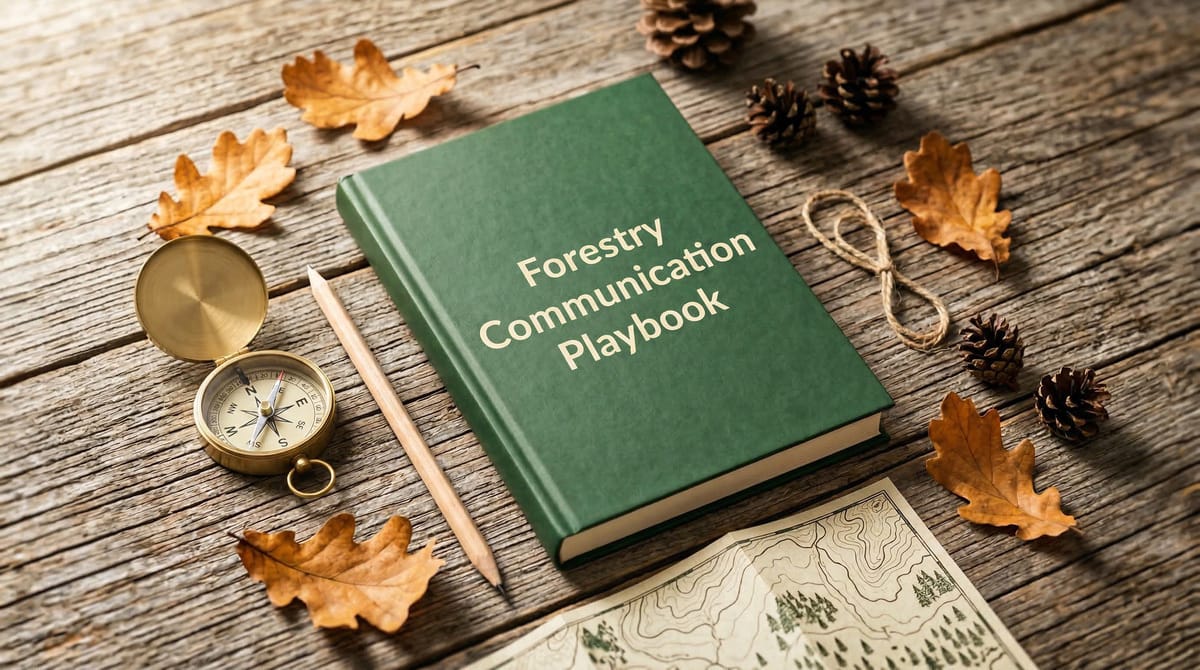
📖 The Forestry Communication Playbook
The next time someone asks why you cut trees, you'll have thirty seconds to answer.
Right now — what do you say?
If the answer isn't ready, the Playbook is.
📗 The Forest-Investment Dictionary is here
The Indufor index measures forest returns. This book teaches you to read what drives them.
I wrote the Forest-Investment Dictionary with Danish forest economist Anders Tærø Nielsen. It has 151 pages, 11 chapters, 14 printable tools, and 3 calculators. Investors learn to read a forest. Foresters learn to read a term sheet.
When returns wobble, the people who understand why make the better calls. The price is €99. Get yours below.

🤝 ForestryBriefing
The brief is free. The briefing is not.
ForestryBrief publishes verified intelligence — free, three times a week, in 25+ countries. When you need that intelligence applied to your specific situation, that's a ForestryBriefing.
Intelligence — Investment due diligence, market intelligence, EUDR compliance, cross-sector risk analysis, background verification in three languages.
Communication — Strategy, trade publication articles, stakeholder messaging, newsletters that people actually open. EN | DE | HU.
Live — Conference presentations, panel moderation, keynotes. Next: WAN-IFRA World Printers Summit, Rotterdam, October 2026.
First briefing guarantee: if it doesn't deliver intelligence you can act on, you don't pay.
Until Tomorrow!
Wish you all the best: Peter
🤝 Need help with forestry communication, intelligence, or due diligence? See what we offer → ForestryBriefing
📩 Got this email forwarded to you? Subscribe to ForestryBrief here.
📚 Missed an issue? Browse the ForestryBrief archive
P.S. What’s the biggest challenge you’re facing in forestry right now?
Hit reply and let me know — I read every message personally.
P. P. S. Know a forest professional who’s drowning in EUDR complexity or missing out on timber market shifts? Forward this email to them!
Shauna Matkovich's Forest Invest Podcast is one of the best resources for understanding where forest finance is heading. If you are interested in Forest Investments, start there.
If you like FB be sure to subscribe to Boreal Tech Brief, a newsletter of my friend Axel covering tech in forestry with a Nordic angle:
