
Hello,
This isn't a regular EFP issue. This is personal.
You're a good forester. I know that because you're reading this — you care enough about the sector to stay informed. But being a good forester isn't enough anymore.
To continue being a good forester, you need the public to trust you with their forests. You need policymakers who write regulations that make sense. You need investors who put capital into sustainable forestry instead of whatever the next carbon hype cycle promises.
For all of that, you need to communicate. And right now, the sector can't.
Most forestry companies don't have a communication department. They have one or two people — usually foresters by training — who handle communication alongside recreation, ecotourism, education, and a dozen other tasks. No communication background. No strategic plan. No dedicated time. Just constant firefighting between jobs that all need attention yesterday.
When the sector can't make its case, it doesn't just lose a PR battle. It loses the social license to manage forests at all. That's not a future risk. That's happening now. In policy. In public perception. In investment flows.
📖 Here's a piece of Chapter 4. This is the actual book.
Picture this. A Saturday afternoon. A family is walking through the forest. They come around a corner and see a harvesting site. Fresh stumps. Skidder tracks. Piles of logs.
The children stop. The mother turns to the father. "Why are they cutting down the trees?"
Nobody answers. Because no forester is there. Or if one is, they avoid eye contact and keep working.
That family walks home with one impression: someone is destroying their forest.
Now picture the same scene. Same family. Same stumps. But this time, a forester stops for two minutes. Smiles. Explains. That family walks home with a completely different impression.
That two-minute conversation does more for forestry's reputation than any press release, any website, any annual report. It's free. It takes no training. And it happens — or doesn't happen — thousands of times across Europe every weekend.
The Playbook calls this the Open Factory. Unlike steel mills or dairy farms, our workplace is open to the public. Millions walk through it every week. They form opinions based on what they see — and what they see looks like destruction to someone who doesn't understand the cycle.
The forester who stopped and smiled did something more important than explaining harvest cycles. That family walked away feeling good about forestry. The Playbook turns that instinct into a named rule — the Positive Vibe Rule — with a single test you can apply to every conversation, every sign, every press release, every social media post you'll ever produce.
There's a second rule right after it: the Context First Rule. It explains why the technically correct answer to "why are you cutting these trees?" is almost always the wrong one — and what to say instead.
Chapter 4 has both. Plus the Communication Pyramid, the Perception → Context → Permission sequence, and why forest pedagogy is PR training in disguise.
And that's one chapter out of ten. Here are the other nine as well:
Why Forestry Lost the PR Battle
The Story We Forgot to Tell
Why Communication Matters
Every Forester Is a PR Person ← you just read a piece of this one
Know Your Audience
Crafting Your Core Message
The Messages That Matter
The Tough Questions — And How to Answer Them
Conservation as Communication
Low-Cost Tactics That Work
It started with a few articles I wrote for Fordaq. Then conversations. Then a question: does a communication playbook for the forestry sector actually exist?
I looked. It doesn't. Nobody had written one.
So I did. The research turned into a structured methodology — ten chapters, fifteen ready-to-use tools — covering why forestry communication fails and what actually works. When I told the Hungarian Forestry Association (OEE) I was writing it in English, they said: write one in Hungarian too. That became a commission. But the English version is the original.
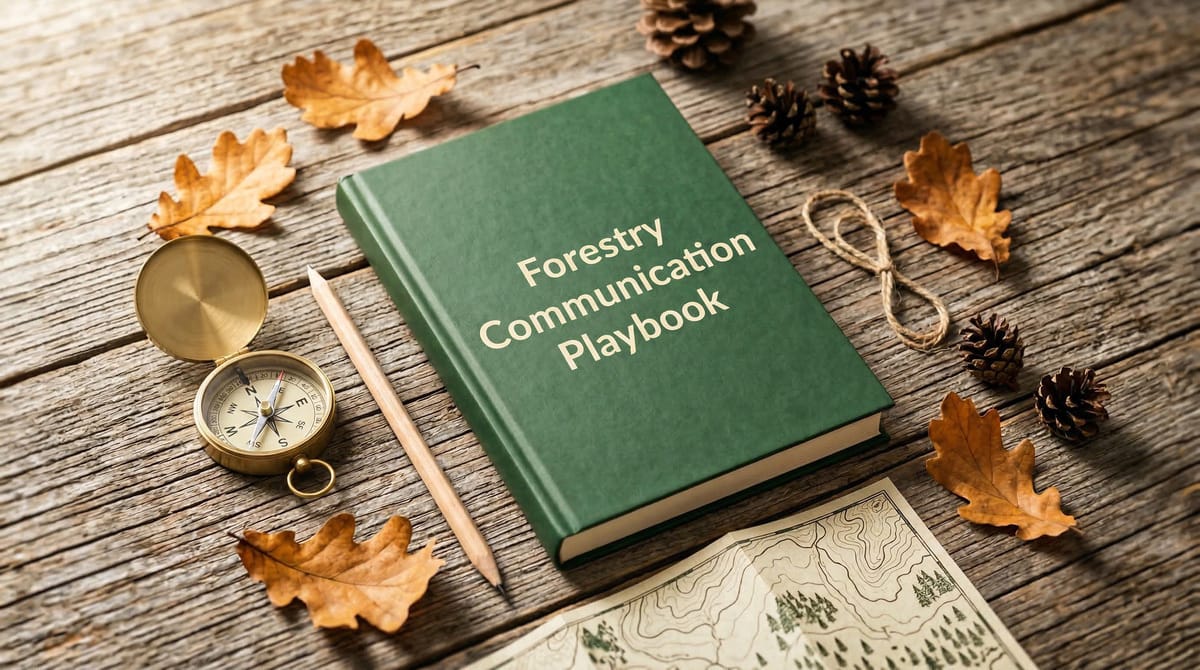
The Forestry Communication Playbook — Part 1.
Ten chapters. Fifteen printable tools. A 76-question quiz. Sixty-eight flashcards. Nine illustrations. Three formats (PDF, EPUB, HTML). Everything in one download.
€29.
My guarantee: If this Playbook doesn't change how you think about forestry communication, email me and I'll refund you. No questions. I'd rather have your trust than your money.
I'm also presenting this work at the WAN-IFRA World Printers Summit in Rotterdam this October — bringing forestry's communication story to a global media audience. More on that soon.
If you've ever been told to "handle the PR" on top of your actual job — this is for you. If you've ever watched the sector lose a public debate it should have won — this is for you.
I wrote this because I believe in European forestry. I want it to win. And winning starts with learning to communicate.
See you tomorrow with the regular EFP.
Wish you all the best: Peter