
The Asset Nobody Listed
Europe is using its forests for defense. No law says so. That gap is where the risk sits.
Part one of two. Part two lands next Friday
Hello,
On a Thursday morning last November, four officials joined a video call.
One came from Ukraine. One from Finland. One from Sweden. One from the United Kingdom.
They were there to discuss forests and national security. The meeting had a formal title. It was called a High-Level Policy Dialogue on forest-based emergency preparedness.
Most people read the write-up afterwards and drew one conclusion. Europe has woken up. Forests are strategic assets now. Governments finally understand.
I read the same write-up and heard something else.
Four governments were describing a hole. Not an achievement.
They were not announcing that forests had been brought into national security planning. They were explaining, politely and in public, that forests are still mostly outside it.
Nine months have passed since that call. Europe has since held a ministerial conference on forests. Thirty-one countries signed a declaration.
Not one critical infrastructure list has changed.
That gap is worth about ten years of policy. Let me show you why.
The Room Where Nobody Disagreed
The dialogue took place on 13 November 2025. It ran two and a half hours, from 09:00 to 11:30 CET. Forest Europe hosted it under the Swedish chairmanship.
The speakers were not commentators. They were the people who would do the work.
Ihor Buksha leads inventory, monitoring and forest management planning at Ukraine's State Forest Resources Agency. Olli Anttonen is chief of preparedness at the Finnish Forest Industries Federation. Lena Ek heads the Royal Swedish Academy of Agriculture and Forestry's work on geopolitical preparedness. Richard Stanford is Chief Executive of the UK Forestry Commission.
Four countries. Four very different forest sectors. No real disagreement between them.
Now read how Forest Europe described the purpose of the meeting. Forests, it said, support several critical societal functions. It then listed three:
energy supply, food production and transport infrastructure.
Hold that sentence. We come back to it shortly.
Stockholm, Seven Months Later
The dialogue was not the end of it. Its insights were meant to feed a policy brief. That brief was meant to inform a ministerial conference.
The conference happened. The 10th Forest Europe Ministerial Conference met in Stockholm on 2–3 June 2026.
More than 130 participants attended, from over 30 countries. Ministers, state secretaries, researchers and industry all came. Thirty-one signatories signed the Stockholm Ministerial Declaration. Albania takes the chairmanship on 1 January 2027.
This was a real event with real weight. It deserves credit.
Preparedness was on the agenda too. A closing session asked how Europe's forests fit into future crises. Viktor Smal came from Ukraine, Jonas Liimatta from Finland, Mikołaj Dorożała from Poland. Richard Stanford came back for it, seven months after the video call.
Now look at what the conference produced.
It ran eight high-level sessions. They covered climate change, biodiversity loss, wildfires, workforce shortages, innovation, wood construction, geopolitical preparedness, and the long-term future of sustainable forest management.
Geopolitical preparedness got one session out of eight.
The Declaration itself reaffirms sustainable forest management and Forest Europe as the pan-European platform for forest policy dialogue. Every trade write-up of the conference led with the same thing. Cooperation. Sustainable forest management. Shared knowledge.
Nobody's headline was that forests had been designated as strategic infrastructure.
That is not a failure by Forest Europe. Forest Europe is a voluntary process. It cannot legislate. It convened the conversation, which is exactly its job, and it did that well.
The point is narrower and harder. The conversation has now happened at the highest level available to European forestry. The legal category still has not moved.
Four Numbers, Four Countries
The November dialogue produced four figures that have travelled widely since. They deserve careful handling. Most are quoted without the definition attached. The definition changes what they mean.
Ukraine: the damage figure depends on what you count.
Forest Europe reported more than 2.5 million hectares of forest damaged, with roughly half a million hectares containing mines.
Treat that as one measure among several. Peer-reviewed work published since puts the impacted area near 2.9 million hectares, with up to 1.3 million hectares holding unexploded ordnance. Ukraine's State Forest Resources Agency recorded a much lower figure in mid-2024, around 708,900 hectares, because it counted only directly affected area.
None of these sources is wrong. They measure different things on different dates. Anyone quoting a single hard number here is quoting a definition they have not checked.
Finland: over a quarter of energy from wood.
This needs its label. Finland's Ministry of Agriculture and Forestry puts wood fuels at over a quarter of total energy consumption. It is not electricity. It is not final energy consumption.
You will see this published as 27 percent and as 28 percent, depending on the source and the revision. Both are describing the same thing.
Wood's share of Finnish electricity generation is not published as a clean standalone figure. Most wood burns in combined heat and power plants, so heat and power are accounted together. Anyone who hands you a tidy electricity percentage for Finnish wood should be asked where it came from.
Here is a properly labelled figure instead. Finnish heat and CHP plants burned 20.8 million cubic metres of solid wood fuel in 2025, worth 40.8 terawatt hours. That is down 5 percent on the year before.
Say it properly and it is a formidable fact. Say it loosely and someone in the room will correct you.
Sweden: 70 percent forest cover, and a sector its own expert says was left out.
Sweden has roughly 27.9 million hectares of forest land. That is about 70 percent of the land area. Of that, 23.5 million hectares is productive forest land, about 58 percent of the country.
Both numbers are official. They measure different categories. Use the one that matches your claim.
On crisis planning, be precise about who is speaking. Forest Europe's summary of Lena Ek's remarks says the Swedish forest sector has been largely absent from national crisis planning. That is Sweden's own preparedness expert, describing her own country, in public.
No Swedish government document was found stating that forestry is excluded. Ek's own framing is that Sweden has restarted work on the forest role in geopolitical preparedness. Restarted implies it had stopped. That is suggestive. It is not the same as a formal exclusion, and we should not write it as one.
United Kingdom: 81 percent of wood imported.
Forest Research's Forestry Statistics 2025 puts imports at 81 percent of all wood consumed in the UK in 2024. The measure is wood raw material equivalent, underbark. Woodland cover sits at 13.5 percent.
The UK is routinely described as the world's second-largest net importer of forest products, behind China. That ranking comes from 2023 trade data and it moves. Treat it as a recent official framing, not a fixed fact.
Its Forestry Commission chief has publicly described a timber security problem in the same terms Britain uses for food security. He also signed the Stockholm Declaration in June.
The List That Does Not Have Forests On It
Now the part almost nobody has checked.
Remember Forest Europe's three critical societal functions. Energy supply. Food production. Transport infrastructure.
All three are legal categories. All three appear on critical infrastructure lists across Europe. They come with obligations, protections, funding and planning duties.
Critical infrastructure is not a compliment. It is a status. So I went looking for the lists.
Finland brought its critical infrastructure law into force on 1 July 2025. It is Act 310/2025, transposing the EU's Critical Entities Resilience Directive. It was approved on 13 June 2025.
The law covers 11 sectors. Energy. Transport. Banking. Financial market infrastructure. Health. Drinking water. Wastewater. Digital infrastructure. Public administration. Space. Food production, processing and distribution.
Forestry is not one of them.
That is Finland. The country where wood fuels supply over a quarter of total energy.
At EU level, the Stockpiling Strategy is COM(2025) 528 final, adopted 9 July 2025. It names emergency supplies, medical countermeasures, critical raw materials, energy equipment, and food and water security.
Timber is not named among those categories.
Be careful with that sentence. The strategy uses an open-ended definition of essential goods that includes natural resources. Wood is not named. Wood is also not textually excluded. "Not named" is the accurate phrase. "Excluded" would be wrong.
The One Real Exception, And Its Limit
There is a genuine counter-example. It is worth understanding properly, because it is the best system in Europe.
Finland runs a National Emergency Supply Agency. Within it sits a formal pool structure covering different parts of the economy. One of those pools is the forest pool.
So Finland has done it. Almost.
Now read what Finland's own government says about the wood itself. Finland's Government Report on Security of Supply states there is no statutory obligation to stockpile wood fuels.
That is not an absence I inferred. That is a government stating it in a published report.
Finland's state emergency reserves hold crude oil, petroleum products, coal and natural gas. They hold grain, seeds and medical supplies. Fuel peat has been stockpiled as an emergency heating measure.
Wood chips and firewood are not held.
The best preparedness system in Europe secures the factories. It does not stockpile the fuel.
Meanwhile, In The Border Forests
While the lists stayed unchanged, something else was happening on the ground.
On 19 January 2024, the defense ministers of Estonia, Latvia and Lithuania signed an agreement in Riga. It created the Baltic defense Line. The published scope covers bunkers, anti-tank ditches, dragon's teeth and natural obstacles.
Estonia's element plans roughly 600 bunkers and about 40 kilometers of anti-tank ditch, at a cost of up to 60 million euros. Ditch construction began in summer 2025. Estonia's defense investment centre reported five bunkers erected by the end of 2025, with further work planned through 2026.
Read those numbers carefully. Six hundred bunkers is a plan. Five bunkers is progress. Published trackers cite higher installation counts for mid-2026, and they may be right. Nobody should quote the plan as if it were built.
Poland announced its own eastern programme, Tarcza Wschód, in May 2024. The budget is 10 billion złoty, roughly 2.3 billion euros, running to 2028. It covers the eastern border with Russia and Belarus. Published figures for that length run from about 640 to 700 kilometers, depending on the source.
The design uses natural obstacles on purpose. Forests, swamps and rivers are part of the concept.
That was clear from the start. In 2024, when the first-phase land agreements were signed, Poland's deputy defense minister put it plainly:
Every hill, tree, and river will be part of our defense.
Those agreements were signed with the National Support Centre for Agriculture and with State Forests, Poland's national forest holding. State land within 500 meters of the borders is being brought into the programme.
Progress figures vary by source and by what gets counted. Published numbers for mid-2026 run from about 61 kilometers to about 100 kilometers. Against a 640 to 700 kilometer plan, either figure tells the same story.
Then Poland did something no other country has done.
On 25 May 2026, the Ministry of Climate and Environment and the Ministry of National defense held a joint press conference. They announced an environmental component of the East Shield.
The changes cover 48 forest districts inside a 50 kilometer zone from the border. They include partial bans on logging and on clearing compartment lines. Dead trees will be left where they fall, to block the path of heavy military equipment.
Inside a narrower 5 kilometer strip along the border, logging is prohibited outright.
The climate minister described it directly.
Forest management is being changed to block the movement of hostile forces.
Read that again. A forestry regulation, issued by an environment ministry, designed as a military obstacle. Calls for funding under the EU's FEnIKS programme opened four days later.
The same logic runs through Poland's reporting to UNESCO. There it is stated in full.
In January 2026, Poland answered the World Heritage Committee on East Shield. The Committee had expressed its utmost concern about the programme's potential impact on Białowieża Forest. It asked Poland to assess that impact formally, before any decision.
Poland's answer explains the military thinking better than any press release could.
The Ministry of National defense says the natural environment plays an operational role. The aim is to use the terrain and build fewer fortifications. Swamps, wetlands and dense forest are classified as "NO GO" or "SLOW GO" zones. Białowieża is given as the example.
Then comes the key sentence. The Ministry says the Białowieża management plan, submitted to UNESCO in December 2025, allows East Shield objectives to be met at the same time, by creating a natural defensive barrier.
Leaving 96 percent of the Polish section to natural processes, it explains, makes the ground difficult to traverse and unpredictable.
Conservation described as terrain denial, by a defense ministry, in a heritage document.
None of this started in May 2026. The Minister of National Defense and the Director General of State Forests signed a cooperation agreement on 23 April 2025. It covers preparing border areas for defense by improving terrain conditions. It names changes in forest management practices directly.
Now the part that matters most.
Poland has designated forest areas. Areas of significant operational importance along the north-eastern border are classified as NO GO or SLOW GO.
But read what Poland says next. Those designations sit in planning and operational documents that cannot be released, because they are classified.
So a designation does exist. It is military, not civil. It carries no published status, no budget line, no compensation route and no duty to consult. A forest owner cannot see it, cannot plan around it, and gains nothing from it.
That is not the same as being on a critical infrastructure list. In some ways it is the opposite.
Five European states have also left the Anti-Personnel Mine Ban Convention. Estonia, Latvia and Lithuania left in December 2025. Finland followed in January 2026. Poland followed in February 2026. Mined belts run through border forest land.
Sweden shows the scale of what sits quietly in play elsewhere. The country has roughly 210,000 kilometers of forest roads. Forest owners and forest companies built them and maintain them.
That figure deserves a caveat. It traces back to work published around 2009 to 2011 and has been recirculated in the academic literature since. No fresh official recount was found. Treat it as a longstanding approximation.
Here is what could not be found at all. No official Swedish document was located that counts the forest road network as civil defense or military mobility infrastructure.
Poland writes it down. Its UNESCO report states plainly that the road network inside Białowieża is used by the Border Guard, the army, the police and emergency services. Poland is also removing almost 117 kilometers of forest road inside the property, letting it grow over. In a NO GO zone, a road is not an asset. It is a way in.
Sweden has no equivalent published statement in either direction.
That absence is the point. Nobody paid for that network as defense infrastructure. Forest owners paid for it as haulage infrastructure. Whether anyone in Stockholm is counting on it is not a matter of public record.
Sources: Wodne Sprawy — the environmental component of the East Shield | UNESCO — State of Conservation Report, Białowieża Forest | Defense Mirror — East Shield land agreements
The Gap, Stated Plainly
Put the two halves together and the shape becomes obvious.
Europe is using its forests for defense right now. Terrain. Trench timber. Road networks. Deadwood left as an obstacle. Mined belts along borders.
Europe has not listed its forests as defense infrastructure anywhere that carries legal weight.
Physical use is running ahead of legal recognition. That is not a small administrative lag. It decides three things that land on forest owners.
It decides who pays. Infrastructure with legal status gets budget lines and maintenance funding. Infrastructure that is merely used does not.
It decides who is consulted. Here the picture is better than the sector often assumes, and it is worth saying so. General expropriation law applies across the border states. Poland has a special act for eastern border infrastructure. Estonia has its Acquisition of Immovables in Public Interest Act. These require compensation at market value, including standing timber. Estonia's defense investment centre has also said that roads, woods and fields inside fortification areas stay largely usable.
So forest owners are not without protection. What does not exist is anything forestry-specific. No published consultation framework. No compensation mechanism built around how forests actually work, where the loss is a rotation rather than a plot.
It decides what gets counted. No published estimate could be found of the timber volume needed for European fortification programmes. None was found for Ukrainian reconstruction either, where total needs are now assessed at 587.7 billion dollars over ten years.
That last point is where part two starts.
Here is the useful news in all of this. A gap in law is a much easier problem than a gap in physics. Nobody has to grow anything to fix it. Finland wrote its list in 2025. Lists get rewritten. Sweden restarted work that had stopped. Poland showed that a forestry rule can be redrafted for security purposes in a single spring.
The sector spent years asking to be taken seriously as strategic. It is being taken seriously. It is simply not being written down.
That is a drafting problem. Drafting problems get solved by people who show up with the right numbers.
What This Issue Cannot Tell You
It cannot tell you whether your forest sits inside a designated zone.
It cannot tell you what your compensation position looks like if it does.
It cannot tell you which of your buyers carries a third-country origin question.
Those answers change with the border you are near, the ownership form you hold, and the market you sell into. A Polish district inside the 50 kilometer zone faces a different question from a Swedish estate with 40 kilometers of road on it. Both face a different question again from a fund holding assets across four jurisdictions.
The general picture is free, because everyone needs it. The specific picture is a service, because it only applies to you.
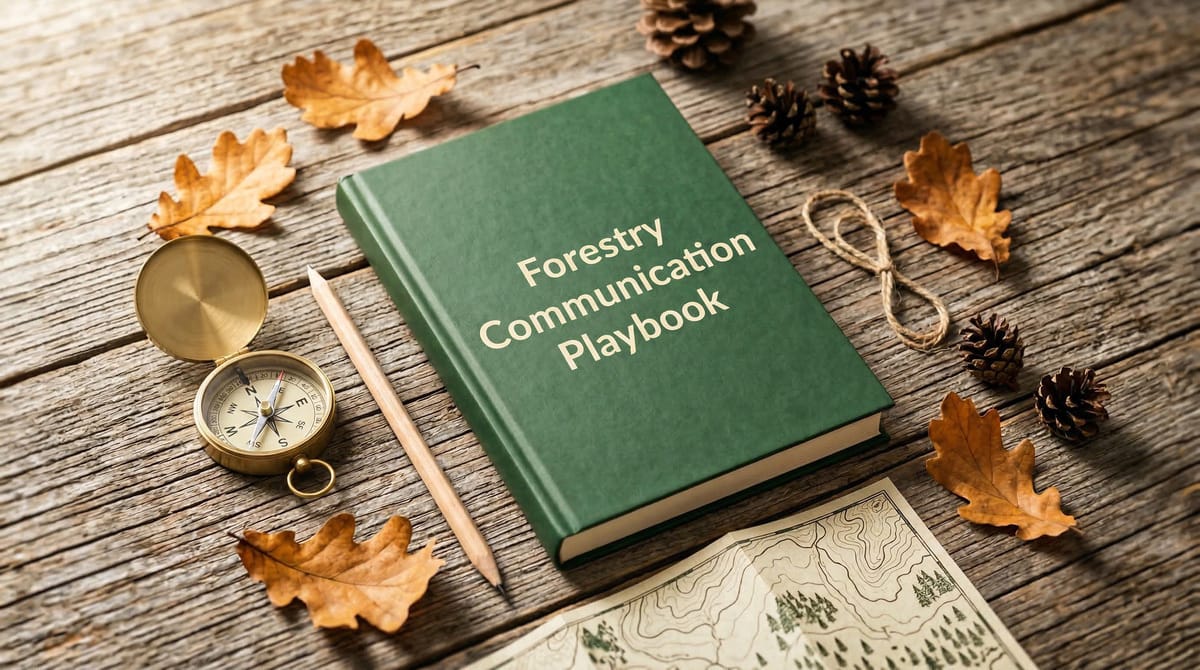
📖 The Forestry Communication Playbook
You get one meeting with a ministry. You bring your best number. Someone across the table asks what it measures.
Finland's wood energy share. Ukraine's damaged hectares. Sweden's forest cover.
Every one of them has two correct versions. Say it properly and it is a formidable fact. Say it loosely and you lose the room.
The Playbook covers how to say a number so it survives the room.
📗 The Forest-Investment Dictionary
Market value pays for the trees. It does not pay for the rotation. Expropriation law across the border states requires compensation at market value, including standing timber. That protects you better than the sector usually assumes. But losing forest is not losing a plot. It is losing a rotation. If you cannot price that difference, you accept the price you are offered.
I wrote the Forest-Investment Dictionary with Danish forest economist Anders Tærø Nielsen. It has 151 pages, 11 chapters, 14 printable tools, and 3 calculators. Investors learn to read a forest. Foresters learn to read a term sheet.
When the market turns, the people who can read the numbers make the better calls. The price is €99. Get yours below.

🤝 ForestryBrief Services
European forestry needs better communication and smarter capital. We deliver both.
Intelligence: EUDR compliance, timber market analysis, carbon market monitoring, forest investment due diligence.
Communication: Content strategy, trade publication articles, stakeholder messaging, staff training. Three languages: EN | DE | HU.
Live — Conference presentations, panel moderation, keynotes. Next: WAN-IFRA World Printers Summit, Rotterdam, October 2026.
First briefing guarantee: if it doesn't deliver intelligence you can act on, you don't pay.
Until Tuesday!
Wish you all the best: Peter
🤝 Need help with forestry communication, intelligence, or due diligence? See what we offer → ForestryBrief Services
📩 Got this email forwarded to you? Subscribe to ForestryBrief here.
📚 Missed an issue? Browse the ForestryBrief archive
P.S. What’s the biggest challenge you’re facing in forestry right now?
Hit reply and let me know — I read every message personally.
P. P. S. Know a forest professional who’s drowning in EUDR complexity or missing out on timber market shifts? Forward this email to them!
Shauna Matkovich's Forest Invest Podcast is one of the best resources for understanding where forest finance is heading. If you are interested in Forest Investments, start there.
If you like FB be sure to subscribe to Boreal Tech Brief, a newsletter of my friend Axel covering tech in forestry with a Nordic angle:
