
The Numbers Nobody in Forestry Publishes
One year of ForestryBrief, opened up. Every metric, the good and the bad, so you have something to measure your own communication against.
Hello,
I have a rule about dates.
Every item that lands in my inbox gets checked against the original article. Trade digests recycle old figures constantly. One port volume number from 2017 still circulates as current. I catch it about twice a month.
So it is a little embarrassing to report that I missed my own.
ForestryBrief turned one on 17 July 2026. I did not notice. I found out two weeks later, while pulling subscriber data for something else entirely.
That is what this issue is about. Not the anniversary. The data.
Why publish any of this
European forestry has no communication benchmark.
Think about it. Every association, certification body and forest company in Europe sends email. Most send a newsletter. Almost all of them run a LinkedIn page.
Not one of them publishes the numbers.
So when a communications officer at a forest association asks "is a 34% open rate good?", nobody can answer. There is no reference point. They are guessing, and their board is guessing with them.
I have 386 days of clean data. It comes straight out of the platform, not out of a slide deck.
So here it is. All of it. Including the parts that do not flatter me.
Use it as a yardstick.
It started with ten people
On 17 July 2025 I published a sample issue. There was no list to send it to. It got 25 web views.
Five days later, European Forestry Pulse #1 went out to ten recipients.
All ten opened it. Three clicked.
At that point ForestryBrief cost €12 a month to run. I was applying for jobs that needed relocation I could not do, because of my kids and because of co-parenting.
Today it is what I do for a living.
The full ledger
Every figure below was pulled from the platform this morning, 7 August 2026.
Metric | Year One |
|---|---|
Days live | 386 |
Posts published | 143 |
Publishing cadence | one post every 2.7 days, solo |
Pulse issues | #0.1 → #110 |
Professional issues | #1 → #27 |
Active subscribers | 621 |
Everyone who ever subscribed | 661 |
Unsubscribed | 40 |
Retention of all-time signups | 93.9% |
All-time open rate | 65.24% |
All-time click rate | 9.02% |
Spam complaints, last two issues | 0 |
LinkedIn followers | 4,556 |
Where the subscribers came from:
Source | Count |
|---|---|
Direct to the website | 190 |
LinkedIn (all variants) | 214 |
Google and other search | 88 |
Forwarded by another reader | 58 |
One recommendation from a fellow newsletter | 42 |
Manual import | 16 |
3 |
Hold that last row. We come back to it.
Against the benchmark
Now the honest part. My numbers mean nothing without a comparison, so here is one.
The platform I publish on (Beehiiv) runs more than 65,000 newsletters. It publishes its own aggregate data every January. That is the right comparison. Same platform, same measurement method, all opted-in readers.
Platform average open rate in 2025: 41.24%. It was 37.98% the year before. Platform-wide spam complaint rate: 0.02%.
ForestryBrief all-time open rate: 65.24%.
The platform grades every publication against the rest of the network. Two badges appeared on my dashboard several months ago and they are still there. Both are calculated from the last ten issues.
Badge | Result |
|---|---|
Open rate | Top 10% of all newsletters on the platform |
Click-to-open rate | Top 40% of all newsletters on the platform |
I want you to look at the second one as hard as the first.
Top 10% on opens. Top 40% on clicks.
That gap is the most useful thing in this entire issue.
The caveat I am obliged to give you
Open rates are broken, and everyone in email knows it.
Apple's Mail Privacy Protection pre-loads email content on Apple's own servers. That includes the invisible tracking pixel that registers an open. It fires whether or not a human ever looks at the message.
Any list with a decent share of Apple Mail users shows inflated opens. Mine included. So does the 41.24% platform average.
This is why I will not tell you that 65.24% means two-thirds of my readers read every issue. It does not. It means my emails reach inboxes and my subject lines survive the scroll.
The absolute number is soft. The ratio is the real finding. Same inflation, same platform, same method, both sides. Roughly 1.6 times the network average.
If you take one methodological point from this issue, take that one. Compare like with like, or do not compare.
Five things the data actually says
1. Frequency beats polish
143 posts in 386 days. One every 2.7 days, written by one person, in his third language.
Two of them went out on 25 December and 1 January.
I have never published a perfect issue. I have published a great many adequate ones on time. Adequate and Tuesday beats brilliant and eventually.
Most forestry organisations have this backwards. They spend six weeks on a quarterly magazine nobody opens. A short, useful, predictable email would serve their members better.
2. Making it harder to subscribe raised the open rate
ForestryBrief uses double opt-in. You subscribe, then you confirm by email. Two steps.
This costs me signups. It is also the single biggest reason the open rate is 65% and not 40%.
Every person on the list actively confirmed they wanted to be there. Nobody was added from a conference badge scan. Nobody was imported from a membership database.
A smaller list of people who chose you outperforms a larger list of people who were entered.
3. Your corporate readers are not getting your email
This is the finding I would most like every forestry communications team to act on.
I audited my own list in August. Roughly one signup in six had never completed confirmation. They had asked for the newsletter, and then vanished.
The losses skewed heavily corporate. Certification bodies. Listed forest products companies. Government departments. Investment managers. People who work behind enterprise email gateways that quietly filter confirmation messages.
For a year I believed those people had changed their minds. They had not. They never got the email.
If you run a list, check your pending queue. Not annually. Monthly. It takes two minutes.
Then check three things:
Does your DMARC record exist? Since 2024 the major mailbox providers expect one from bulk senders.
Is the address you tell people to whitelist the address you actually send from? Mine was not.
Does your confirmation page tell people to check spam, and offer them a human to reply to if nothing arrives?
That third one is what catches the institutional reader stuck behind a hard gateway.
4. One good neighbour beat every broad channel
Look at those two rows again.
One recommendation from a fellow newsletter: 42 subscribers. Facebook: 3.
The recommendation comes from Axel Wretemark's Boreal Tech Brief. Adjacent subject, overlapping readership, genuine mutual regard. Forty-two people, none of them cold.
Broad reach delivered three.
The lesson generalises well beyond newsletters. In forestry communication, the audience you want is already gathered somewhere. Find who has gathered them and be useful to that person. Stop buying reach.
5. Retention is the number, not acquisition
661 people have subscribed to ForestryBrief. 40 have left.
93.9% of everyone who has ever signed up is still here.
Growth numbers are easy to inflate and easy to admire. Retention is the only metric that tells you whether the thing you are making is worth someone's attention twice.
If your list is growing and your retention is poor, you do not have an audience. You have churn with good marketing.
What did not work
A benchmark that only reports wins is a brochure. Four things went badly.
The paid experiment failed. Professional launched as a paid product in 2025. Only one person Subscribed with their actual credit card, two I added manually because I wanted them to see what I am doing and one of which was my own test account. I made it free instead. I never had the heart to cancel the lovely person who had backed it, and they get exactly what everyone else gets. If you are reading this: thank you, and I hope we talk again soon. You are one of the biggest reasons ForestryBrief is what it is today.
Monday Trading Edge died. Launched 1 September 2025. A third weekly format, on top of two Pulse issues. I could not sustain it at the quality standard, so I stopped. Better to kill a format than to publish a weak one.
The click-to-open gap. Top 10% on opens, top 40% on clicks. Some of that is structural. The platform reports that click rates are falling network-wide, partly because readers finish a good newsletter instead of clicking out of it. I write long summaries with the numbers included, so there is often no need to click. But I am not going to hide behind that explanation entirely. Middling is middling. It is the thing I am working on in year two.
I ran a broken confirmation flow for twelve months. See point three. I check every figure in every issue twice. I had never once checked my own pipe.
The relationships
One more finding, and it is the one that surprised me most.
Year one brought institutional relationships I would not have dared to forecast. A fund manager. A certification body. A trade association. A conference organiser. Investors on two continents.
Not one of them was pitched.
Every single one arrived inbound. Someone read an issue, or saw a post, and wrote. I have never sent a cold email in the history of this publication as far as I can remember. Correct me if I am wrong…
I am not claiming this as a strategy anyone can copy on demand. But it is a data point worth having if you are deciding whether to publish consistently for a year with no visible return.
The return is not visible. Then it is.
Year two
No promises I cannot keep. Three things are already underway.
A live data dashboard. Finnish and Norwegian timber prices are running. Swedish data is next. The aim is one place for real European price and demand data. No more stitching together five statistical agencies by hand. Plus a lot of other goodies you will use in your day-to-day work. You will subscribe to this service as soon as it goes live and you will be glad you did. I can promise you that.
Playbook Part 3. The third volume of the communication trilogy, due in the autumn.
Rotterdam. I am speaking at the WAN-IFRA World Printers Summit on 5 October about forestry and paper supply. If you are there, find me.
The Pulse stays free and stays twice a week. Professional stays free. That is not changing.
Thank you
Ten people opened issue #1. All ten.
I do not know who all of you are now. I know that 621 of you are still here. I know that 40 of you left. And I know that a great many of you have replied. You corrected me. You forwarded issues to colleagues. You tagged people in comments.
That is the whole business model. There isn't another one.
If this was useful and you want to support ForestryBrief, there are two direct ways to do it. Buy one of the ebooks below. Or book a briefing. If neither fits, forward this to one person who would benefit. That works too.
Now go and check your pending subscriber queue.
Sources
All ForestryBrief figures retrieved from the beehiiv API and dashboard on 7 August 2026. Platform benchmark figures: beehiiv, "The State of Newsletters 2026," published 5 January 2026, and beehiiv, "2025 State of Email Newsletters," published January 2025. Performance badge percentiles are calculated by beehiiv across its publisher network based on a publication's previous ten posts. Apple Mail Privacy Protection has inflated reported open rates across the email industry since its introduction with iOS 15 in September 2021.
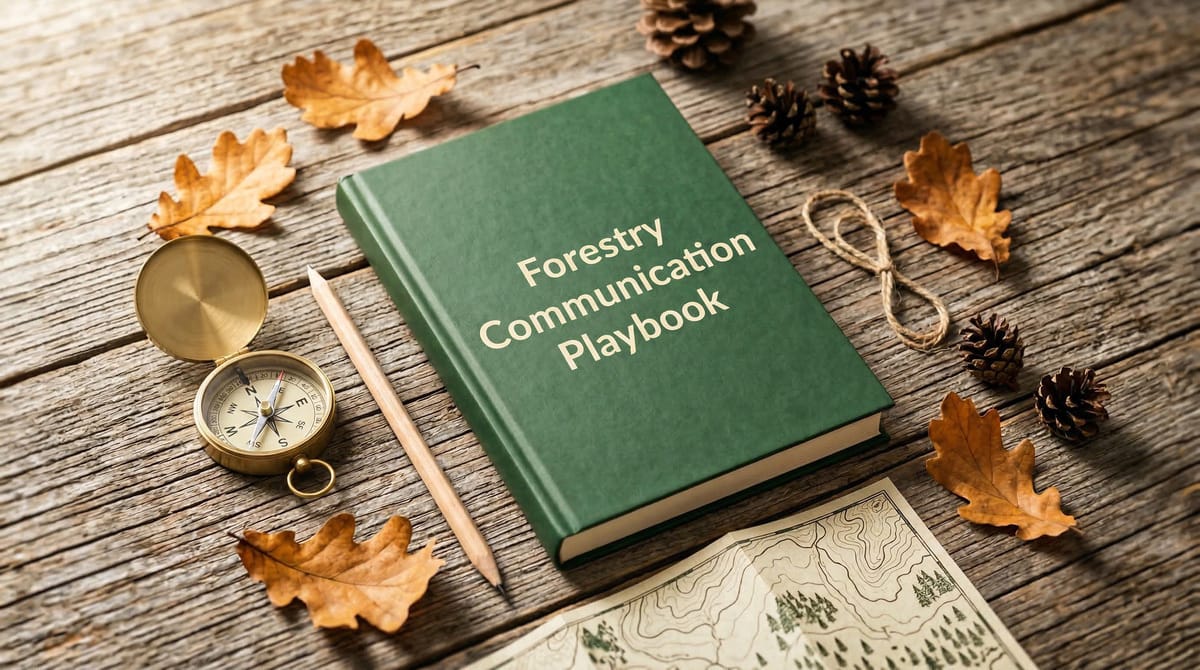
📖 The Forestry Communication Playbook
You just read a year of communication data from one newsletter.
The Playbook is the method behind it. Everything I know about forestry communication.
📗 The Forest-Investment Dictionary
I wrote the Forest-Investment Dictionary with Danish forest economist Anders Tærø Nielsen. It has 151 pages, 11 chapters, 14 printable tools, and 3 calculators. Investors learn to read a forest. Foresters learn to read a term sheet.
When the market turns, the people who can read the numbers make the better calls. The price is €99. Get yours below.

🤝 ForestryBrief Services
European forestry needs better communication and smarter capital. We deliver both.
Intelligence: EUDR compliance, timber market analysis, carbon market monitoring, forest investment due diligence.
Communication: Content strategy, trade publication articles, stakeholder messaging, staff training. Three languages: EN | DE | HU.
Live — Conference presentations, panel moderation, keynotes. Next: WAN-IFRA World Printers Summit, Rotterdam, October 2026.
First briefing guarantee: if it doesn't deliver intelligence you can act on, you don't pay.
Until Tuesday!
Wish you all the best: Peter
🤝 Need help with forestry communication, intelligence, or due diligence? See what we offer → ForestryBrief Services
📩 Got this email forwarded to you? Subscribe to ForestryBrief here.
📚 Missed an issue? Browse the ForestryBrief archive
P.S. What’s the biggest challenge you’re facing in forestry right now?
Hit reply and let me know — I read every message personally.
P. P. S. Know a forest professional who’s drowning in EUDR complexity or missing out on timber market shifts? Forward this email to them!
Shauna Matkovich's Forest Invest Podcast is one of the best resources for understanding where forest finance is heading. If you are interested in Forest Investments, start there.
If you like FB be sure to subscribe to Boreal Tech Brief, a newsletter of my friend Axel covering tech in forestry with a Nordic angle:
