
Below the Waterline
A Canadian-founded company operating in French Guiana — with a Paris-headquartered, Euronext-listed parent — is opening a fiber category Europe has not yet learned to count.
The trees that did not move
In 1994, a dam closed in French Guiana. The water rose. Trees did not move.
Hundreds of thousands of them stood where they had grown. The water reached their canopies. Then it kept rising. Thirty years later, those trees are still there. Standing. Underwater.
This is the Petit-Saut reservoir on the Sinnamary River. It is the largest artificial lake in France — and among the largest anywhere in the European Union. The maximum surface is around 365 km², averaging closer to 300 km² depending on hydrology. Beneath it sits a tropical forest that EDF chose not to clear before flooding. The submerged forest is not an environmental success story. The dam is a textbook case study in tropical reservoir greenhouse gas emissions. Peak methane fluxes were recorded in the mid-1990s. But the wood, in the cold, low-oxygen depths, is largely preserved.
A company called Triton Timber Group has the concession to harvest it.
Almost no one in European forestry knows the name. That is the point of this piece.
A Canadian start, a French parent
Triton was founded in 2000 in Victoria, British Columbia. Two patented underwater harvesters carry the brand. SAWFISH™ handles deep water. SHARC™ works trees down to about 25 metres. The SHARC has a 25-metre telescopic boom and runs on biodegradable hydraulic fluid. The barges return to shore on the lake's surface. No roads cut into the forest. The lakebed stays undisturbed.
Three Guyanese SHARCs are named Angélique, Amarante, and Amourette. The names come from prized tropical hardwoods of the Guianas. Angélique is Dicorynia guianensis (basralocus). Amarante is Peltogyne spp. (purpleheart). Amourette is Brosimum guianense (snakewood).
The “Canadian-founded” label is correct but incomplete.
Since December 2019, Triton has been a wholly-owned subsidiary of Voltalia SA. Voltalia is a renewable energy independent power producer listed on Euronext Paris (FR0011995588). Voltalia is itself majority-owned by the Association Familiale Mulliez (AFM) of France through Voltalia Investissement. The holding company held about 71% of the equity at the end of 2024. Robert Klein became Voltalia's CEO in January 2025, taking over from Sébastien Clerc.
This matters for European readers. Triton is no longer a small Canadian operator. It now sits inside a publicly-traded French renewable energy group. That parent has clean disclosure, an independent board, and a corporate balance sheet behind it. That changes how an institutional investor reads the asset.
What the meeting taught me
I spoke in late April with Tom Avery and Marion François. Tom is a lifelong professional forester. He runs Triton's resource assessment and development work. He trained at the Northern Alberta Institute of Technology and the University of Northern British Columbia. He spent his pre-Triton years at West Fraser, one of Canada's largest wood-products companies.
Marion is Corporate Affairs Manager at Triton. She studied mechanical and industrial engineering at CNAM in Paris. She worked as a field engineer for General Electric on heavy-duty gas turbines. Before joining Triton in October 2020, she spent eight years in the French administration for the Antarctic territories. Seven of those years were as Technical director. The final year was as district manager in Terre Adélie.
The conversation reframed something I thought I knew about reclaimed timber.
Triton runs the entire value chain at Petit-Saut. Harvest planning. Environmental monitoring. Underwater harvesting. Sorting and processing at lakeside. Kiln-drying. Finishing. Export. The Office National des Forêts (ONF) holds the underlying state-property mandate. Through a convention with ONF, Triton is authorised to extract up to 5 million tonnes of submerged wood. Public sources put the duration at 25 to 30 years. The current authorisation is expected to run into the early 2050s. The annual extraction target is around 140,000 tonnes. The flagship customer is next door.
The hub
Voltalia and Triton call the joint Petit-Saut operation the Pôle Scierie et Energie de Petit Saut. In English: the Petit-Saut Sawmill and Energy Hub. According to the project's communications, total investment exceeds €200 million. French press has called it the largest private investment currently underway in French Guiana.
The biomass plant is operated by Voltalia through a dedicated project company (SPV), Sinnamary Biomasse Energie. Capacity 10.5 MW. Annual output around 80 GWh. Voltalia announced commissioning on October 14, 2025. The plant supplies roughly 8% of the electricity demand on the French Guianese coast. The economic anchor is a 25-year offtake contract. It runs under France's Commission de Régulation de l'Énergie mechanism for non-interconnected zones. Voltalia's existing biomass assets at Kourou and Cacao add to the new SBE plant. In French Guiana, Voltalia now supplies around 16% of the territory's electricity through its solar, hybrid (solar and storage), hydroelectric and biomass assets.
The sawmill side is Triton's. The target is around 9,000 m³ of reclaimed timber per year. Installed sawmill capacity is stated at 25,000 m³. Lower-grade material flows directly into the SBE plant. The Pôle Scierie et Energie commits to “over 90 direct local jobs” during the operating phase, with 70 on Triton's side and the remainder at Voltalia's SBE. Reporting from late 2025 confirmed about 60 hires made, with the build-out continuing.
These figures are project-led forecasts. The first submerged log was raised on July 25, 2023. Commercial sawmill output is still ramping. Treat the numbers as targets the company has stated, not as audited operational results.
The Tom and Marion split
Tom's framing was the asset. He spoke about building what he calls a resource and reserve portfolio. A structured way to compare reservoirs across continents — Brazil, Laos, British Columbia — using consistent filters. The idea is to articulate the inherent value of underwater fiber baskets globally. To make them legible to governments, reservoir owners, and investors. As he put it on our call:
“There is intrinsic or inherent value in those trees underwater. And one of the messages I want to convey is that you have a resource here. There is value here. And Triton can help extract it.”
That is the investor side of the story. It is also the harder side. The asset class barely exists in the categories investors recognise.
Marion's framing was the value chain. She described how Triton handles every step from resource analysis through technology adaptation, harvesting, processing and finishing. Often the operation solves a problem the reservoir owner, or project developers, did not know how to address. Decaying submerged timber emits greenhouse gases. It can affect water quality and create risks for dam infrastructure. The trees also pose serious navigation hazards for lake users. Triton turns that liability into a fiber product.
Marion put it this way:
“Either it's a positive or a negative one, depending on which side you are on. It's still something that you can use. Because everybody is looking for fiber these days.”
Two people. Two angles. Same company. The asset story and the operations story are both true.
A quarter-century of reservoirs
Petit-Saut is not Triton's first reservoir. It is the largest current operation in a 25-year track record.
Triton's earliest commercial harvest was at Lois Lake in British Columbia. Both SAWFISH™ and SHARC™ went through testing and development there between 2002 and 2009. The SAWFISH™ was deployed at the Nechako Reservoir in BC in 2005. From 2007, the company worked at Kenyir Lake in Malaysia. Between 2011 and 2015, a Triton subsidiary called Clark Sustainable Resource Developments held a concession on Lake Volta in Ghana. The terms ran 25 years across 350,000 hectares. At the time, it was the largest underwater logging concession in the world.
Other engagements include harvesting on Bayano Lake in Panama and remediation projects on Williston Lake in BC and Lake Shannon in Washington State. Feasibility and assessment work has covered the Jirau Reservoir in Brazil (2013), the Bakun Reservoir in Sarawak (2014), the Brokopondo Reservoir in Suriname (2014), the Panama Canal anchorage parcels (2014) and the Corumbá III Reservoir in Brazil.
The geographic spread matters. Triton has a body of operational data across continents, climates, and regulatory regimes. The Petit-Saut blueprint can travel.
Why this connects to Europe
European pellet imports reached around 4.7 million tonnes in 2025. EU pellet production fell roughly 7% in 2024 to 22.7 million tonnes. The biggest pressure point is sawmill residues. Over 80% of European pellet feedstock comes from sawmill by-products. With construction softening and sawmills running below capacity, residues are tight. The bark beetle salvage cycle is winding down. Russian and Belarusian pellets remain banned. Latvia and Estonia have tightened harvesting rules. Drax in the UK alone imported 9.6 million tonnes of pellets in 2024.
The EU Deforestation Regulation adds further pressure. Large operators must comply from December 30, 2026. Geolocation data and due-diligence files apply to every shipment. Mordor Intelligence estimates this will add €2 to €5 per tonne to costs for imported pellets. The compliance machinery favours larger, certified operators.
Against this picture, Triton sits in an unusual position.
The wood it harvests has been underwater for over thirty years. The trees died before the EU's current regulatory regime existed. The flooding pre-dates EUDR's December 2020 cutoff by twenty-six years. The conversion was forest to reservoir, not forest to agriculture. On a plain reading of Article 2(13) of the regulation, Petit-Saut wood is not deforestation-implicated.
Whether reclaimed underwater timber qualifies under the regulation's waste-and-recycled-material exemption in Annex I is a separate question. The European Commission's guidance to date cites timber from dismantled buildings as a qualifying example. It does not specifically address reservoir-recovered timber.
On the French side, two regulatory signals point in Triton's favour.
First, Triton states that the French Ministry of Agriculture has confirmed Petit-Saut submerged timber falls outside the scope of EUDR. I have not yet seen this confirmation in a published Commission or Member-State document. Treat it as Triton's representation pending independent publication.
Second, the picture is clearer on the renewable energy side. Décret n° 2023-1367 of 28 December 2023 sets sustainability and greenhouse-gas-reduction derogations for biomass fuels in France's overseas territories. The decree specifically defines the legal status of biomass extracted from the Petit-Saut reservoir. It applies Article L.281-4 of the French Energy Code to that biomass, treating it as waste-derived under the EU Renewable Energy Directive (RED II) framework. Article 3 of the decree reserves the EU deforestation regulation separately.
What is unambiguous: French Guiana is part of the European Union. It is an outermost region of France. The legal basis is Article 349 of the Treaty on the Functioning of the European Union. EU law applies in full, with limited modulation. Wood produced there is EU-origin for intra-EU trade purposes. No third-country tariff applies on shipments to mainland France or other Member States.
The transatlantic frame
The structural picture is unusual.
A Canadian-founded company. A French parent. A South American operating site that is legally EU territory. A €200 million sawmill and biomass complex anchored by a 25-year regulated French offtake contract. A fiber product that may or may not benefit from a novel reading of European deforestation rules. A market — European pellet and sawn timber — looking for non-Russian, non-Belarusian alternatives. At exactly the moment when residues are tight.
For a European pellet manufacturer scanning for non-traditional fiber, this matters. Tom raised the point on our call:
“If you're a major Scandinavian pellet manufacturer interested in replacing fiber, and you understand there's a company that could be exporting two or three or four hundred thousand tons of pellets per year out of South America or British Columbia, from underwater — yes. Interesting.”
Today, Triton's local economic anchor is the Guianese grid. The export bulk pellet route to Northern Europe has not been built. But the Petit-Saut operation is the proof of concept. Tom's resource and reserve portfolio work is aimed at the next reservoirs. Some of those will be in jurisdictions where bulk export economics could close.
What is not yet known
Reclaimed underwater timber as an asset class is still being defined. A few things are genuinely open.
Certification. FSC, PEFC and the Sustainable Biomass Program have not, as far as I have found, published specific protocols for reservoir-recovered timber. Triton held Rainforest Alliance “Rediscovered Wood” Chain of Custody certification from 2004 to 2014, when the standard was discontinued for lack of market scale. That remains the longest record in this niche. But the European institutional investor's preferred frameworks are FSC and PEFC. Mapping reclaimed underwater timber into those categories is unfinished work.
Carbon accounting. This is contested ground, and the article should say so plainly. Triton and Voltalia state, under UNFCCC Methodology ACM0018, an avoided emission of around 67,900 tCO₂e per year for the SBE biomass plant. The project financing passed AFD due diligence under IFC standards. The figure is still a project-led number using a recognised methodology. It is not an independently peer-reviewed life-cycle assessment.
Separately, the Office Français de la Biodiversité (OFB) has published scientific work through its R&D pole on greenhouse gas emissions from tropical reservoirs more broadly. That synthesis is not an assessment of the Petit-Saut project. It uses different system boundaries and addresses a different question. The two should not be conflated.
There is no peer-reviewed life-cycle assessment of reclaimed underwater timber as a class. The honest answer is: it is too early to put a single, defensible carbon number on this fiber.
Investor categorisation. Two questions sit here, and they have different answers. The impact thesis is the easier one. The fiber arrives without a standing tree being cut. It removes decaying biomass that emits gas and threatens dam infrastructure. It feeds renewable generation on an isolated grid. Read against nature-based and impact investment theory, that logic is fairly straightforward. It has simply not been obvious to a market that never counted this fiber. The harder question is the wrapper. Reclaimed underwater timber does not map cleanly onto TIMO or natural capital fund templates. The biological asset is not growing. The harvest profile is closer to a mineable resource than a managed forest. The cost structure is technology-intensive. SFDR Article 8 or 9 framing has not been tested on this asset class. Tom's instinct that the categories need building is correct.
These gaps are not weaknesses in the Triton story. They are the work to be done. The European forestry investment community has been waiting for exactly this kind of work.
The 10th Man read
The consensus says European fiber supply is tightening. Residues are constrained. Pellet imports will rise from outside the EU. Compliance costs will favour larger operators.
The 10th Man read says something else. A fiber category already exists inside EU territory. None of those analyses count it. It has not been counted because it has not been categorised. A Canadian-founded company, owned by a Euronext-listed French renewable energy group, is the operator. The asset is novel. The regulatory questions are open. The investor categories are unbuilt.
If you are an investor looking at European natural capital, this is worth knowing about.
If you are a pellet manufacturer looking at the next decade, this is worth a phone call.
If you have spent your career on terrestrial forests, this is worth ten minutes of curiosity.
Sources
Meeting transcript with Tom Avery and Marion François, April 28, 2026, with quotes used with permission, and follow-up review correspondence May to July 2026. Triton company information: tritontimber.com and Voltalia investor materials. Voltalia 2019 Triton acquisition: MarketScreener, December 4, 2019. SBE biomass plant commissioning: Voltalia press release, October 14, 2025. Pôle Scierie et Energie de Petit Saut investment scale and offtake structure: pole-scierie-et-energie.com and L'Usine Nouvelle. EU pellet market data: USDA Wood Pellets Annual 2025 (The Hague, EU report E42025-0004) and Mordor Intelligence Europe Wood Pellet Market Report 2025. EUDR cutoff and timeline: Regulation (EU) 2023/1115. French overseas biomass derogations and Petit-Saut legal status under RED II: Décret n° 2023-1367 du 28 décembre 2023, JORF n°0303 du 30 décembre 2023, texte n° 116. French Guiana EU status: Treaty on the Functioning of the European Union, Article 349. Petit-Saut dam history and reservoir surface: Wikipedia (French and English), NASA Earth Observatory October 2024 OLI-2 imagery, Hydroécologie Appliquée 1992. ONF concession terms: France Guyane and Wikipedia FR (Lac de Petit-Saut). Triton track record: tritontimber.com Past Projects and Concession Operations pages, plus trade press. Tropical hardwood nomenclature: USDA Forest Service Forest Products Laboratory; The Wood Database.
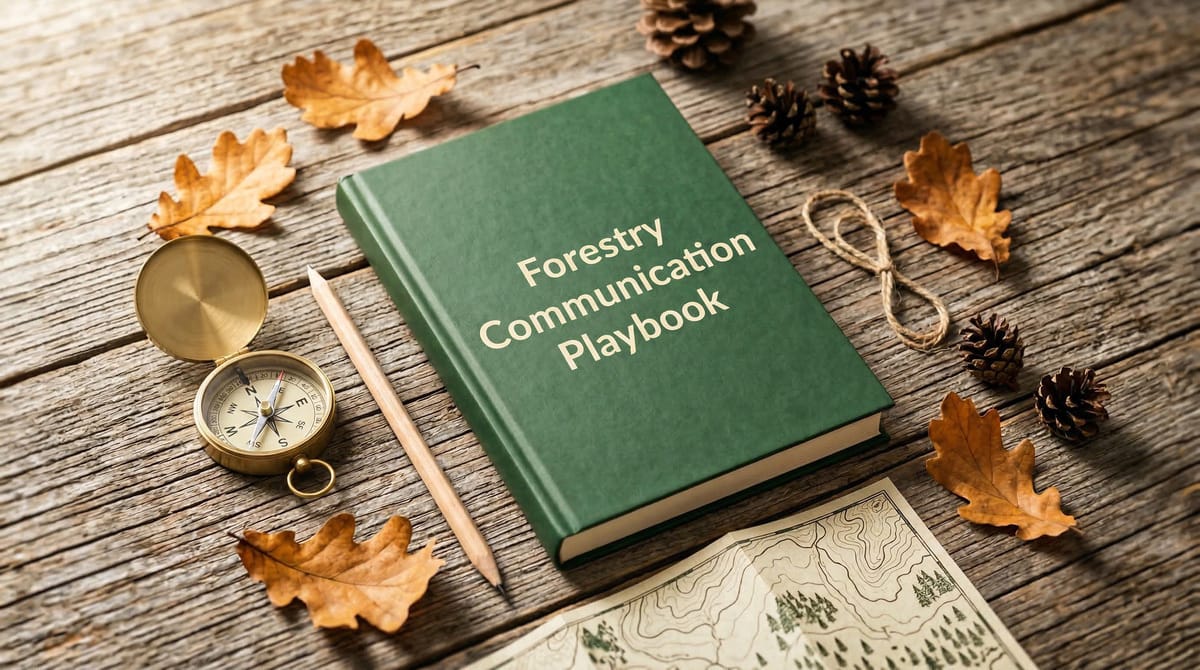
📖 The Forestry Communication Playbook
The next time someone asks why you cut trees (even under water), you'll have thirty seconds to answer.
Right now — what do you say?
If the answer isn't ready, the Playbook is. Everything I know about forestry communication.
📗 The Forest-Investment Dictionary
I wrote the Forest-Investment Dictionary with Danish forest economist Anders Tærø Nielsen. It has 151 pages, 11 chapters, 14 printable tools, and 3 calculators. Investors learn to read a forest. Foresters learn to read a term sheet.
When the market turns, the people who can read the numbers make the better calls. The price is €99. Get yours below.

🤝 ForestryBrief Services
European forestry needs better communication and smarter capital. We deliver both.
Intelligence: EUDR compliance, timber market analysis, carbon market monitoring, forest investment due diligence.
Communication: Content strategy, trade publication articles, stakeholder messaging, staff training. Three languages: EN | DE | HU.
Live — Conference presentations, panel moderation, keynotes. Next: WAN-IFRA World Printers Summit, Rotterdam, October 2026.
First briefing guarantee: if it doesn't deliver intelligence you can act on, you don't pay.
Until Thursday!
Wish you all the best: Peter
🤝 Need help with forestry communication, intelligence, or due diligence? See what we offer → ForestryBrief Services
📩 Got this email forwarded to you? Subscribe to ForestryBrief here.
📚 Missed an issue? Browse the ForestryBrief archive
P.S. What’s the biggest challenge you’re facing in forestry right now?
Hit reply and let me know — I read every message personally.
P. P. S. Know a forest professional who’s drowning in EUDR complexity or missing out on timber market shifts? Forward this email to them!
Shauna Matkovich's Forest Invest Podcast is one of the best resources for understanding where forest finance is heading. If you are interested in Forest Investments, start there.
If you like FB be sure to subscribe to Boreal Tech Brief, a newsletter of my friend Axel covering tech in forestry with a Nordic angle:
