
The Claim and the Tree
How money decides what a forest is worth — and why the capital that respects the biology is the capital that wins
Butterfly Effect — Issue #3: Finance & Capital Markets
The Butterfly Effect series maps the web European forestry sits inside. Part 0 explained how the sector actually works. Issue #1 (Expectations Gap) showed why society wants forests to do everything at once. Issue #2 (Energy) traced the energy squeeze. This issue traces a quieter thread: how money reaches into your forest, and what it expects when it gets there. The news on this thread changes every week. The wiring underneath it does not. This issue is about the wiring.
What this issue is
Picture a forester and an investor standing in front of the same stand of trees.
The forester sees growth rings. A thinning that is due. A stand that will be ready in forty years.
The investor sees a yield. A discount rate. A hold period.
Same forest. Two languages. This issue is the translation.
Here is the idea at the centre of it. A financial claim on a forest and the physical forest are two different things. One lives in a spreadsheet. The other lives in the ground. The gap between them is where both the risk and the reward sit.
Most Butterfly Effect issues trace a force from the outside in. Energy. Climate. Regulation. This one traces money. And money is the strangest thread of all, because it does not behave like a tree.
Three durable truths shape how money meets a forest. This issue covers all three.
One. How money values a forest — the claim versus the tree.
Two. Where the value actually sits in the chain — owning versus processing.
Three. What risk hides under the asset — insurance, climate, and carbon that pays less than it promises.
Master those three and you understand how finance shapes forestry. You do not need a finance degree. You need a mental model. By the end of this issue you will have one.
Then we reach the payoff. ForestryBrief calls it Standing Wealth.
This is the general map. It is free, because everyone who deals with capital needs it. How it applies to your forest, your country, and your buyers is a different thing. That part is a ForestryBriefing.
FOREST FINANCE IN FIVE NUMBERS
~10.7% a year — The average return of US institutional timberland since 1987. Calm, not flashy. (NCREIF / AcreTrader)
6.9% vs 15.9% — How much timberland returns bounce around, versus the stock market. Less than half as wild. (Timberland Investment Resources, 1991–2020)
+0.81% vs +18.4% — Timberland versus the S&P 500 across the COVID year of 2020. Timber barely moved while stocks roared. (Callan / NCREIF)
about half — The share of the world's pension plans that now hold timberland or farmland. The money has arrived. (Nuveen)
90% vs 5% vs 2% — Private forest owners insured in Sweden, Germany, and France. Same continent, three different risk worlds. (Brunette & Couture)
1. Why money comes to the forest
Start with the basics. Who buys forests, and why?
The buyers are big pools of patient money. Pension funds. Insurance companies. Sovereign wealth funds. Family offices. They share one problem. They hold enormous sums of money for a very long time. A pension fund must pay people in thirty years. It needs assets that last thirty years.
That money has two kinds of homes.
The first is paper assets. Stocks and bonds. You own a claim on a screen. You can sell it in a second.
The second is real assets. Land, buildings, and forests. You own a physical thing you can stand on. A real asset is exactly that — something real.
Forests are a real asset with three traits that big money loves.
They hold value when money loses it. When prices rise across the economy, cash buys less. Economists call protection against this an inflation hedge. Forests are a good one. Over the years 1997 to 2022, timberland returns tracked inflation far more closely than stocks did. The link for timberland was strong. For the stock market it was almost nothing.
They do not move with the stock market. When shares crash, forests mostly keep growing. This is called low correlation. It means a forest zigs when your shares zag. That makes a portfolio steadier. Big investors pay for that.
They are calm. Forest returns bounce around far less than share prices do. Since 1987, US institutional timberland returned about 10.7% a year. Its returns swung less than half as wildly as the stock market's. Per unit of risk taken, it paid investors better than equities did.
So forests are a steady, inflation-proof, low-drama real asset. That is why the money comes.
Now the one number that rules all of it. The required return. You will also hear it called the discount rate.
Think of it as how impatient the money is.
Money that is happy with 4% a year is patient money. Money that demands 12% a year is impatient money. The required return decides what a far-off harvest is worth today. A high required return shrinks the value of anything that pays off slowly. A forest pays off very slowly. So the required return matters more for a forest than for almost any other asset.
Picking and defending that number for a real forest is a craft in itself. It is where good advice earns its keep. We are not covering the how here. We are making sure you know the what and the why.
One more piece of wiring. Interest rates.
When central banks raise rates, safe bonds start paying more. Investors then demand more from everything else, including forests. Land prices feel the pressure. When central banks cut rates, safe bonds pay less. Money goes hunting for real assets, and forest values firm up.
This pull works in both directions, always. It is permanent. The exact setting changes month to month. The mechanism never does.
Put it together and the result is already visible. About half of the world's pension plans now hold timberland or farmland. In Europe the figure is 44% of pension schemes. The money has arrived. The real question is what it expects once it gets here.
2. The claim and the tree
Here is the gap at the heart of forest finance.
A spreadsheet sees a number that grows on a schedule. A forest grows on its own clock. The two do not always agree. When they fight, the forest wins, because the forest is real.
Roy Nott understands this in a useful way. Nott trained in forestry at Yale and was a senior executive at a major US timber company. He now runs LD Nott Company. He describes forest value in the language of time.
Old-growth forests, he says, were built over biological time. Centuries. They were stored value, packed slowly by nature. Industrial forestry cashed that store. In its place we planted forests that run on financial time. Decades. The old forest was stored capital. The new forest is flow income. Two very different things wearing the same word — forest.
This is the gap that trips up money.
Money expects to speed things up. A forest will not be rushed. You cannot turn a sixty-year rotation into a thirty-year one without changing what you grow and what it is worth. Fertiliser helps a little. Genetics help a little. But the biological clock still rules. When return expectations collide with growth rates, the expectations are the ones that break.
That sounds like bad news for the forest as an investment. It is the opposite.
Because the asset is a living tree and not a quarterly earnings line, it does not panic when markets do. A forest is a shock-absorber, not a moonshot.
Look at what happened in two famous shocks.
In 2008, the global financial crisis hit hard. The S&P 500 lost about 38% that year. Institutional timberland stayed positive. It softened in the years that followed, as all land did. It never crashed.
In 2020, COVID hit. Stocks fell hard, then roared back, ending the year up more than 18%. Timberland did something far more boring. It returned under 1% for the whole year. It just kept growing wood.
That is the lesson in two numbers. Timberland rarely wins the race in a boom. It rarely loses badly in a bust. It compounds quietly through both. Trees grow in a recession. That is the entire point.
But there is a catch for the investor, and it sets up everything that follows.
This is patient money's game. Capital that must move fast, exit early, or hit double-digit returns every year is fighting the biology. It almost always loses that fight. Most big funds that buy natural assets know this. They aim for a steady 8% to 10% a year, not a quick fortune. They are buying time as much as timber.
3. Own the tree, not the mill
The second durable truth is about where the value sits.
In the forest economy, value sits in owning the growing asset. Not in processing it. Owning beats converting. This is geometry, not opinion, and it does not change.
Watch how it works.
A sawmill buys logs and sells boards. Its profit is the gap between the two prices. That gap is thin, and it swings hard. When log prices climb faster than lumber prices, the mill's margin gets crushed. The owner who sold those logs does just fine at the same moment.
Europe shows this pattern on a loop. Industry reports describe a "forestry paradox" — log costs rising faster than the prices mills can get for finished timber. The squeeze lands on the processor. The forest owner captures the high log price and moves on. This is not a one-off bad year. It is the permanent shape of the chain.
Here is why the owner wins over the long run. The mill lives or dies on a spread it cannot control. The forest owner holds an asset that grows whether the mill has a good year or a bad one. The tree does not care about the mill's margin. It just adds another ring.
The smartest money has already noticed.
IKEA's investment arm has quietly become one of the largest private forest owners in Europe. It holds more than 330,000 hectares of forest across several countries, and it keeps buying. Remember what IKEA is. It is one of the largest users of wood on the planet. It could have simply kept buying boards on the open market forever. Instead it bought forests.
Think about what that choice says. A furniture giant decided the durable value was in owning the tree, not just turning it into a shelf. The investment arm is owned by a foundation. That lets it think in generations, not quarters. Patient capital, again, buying the asset rather than chasing the spread.
The lesson for the forest owner is a quiet confidence booster. You are already sitting on the part of the chain the biggest players are trying to buy into. Owning standing timber is not the dull end of forestry. It is the end everyone else wants.
4. The risk under the asset
The third durable truth is the one the brochure skips.
Every forest asset sits on top of risk. The patient owner reads that risk. The impatient buyer skips it and gets surprised. Three layers matter, and none of them show up in a one-line "European timberland" allocation.
Layer one. The weather can take it, and most forests are not insured.
Forest insurance across Europe is wildly uneven. Sweden insures about 90% of its private forest owners. That covers roughly 95% of its private forest area. Germany insures about 5%. France insures about 2%.
Same continent. Completely different protection. (These shares come from long-standing European forest research and are likely on the conservative side today, but the gap between countries is the durable point.)
So an investor buying a Swedish forest and a German forest is buying two different risk profiles. Most fund paperwork treats "European forest" as one thing. The uninsured exposure hides in plain sight. Reading it is part of the job.
Layer two. The climate is rewriting the risk tables.
A 2025 study in the journal Nature Climate Change modelled forest damage across about 91 million hectares of European forest. The damage comes from storms, drought, and insects like bark beetles. Under severe climate change, the modelled loss rises from around €115 billion to around €247 billion. In the worst case, that cuts the timber value of Europe's forests by up to 42%.
These are scenarios, not a bill that has arrived. But the direction is clear. The risk under the asset is moving. Yesterday's insurance math is already behind.
Read positively, this is an edge for the careful owner. A forest with mixed species and varied structure rides out a bad climate decade far better than a single-species block. The owner who diversifies is ahead of the capital that bought a monoculture on an old actuarial table.
Layer three. Carbon looks valuable on paper and pays much less in the bank.
Carbon is sold as the new forest income. Be careful with the arithmetic.
A forest's "paper" carbon value is simple to calculate. Take the tonnes of carbon, multiply by a headline price, and you get a big number. The money you can actually bank is much smaller. For durable reasons.
Buffer pools take a slice. Carbon projects must hold back a chunk of credits as insurance against fire and loss. That slice is often 8.7% to 19.2% of the total. It is volume you can never sell.
Quality cuts the price. In 2025, high-rated forest credits sold for around $14.80 a tonne. Low-rated ones sold for around $3.50. Most older forest credits sit near the bottom.
Costs and rules trim the rest. Measurement, verification, and proving the carbon is genuinely extra all cost money and shrink the cheque.
Here is the tell. The most sophisticated buyers — the pension funds underwriting forest deals — often value carbon income at zero in their models. They buy the trees and treat carbon as a bonus, not a basis. How to actually structure and sell a credible carbon project is a craft. That is a briefing, not a newsletter.
Three layers of risk under the asset. Insurance, climate, and carbon. Reading them honestly is what separates capital that lasts from capital that gets surprised.
5. Standing Wealth
Now put the three truths side by side. They all fall out of one gap. Financial time versus biological time.
The claim and the tree. Money expects a schedule. The forest keeps its own clock. Patient capital wins.
Own, do not process. Value sits in the growing asset, not the thin spread the mill chases. Owning wins.
The risk under the asset. The owner who reads insurance, climate, and carbon honestly is ahead of the buyer who trusted the brochure.
The common thread is patience that knows the biology. Capital that respects the clock, owns the asset, and prices the real risk does well in forestry. Capital that fights the clock, chases the processing margin, and trusts the headline number gets hurt. The forest sorts the two without mercy.
ForestryBrief has a name for what the patient, biologically literate owner is building. Standing Wealth.
Most wealth you buy starts losing value the day it is yours. A car. A boat. They depreciate while they sit. Standing wealth is different. It is wealth that is still growing while you sleep. It adds a ring every season, whether the market is up or down.
A yacht depreciates. Standing wealth grows.
End on the honest, hopeful point. The loudest worry in the sector is that money will hollow out forests. That capital will demand returns the forest cannot give. The answer is not to fear capital. The answer is to teach capital the forest's language.
The forests that win the next century will be owned or backed by money that understands the clock, the chain, and the risk. Forestry does not need less capital. It needs more of the right kind. Patient, literate, and in it for the long grow.
FIVE QUESTIONS BEFORE YOU LET CAPITAL INTO YOUR FOREST
If you cannot answer these, that is useful to know.
1. Is the money talking to you patient or impatient? What yearly return does it need, and how fast does it want out?
2. Are you being paid for the asset, or for a fast exit? Patient money pays for the tree and the time. Impatient money prices in a quick sale, out of your share.
3. Is your forest insured? And do you know how that compares to the country your buyer is used to?
4. Is your forest diverse enough to survive a bad climate decade? A single-species block carries a risk the brochure will not show.
5. Are you counting carbon income you can actually bank? Strip out the buffer pool, the quality discount, and the costs first.
What this means for you
If you own forest: You hold the part of the chain the biggest players want to buy into. Treat standing timber as the asset it is, not the leftover after a harvest. Then check your real risk. Is your forest insured? Is it diverse enough to survive a bad climate decade? Are you counting carbon income you cannot actually bank?
If you are thinking about selling or bringing in a partner: Patient money and impatient money want very different things from your forest. Patient money pays for the asset and the time. Impatient money prices in a fast exit and a high return, and that math usually comes out of your share. Find out which kind you are talking to before you sign anything.
If you advise owners or sit on a forestry association: The basics in this issue are the language your members need. Real asset. Required return. Own versus process. The risk under the asset. With that language, members deal with incoming capital as equals, not as sellers being told what their own forest is worth.
If you are an investor new to this asset class: A forest is the calmest line in your portfolio and the one most likely to be misread. The traits that make it attractive — low correlation, inflation protection, low drama — are the same traits that punish impatience. Buy it for what it is. How to value a specific forest, set the right discount rate, and structure the vehicle is the craft. That part is not a newsletter.
The 10th Man read
The consensus says forest investment is boring and safe. A quiet, bond-like corner of the real-asset world. Buy it, forget it, collect.
The 10th Man read is different. Forest investment is neither boring nor automatically safe. It is patient, biological, and easy to misprice. The very traits that make it calm in a crash make it unforgiving to anyone in a hurry. The danger is not volatility. The danger is misunderstanding what you bought.
The contrarian edge here is simple. The money that does best in forests is not the cleverest or the fastest. It is the money that read the biology the others ignored. It saw the tree behind the claim.
The general picture is the Butterfly Effect. The specific picture — your forest, your country, your buyers, and the right structure for your capital — that is a ForestryBriefing.
Next month's Butterfly Effect
Issue #4: Geopolitics & Security
Forests as critical infrastructure. Sanctions, trade wars, and resource nationalism. Why governments are starting to treat their forests as a security asset, and what changes for the owner when they do.
Coming in a few weeks.
Sources
Forests as an asset class — returns, risk, and behaviour through shocks
NCREIF Timberland Property Index (US institutional timberland, quarterly total returns, inception 1987). https://user.ncreif.org/data-products/timberland/
Callan Periodic Table of Investment Returns (NCREIF Timberland +0.81% in 2020; S&P 500 +18.40% in 2020; S&P 500 total return about −38% in 2008). https://www.callan.com/periodic-table/
Prentiss & Carlisle – “Re-Examining the Case for Timberland” https://www.prentissandcarlisle.com/wp-content/uploads/2019/02/PC_WP_2017-Q3_Re_Examining_The_Case_For_Timberland.pdf
AcreTrader, What's the return on timber investments? (since-inception return about 10.7%; standard deviation 6.9% vs 15.9% for the S&P 500; Sharpe ratio 1.03 vs 0.76; figures sourced to Timberland Investment Resources). https://acretrader.com/learn/farmland-investing/whats-the-return-on-timber-investments
Who is buying, and what they expect
Nuveen / EQuilibrium survey (about half of global pension plans, and 44% of European pension schemes, hold timberland or farmland). https://www.nuveen.com/global/insights/equilibrium/european-pension-asset-allocation-plans
Pensions Expert, on Pensions for Purpose / Palladium research (most natural-capital schemes target an 8–10% IRR and exclude carbon-market revenue from underwriting). https://www.pensions-expert.com/investment/pension-schemes-targeting-20-returns-from-nature-investments/70048.article
Biological time vs financial time (framing)
Roy Nott, LD Nott Company (Aberdeen, Washington). Public LinkedIn writing on the time-based and thermodynamic view of forest value, 2026.
Where value sits in the chain — own vs process
Fordaq, Europe's Forestry Paradox: Sky-High Log Prices Amid Sawmill Struggles (log costs rising faster than finished-timber prices, eroding processor margins). https://www.fordaq.com/news/Europe%E2%80%99s_Forestry_Paradox_Sky-High_Log_117026.html
Fastmarkets, Margin squeeze hits Nordic timber (raw-material costs outpacing sawn-timber prices). https://www.fastmarkets.com/insights/margin-squeeze-hits-nordic-timber-after-fracture-in-raw-materials-export-markets/
Ingka Group, Ingka Investments forestland (forestland holdings across several countries; long-term, foundation-owned rationale). https://www.ingka.com/what-we-do/ingka-investments/forestland-investments/
The risk under the asset — insurance, climate, carbon
Brunette, Couture & Pannequin (2017), Is forest insurance a relevant vector to induce adaptation efforts to climate change?, Annals of Forest Science (Sweden ~90% and France ~2% of private forest owners insured; Germany ~5%). https://link.springer.com/article/10.1007/s13595-017-0639-9
MDPI, Forests 2023, 14(2):289 (share of private forest area insured by country; Sweden ~95%). https://www.mdpi.com/1999-4907/14/2/289
Mohr, Bastit, Grünig, Knoke, Rammer, Senf, Thom & Seidl (2025), Rising cost of disturbances for forestry in Europe under climate change, Nature Climate Change 15:1078–1083. DOI: 10.1038/s41558-025-02408-9. https://www.nature.com/articles/s41558-025-02408-9
Technical University of Munich press release on the above study (€115bn → €247bn; up to 42% of timber value; ~91 million hectares modelled). https://www.tum.de/en/news-and-events/all-news/press-releases/details/the-economic-cost-of-climate-change-for-europes-forests
Regreener, Voluntary carbon market update (high-rated credits ~$14.80/t vs low-rated ~$3.50/t in 2025, citing MSCI; nature-based credit price ranges). https://www.regreener.earth/blog/voluntary-carbon-market-update
California Air Resources Board, Compliance Offset Protocol — U.S. Forest Projects (buffer-pool / reversal-risk contribution of roughly 8.7–19.2% of credited carbon, depending on risk rating). Corroborated in peer-reviewed carbon-market literature.
ForestryBrief cross-references
Butterfly Effect Part 0, 20 March 2026 (How European forestry actually works). https://forestrybrief.com/p/forestrybrief-professional-10
Butterfly Effect Issue #1, 17 April 2026 (The Expectations Gap). https://forestrybrief.com/p/forestrybrief-professional-13-969c
Butterfly Effect Issue #2, 29 May 2026 (The Renewable Sector That Runs on Diesel). https://forestrybrief.com/p/forestrybrief-professional-19
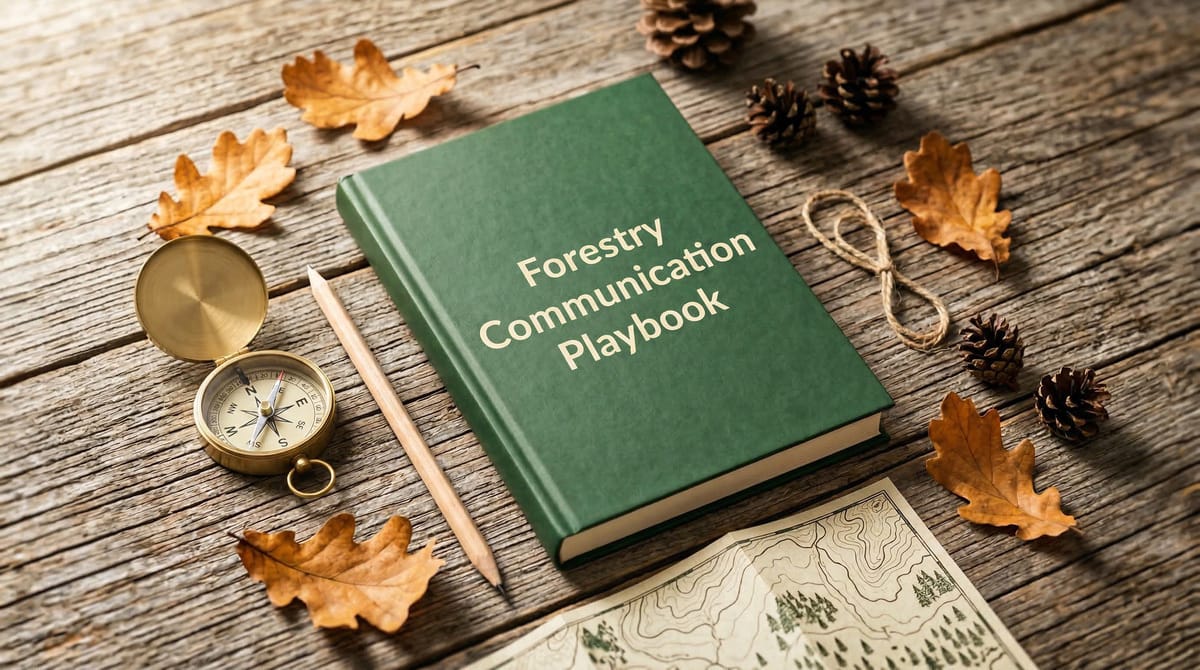
📖 The Forestry Communication Playbook
The next time someone tells you forestry is a poor investment, you will have thirty seconds to answer.
Right now — what do you say?
If the answer is not ready, the Playbook is. Everything I know about forestry communication, in one book. And something even more awesome than this is coming in a few days - on this exact topic: Finances and Investments in forest assets… Stay tuned!
🤝 ForestryBriefing
The brief is free. The briefing is not.
This issue is the general map of how money meets a forest. Your exposure to it is specific. A family estate selling standing timber, a fund weighing a first forestry allocation, and an association preparing members for incoming capital are facing the same forces in very different ways.
ForestryBrief publishes verified intelligence three times a week, in 25+ countries, free. When you need that intelligence applied to your own situation, that is a ForestryBriefing.
Intelligence — Investment due diligence, asset and risk mapping, EUDR compliance, cross-sector analysis, background verification in three languages.
Communication — Stakeholder messaging, trade publication articles, newsletters people actually open. EN | DE | HU.
Live — Conference presentations, panel moderation, keynotes. Next: WAN-IFRA World Printers Summit, Rotterdam, October 2026.
First briefing guarantee: if it does not deliver intelligence you can act on, you do not pay.
Until Tuesday!
Wish you all the best: Peter
🤝 Need help with forestry communication, intelligence, or due diligence? See what we offer → ForestryBrief Services
📩 Got this email forwarded to you? Subscribe to ForestryBrief here.
📚 Missed an issue? Browse the ForestryBrief archive
P.S. What’s the biggest challenge you’re facing in forestry right now?
Hit reply and let me know — I read every message personally.
P. P. S. Know a forest professional who’s drowning in EUDR complexity or missing out on timber market shifts? Forward this email to them!
Shauna Matkovich's Forest Invest Podcast is one of the best resources for understanding where forest finance is heading. If you are interested in Forest Investments, start there.
If you like FB be sure to subscribe to Boreal Tech Brief, a newsletter of my friend Axel covering tech in forestry with a Nordic angle:
