
A Yacht Depreciates. Standing Wealth Grows.
Why the smartest money is quietly buying living forests — and how not to get fooled
Hello,
A superyacht can lose about half its value in its first decade. It burns fuel, eats berthing fees, and rusts in salt air. It is the purest status object money can buy. It is also a slow fire that you pay to keep burning.
Now picture a different kind of trophy.
A Danish retail billionaire owns a large stretch of the Scottish Highlands. He is not building a casino on it. He is planting native pine, restoring peat bogs, and bringing back eagles. His stated time horizon is 200 years. He will never see the finished result. His great-great-grandchildren might.
One asset shrinks while you watch. The other grows while you sleep.
This issue is about that second kind of wealth. The people already building it. The returns it can pay. And the traps that turn good intentions into expensive mistakes.
We have a name for it. More on that at the end.
The New Trophy
For most of history, the rich showed status through things that decay. Bigger houses. Faster cars. Longer boats. The signal was simple. "I can afford to waste this much."
A quieter signal is now spreading among some of the world's smartest money. The new trophy is a living system that you protect and grow. Not a thing you consume. A thing you steward.
Look at who is already doing it.
Anders Holch Povlsen built his fortune in fashion retail. He is now Scotland's largest private landowner. Through his company Wildland, he and his wife manage around 220,000 acres across 13 Highland estates. The plan is ecological recovery on a 200-year timescale. Deer numbers cut so native forest can return. Peatland repaired. Lost species brought back.
Here is the part that matters for this issue. Wildland is blunt about what it is not. It describes itself as not a charity, or a carbon offset scheme dressed up in green. The model is meant to pay its own way through luxury hospitality and property. Stewardship as a business, not a donation (WildLand; Globetrender).
Yvon Chouinard founded the outdoor brand Patagonia. In 2022 he did something almost unheard of. He gave the whole company away. Ownership passed to a trust and a non-profit built to fight the environmental crisis. The structure is designed so that company profits now fund nature protection. Patagonia reports it has distributed $180 million to the cause since the change. His line for it became famous. "Earth is now our only shareholder" (Patagonia — Ownership).
Kristine and Douglas Tompkins made their money in clothing, with brands like Esprit and The North Face. Over about 25 years they spent roughly $345 million buying degraded land in Chile and Argentina. Then they gave it back. In 2019 they donated around one million acres to Chile. It was the largest private land donation in history at the time. It helped create and expand a chain of national parks (Tompkins Conservation; AFAR).
Hansjörg Wyss built a medical-devices fortune in Switzerland. He has pledged at least $1.5 billion to protect nature, aimed at the global goal of protecting 30% of the planet by 2030. His campaign reports helping safeguard nearly 65 million acres of land and vast areas of ocean (Wyss Campaign for Nature).
These are not small gestures from people with nothing to lose. These are some of the most successful business minds alive. They chose nature as their signature legacy. The next generation of wealth is watching them.
You do not need a billion to start. A new model is making this reachable. In Scotland, a former clean-energy entrepreneur built a nature-recovery company and raised £7.5 million from more than 50 investors in its first round. Family offices, wealthy individuals, and impact investors all took part. They are measuring carbon and biodiversity on the land at a fine level of detail (Green Finance Institute). This is early, and the company is honest that some of its long-range numbers are still estimates. But the door is now open to more than just billionaires.
The Part Nobody Expects: It Pays
Here is where most people stop listening. They assume nature is charity. Spend money, feel good, see nothing back.
That assumption is wrong. And the proof is sitting on a single hillside in Wales.
ForestryBrief covered this earlier in the Butterfly Effect series. Foresight Group ran a 145-hectare Welsh woodland called Banc Woodland. They bought it in 2021, planted it in 2022, and sold it after 4.75 years. The result was a 15.5% internal rate of return and a 1.8x multiple. And the income did not come from timber and land alone. The sale also included 16,550 verified Woodland Carbon Code units (Foresight Group).
Read that again. Money and nature. The same hectare. At the same time.
This is the heart of the whole idea. People treat returns and the environment like a seesaw. Push one side up, the other goes down. But a well-run forest can lift both at once. The trees grow, which is the financial return. The growth also stores carbon and shelters life. One asset. Two outputs. No trade-off forced on you.
And this is not a lone case. Serious money is moving into forests right now.
Who | The move | When | Source |
|---|---|---|---|
Stafford Capital Partners | $1.2bn timberland fund | Dec 2025 | Business Wire |
BTG Pactual (timberland) | $1.24bn, its largest reforestation fund yet | Apr 2026 | Business Wire |
CapMan Natural Capital | New Article 9 forest fund; ~€1.5bn, 215,000 ha, 8 EU countries | Dec 2025 | CapMan |
France Valley | ~€1.3bn natural assets; a top-3 European manager | 2025–26 | IPE / France Valley |
Foresight (one Welsh hillside) | 15.5% IRR + 1.8x + 16,550 carbon-code units | Nov 2025 | Foresight |
Full sources are linked in the text and listed at the end.
These are not small bets. As of mid-2024, one major manager put about $123 billion of institutional capital in timberland worldwide (Chief Investment Officer). This is not a fringe idea. It is an asset class.
Europe shows the full cycle, not just fundraising. CapMan Natural Capital recently sold about 24,000 hectares of Baltic forest to Inter IKEA (CapMan / Dasos). Buy, grow, then sell at a profit. The whole loop, proven on the continent.
Why do forests fit serious portfolios so well? Three plain reasons.
Trees grow no matter what the market does. A tree adds wood every year. Bull market or bear market. That growth is a return that does not need a buyer to show up.
Forests hedge inflation. When building costs rise, wood prices rise too. The asset is physical. It cannot be printed or diluted away.
Forests do not move with the stock market. When shares fall, a forest keeps growing. That makes it a rare source of calm in a portfolio.
So the wealthy who buy living forests are not only buying status and legacy. They are buying a real asset that pays. The philanthropy and the profit can sit on the same balance sheet. That is the part nobody expects. And it is the part that turns a nice idea into a serious one.
How Not to Get Fooled
Now the hard part. The 10th Man part.
When something becomes fashionable, the fakes arrive. Money attracts grifters. Green money attracts green grifters. If you are going to put serious capital into nature, you must know how to tell the real thing from the costume.
Start with carbon credits. The idea is simple. You pay for a project that removes or avoids carbon, and you get a credit for it. The problem is that many of these credits have not held up to scrutiny. A major joint investigation by several news organisations found that a large share of rainforest offset credits in the voluntary market may not represent real emission cuts (The Guardian investigation). The certifier disputes the method. The debate continues. The lesson stands. A credit is only as good as the system behind it.
Next, tree planting. It sounds foolproof. Plant trees, save the planet. But planting is not the same as growing. One record-setting mangrove planting saw fewer than 2% of seedlings survive (Yale Environment 360). A study across parts of Asia found nearly half of planted trees died within five years (Mongabay). The wrong tree, in the wrong place, with no aftercare, is wasted money. This is exactly why real forestry needs real foresters.
Then the outright scams. The UK's financial regulator names forestry among the unregulated investments scammers steer money into (FCA). Cold calls. Inflated prices. No way to sell when you want out. The pitch sounds green. The outcome is a loss.
None of this means nature investment is a trap. It means rigour is the moat. Here is how the real thing protects itself.
Real assets, not paper promises. A forest you can visit, measure, and walk through is harder to fake than a certificate.
Verified frameworks. The UK's Woodland Carbon Code, for example, audits carbon claims under a national system. That is why credits from it can actually be sold.
Named, regulated managers with a track record. Ask for audited numbers. Ask what happens if timber prices fall 30% for three years. A serious manager has an answer.
Professional forestry on the ground. Someone who knows the soil, the species, and the climate. Not a remote spreadsheet.
This is the reason ForestryBriefings exists. The biggest risk for a wealthy person entering this space is not losing money. It is the embarrassment of bragging about a "green" investment that turns out to be a scam. Nobody flaunts a project that blows up in public.
So the job is simple to say and hard to do. Find the real ones. Call out the fakes. Make it safe to be proud of what you own.
The Quiet Status Shift
There is a reason this trend is gathering speed. It is not only about doing good. It is about how humans signal status. And the science here is clear.
Researchers have studied what they call "conspicuous conservation." In experiments, people chose green products over more luxurious ones when status was on their mind. The effect was strongest when they were shopping in public and when the green choice cost more. As the lead researcher put it, people want to be seen as being altruistic (ScienceDaily, on Griskevicius et al., 2010).
In plain terms. A visible, costly, lasting act of stewardship is becoming a stronger status signal than another luxury toy. The forest beats the boat. Not in spite of the cost. Because of it.
Now add the money in motion. A huge wealth transfer is underway. One research firm projects around $124 trillion will pass to heirs and charity through 2048 (Cerulli Associates). And the younger generation thinks differently about it. One major bank study found 73% of millennials use sustainable investments, against just 21% of older investors (Barron's, on the Bank of America study). Family offices are leaning the same way, with many planning to invest in green and nature themes.
Put it together. The next wave of serious money is younger, greener, and looking for meaning as much as returns. It wants assets it can be proud of. Living forests fit that need almost perfectly.
The gap between need and supply is huge. The UN's nature-finance body says investment in nature must rise sharply to meet the world's goals, while far larger sums still flow to activities that harm nature (UNEP — State of Finance for Nature 2026). That gap is not a warning. It is the opportunity. The capital has to come. The early and careful movers will shape where it goes.
Standing Wealth
So here is the name.
We call it Standing Wealth.
The phrase comes from forestry itself. "Standing timber" is the value of trees still rooted in the ground, still growing. It is wealth that gets larger simply by standing there. No factory. No quarterly grind. Just biological time doing its work.
Standing Wealth is the opposite of a depreciating toy. A yacht loses value the day you buy it. A well-run forest gains value every year it stands. One is a cost you flaunt. The other is a legacy that grows.
This is the lens ForestryBrief will use for the people and the capital at the top of the pyramid. Not nature as charity. Not returns without meaning. Both, on the same ground, for the owner and for everyone downstream of a healthy forest.
This is the seed of a much bigger story. We will plant the full version on a larger stage later. For now, remember the line.
A yacht depreciates. Standing wealth grows.
This issue covered the landscape. But the landscape is not your portfolio.
Your risk depends on country, species mix, market, and fund structure. The difference between a real nature investment and a costly mistake comes down to the specific deal in front of you. That check cannot be written in a newsletter. It only applies to you.
ForestryBrief offers tailored intelligence and due diligence for forest owners, family offices, and investors. It is called a ForestryBriefing. If you want to know whether a specific nature investment is real or dressed up — that is what we do. Reach me directly at [email protected].
Sources:
Wildland Ltd / Anders Holch Povlsen — WildLand; Globetrender
Patagonia ownership transfer — Patagonia — Ownership
Tompkins Conservation — Tompkins Conservation | AFAR
Wyss Campaign for Nature — Wyss Campaign for Nature
Highlands Rewilding first raise — Green Finance Institute
Foresight Group — Banc Woodland exit — Foresight Group
Stafford Capital Partners — $1.2bn timberland fund — Business Wire
BTG Pactual Timberland Investment Group — $1.24bn reforestation fund — Business Wire
CapMan Natural Capital — European Forest Fund IV first close — CapMan | Baltic divestment to Inter IKEA — CapMan / Dasos
France Valley — top-3 European natural-capital manager — IPE / France Valley
Institutional timberland ~$123bn — Chief Investment Officer
Carbon offset integrity investigation — The Guardian | Business & Human Rights Resource Centre
Tree-planting survival — Yale Environment 360 | Mongabay
Forestry in investment scams — FCA
Conspicuous conservation — ScienceDaily, on Griskevicius et al., 2010, Journal of Personality and Social Psychology
Wealth transfer ~$124tn — Cerulli Associates
Generational sustainable investing — Barron's, on the Bank of America Private Bank study
Nature finance gap — UNEP — State of Finance for Nature 2026 (stable mirror)
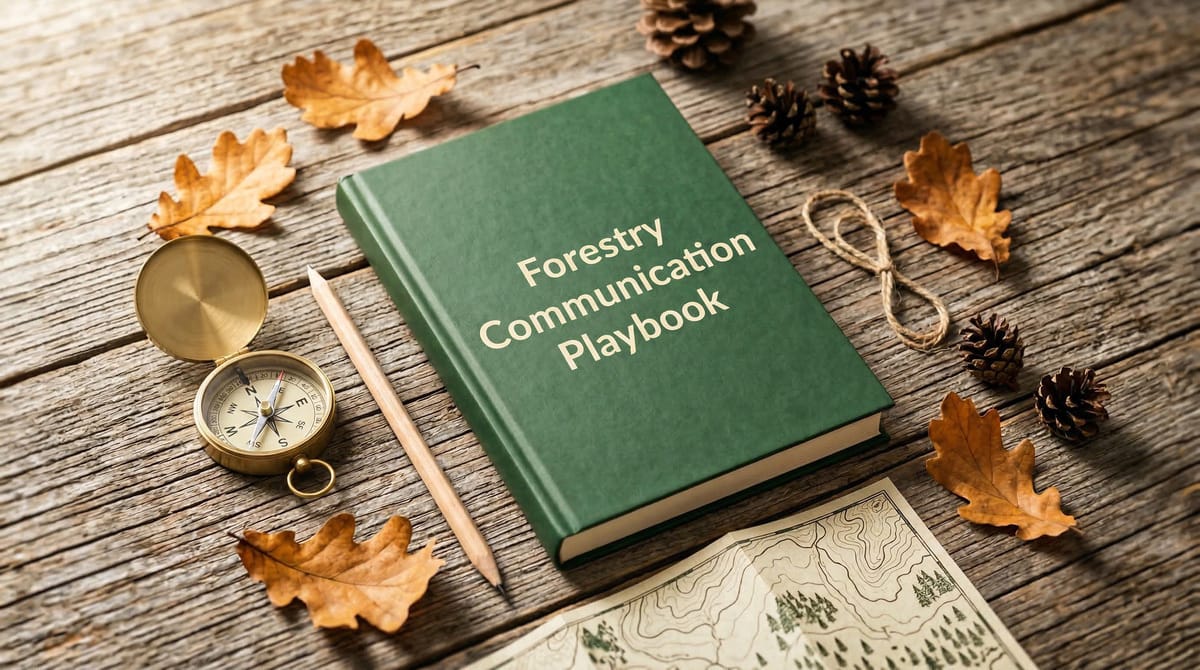
📖 The Forestry Communication Playbook
The next time someone asks why you cut trees, you'll have thirty seconds to answer.
Right now — what do you say?
If the answer isn't ready, the Playbook is. Everything I know about forestry communication.
By the way, something interesting is coming in a few short days, stay tuned…
🤝 ForestryBrief Services
European forestry needs better communication and smarter capital. We deliver both.
Intelligence: EUDR compliance, timber market analysis, carbon market monitoring, forest investment due diligence.
Communication: Content strategy, trade publication articles, stakeholder messaging, staff training. Three languages: EN | DE | HU.
Until Thursday!
Wish you all the best: Peter
🤝 Need help with forestry communication, intelligence, or due diligence? See what we offer → ForestryBrief Services
📩 Got this email forwarded to you? Subscribe to ForestryBrief here.
📚 Missed an issue? Browse the ForestryBrief archive
P.S. What’s the biggest challenge you’re facing in forestry right now?
Hit reply and let me know — I read every message personally.
P. P. S. Know a forest professional who’s drowning in EUDR complexity or missing out on timber market shifts? Forward this email to them!
Shauna Matkovich's Forest Invest Podcast is one of the best resources for understanding where forest finance is heading. If you are interested in Forest Investments, start there.
If you like FB be sure to subscribe to Boreal Tech Brief, a newsletter of my friend Axel covering tech in forestry with a Nordic angle:
