
What North America Asked For — and What Brussels Sent Back
EUDR got simpler — just not for the forests across the Atlantic. Plus the low-risk advantage nobody is talking about.
Hello,
On May 4, Brussels simplified its Deforestation Regulation. The package was big. The relief was real. We covered the operating manual in one of our last Professional issues.
This issue does something different. It looks west.
North America walked into this review with a clear list of asks. Forest owners asked. Mills asked. Two governments asked. Most of what they wanted did not make it into the package.
That sounds like a loss. The headlines say so too. But the story underneath is better than the noise. Read to the end for the part nobody is talking about.
Here is who asked, what they got, and what it means for transatlantic wood.
The Four Asks
North America's requests were not new. The same four came up again and again.
One. A "no risk" tier. Create a new, lighter category for the safest countries. Exempt them from the heaviest paperwork.
Two. Drop the coordinates. Remove the geolocation requirement for low-risk countries.
Three. Fix one word. Match the EUDR's "forest degradation" wording to the United Nations FAO definition. ("FAO" is the UN's Food and Agriculture Organization.)
Four. Fix the maps. Improve the EU's data tools, especially the deforestation Observatory maps.
These came from the National Alliance of Forest Owners (NAFO) and the US government. NAFO speaks for owners of 43 million acres of private working forests. Both filed formal feedback to the EU consultation.
What Brussels Sent Back
The short answer: the rules got simpler, but the core stayed shut.
The Commission did not reopen the main law. It created no "no risk" tier. The start dates held. Large and medium operators face December 30, 2026. So does the whole timber sector.
The Commission estimates the changes cut compliance costs by about 75%. That is roughly €8.1 billion a year down to €2.0 billion a year, once everything applies. That is a Commission estimate, not an audited number.
Here is the catch. Those savings mostly land in two places. They help EU operators. And they help small producers inside low-risk countries who sell straight into the EU.
A US or Canadian forest owner does neither. Their wood enters Europe through an EU importer. That importer still files the statement. That importer still submits the coordinates. So the biggest savings skip third-country producers by design.
A USDA report put it plainly. The Commission, it said, "has not addressed key U.S. concerns."
Here is the ask against the answer.
North America asked for | Brussels sent back |
|---|---|
A "no risk" tier for the safest countries | No new tier. Low-risk stays the floor. |
No coordinates for low-risk countries | Coordinates stay. Eased only for some EU micro and small producers. |
"Forest degradation" matched to the FAO wording | Clarified in guidance, not in the law itself. |
Better Observatory data tools | Improvements promised. Not yet delivered at scale. |
Who Said What
The reaction was loud. It was also not one voice. Here is the map.
The forest owners
NAFO led for private landowners. Its message has not changed in a year. The rules still fall hardest on small owners.
NAFO wants the degradation wording fixed. It wants the coordinates eased for low-risk countries. It wants the data maps to actually work. The group filed its feedback to the consultation. Its position there matches what it has said in public for months.
The mills and exporters
The American Forest & Paper Association (AF&PA) was the bluntest. Its statement on the package was titled No Fixes, More Risk.
AF&PA warned the relief is "concentrated on EU operators." It put US forest-product trade with the EU at over $3.5 billion a year. Its ask is simple and unchanged: exempt US forest products outright.
The American Hardwood Export Council took a calmer line. It backs the goal of the law. It is building its own compliance system instead of fighting the whole thing.
That system uses state-level risk maps, GPS, and satellite checks. The Council asks for just one narrow legal fix. Two US voices, two strategies — one blunt, one building.
The US government
The US Mission to the EU filed its own feedback. The position is consistent across every US channel.
Washington points to a trade deal from August 2025. In it, the EU itself called US production a "negligible risk" to global deforestation. The US argument follows from that. If the risk is negligible, the heavy paperwork makes no sense.
Senator Tom Cotton put the case in five words. "A deal is a deal," he wrote, after his own meeting with the Commission.
One nuance matters. The US is not united here. Representatives Lloyd Doggett and Rashida Tlaib wrote to Brussels in April. They urged it to hold the line, not loosen it. So the pressure runs both ways.
The Tribal forests
This is the sharpest point, and the most overlooked. The Intertribal Timber Council spoke for sovereign Tribal land.
Roughly 7.8 million hectares of US Tribal forestland now sit in that regime. The same one built for high-deforestation regions. These are forests under Indigenous management, often for generations.
Its leader did not soften it. The Commission, he said, still treats Indigenous forestry "as if they pose the same risks as regions experiencing active deforestation." It is a fair point. Well-managed Tribal forests must prove they are not driving deforestation. Deforestation they do not cause.
Canada
Canada gets the least attention in this story. It deserves more.
Canada is on the EU's low-risk list. It sits there beside the United States and the EU itself. Only four countries are high-risk. Canada is nowhere near them.
But low-risk is not the same as exempt. Canadian wood still enters Europe through an EU importer. So the coordinate burden stays, just as it does for the US.
Canada's largest forest body, FPAC, has taken a steadier tone than Washington. Last autumn it called the EU's IT system "not fit for purpose." That system is still being rebuilt, so the point stands. FPAC has also flagged small firms buried inside big supply chains.
And it has asked Ottawa to lean on Brussels. The ask: honor Canada's low-risk status under the June 2025 EU–Canada partnership. Canada picked diplomacy over confrontation. In 2022, the forest sector added C$33.4 billion to national GDP. The stakes are real.
The Other Side
Not everyone wanted the law loosened. That part rarely makes the trade press.
Green groups actually welcomed the Commission's restraint. No reopening. No "no risk" tier. To them, that was the right call.
Their fight was somewhere else. The draft package drops leather from the rules. Cattle leather, hides, and skins would leave the scope.
Groups like Mighty Earth called that a "ridiculous loophole." The Commission's reason: leather is a low-value byproduct that is hard to trace. The debate is live, and the draft is not final.
For forest readers, the takeaway is simpler. Wood, pulp and paper products stay in scope. The leather fight does not change a single line of the forester's paperwork.
The Advantage Nobody Is Talking About
Now step back from the noise. Look at the fundamentals instead.
North American forests are on the EU's own low-risk list. The EU's own 2025 trade deal called US production negligible risk. US forest cover is stable at about 36% of the land. Its forest carbon stocks have grown, not shrunk. Canada's forests are vast and heavily certified.
The thing these rules exist to catch is deforestation. That is not what North American working forests do. They harvest, replant, and grow.
So read the friction for what it is. It is administrative, not existential. It is forms and definitions, not a closed door. And administrative problems get fixed.
Here is the other half. Europe is short of wood. One major study puts the gap at 117 million cubic metres a year by 2040. That demand does not vanish because a form is annoying.
North American fiber will keep crossing the Atlantic. Get your plot data and certification clean now. You will clear the bar with room to spare. The bar was built for high-risk geographies. North America is not one.
That is the part the headlines miss. The paperwork is a hurdle. The position is strong.
What's Still Moving
A few things are not settled yet. Treat these as open, not decided.
The product list now goes to the European Parliament and Council. They have two months to review it. The final list could still shift.
The EUDR's online system reopens in June 2026. Testing starts there. The big dates still hold. Large and medium operators are bound from December 30, 2026.
Watch three things from a transatlantic seat. Whether the final product list changes. Whether Washington escalates inside the wider US–EU trade talks. And whether Brussels ever moves on how it scores country risk.
The Intelligence Below the Surface
This maps where the whole sector stands. But the map is not your shipment.
Your exposure depends on your species, your grades, and your markets. And on how your contracts are written. A US oak exporter and a Canadian pulp shipper face different forms and different risks. The general picture is free because everyone needs it. The specific picture is a service because it only fits you.
ForestryBrief builds market-specific trade intelligence for exporters and importers working across the Atlantic. If you want to know what the EUDR reset means for your shipments — [email protected].
Closing
The rules got simpler this month. The fight over the last mile goes on.
North America asked for a lot and got little of it. But the fundamentals did not change. North American forests are low-risk, and Europe needs their wood.
The paperwork is the hurdle. The hand is strong. Clarity beats noise — every time.
📎 Your Operational Companion (updated 11 June 2026)
You've read the politics. Here's the operating manual to go with it.
Our EUDR Quick Reference Guide is a free, three-page reality check. The three operator roles. The First Operator decision tree. The country risk tiers. The Annex I product list. The dates that matter through 2027. Just refreshed on 11 June.

Sources
The EU package
European Commission press release IP/26/941 — 4 May 2026
COM(2026) 191 final — review report (Council PDF)
Draft Delegated Act on Annex I — Have Your Say consultation, closed 1 June 2026
The two consultation submissions
United States
USDA FAS GAIN E42026-0041 — 7 May 2026
AF&PA, No Fixes, More Risk — 4 May 2026
NAFO, Welcome EUDR delay, urge meaningful simplification — Dec 2025
Intertribal Timber Council statement (7.8M ha; Desautel quote) — PR Newswire, 11 May 2026; secondary: Wood Central
"A deal is a deal" — Sen. Tom Cotton, statement on X, ~26 April 2026 (link the exact post before publishing)
US lawmakers' letter (Doggett, Tlaib, 24 April 2026) — Euronews
Congressional Research Service IF12777 — trade scale
Canada
NGOs / leather
Mighty Earth, leather "loophole"
Mongabay — leather removal, 5 May 2026
Europe's wood supply
AFRY/EPF Strategic Wood Availability Study, summary via TTJ — 20 Nov 2025
Notes: The 75% / €8.1bn→€2.0bn figures are Commission estimates. The substance of the NAFO and U.S. Mission submissions is drawn from each body's published statements and official channels; the verbatim consultation filings are not separately reproduced here. Reuters' 30 April 2026 leather scoop and some Fastmarkets coverage may be metered (subscription) — used only as corroboration.
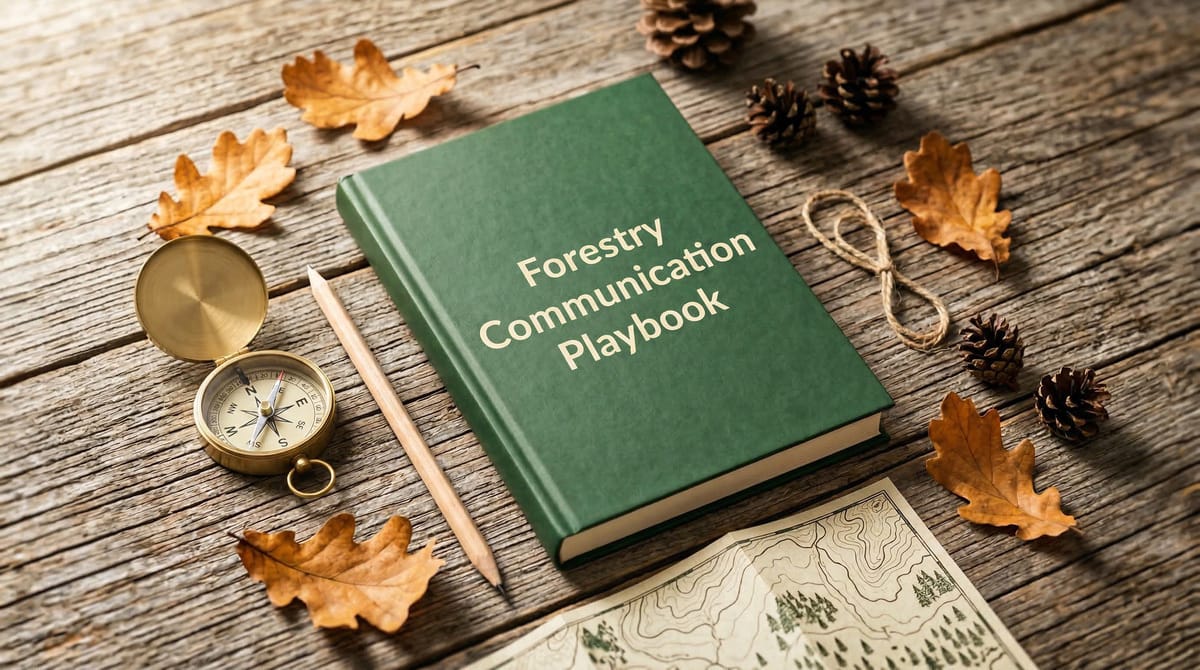
📖 The Forestry Communication Playbook
The next time someone claims the EUDR shuts North American wood out of Europe, you'll want a clean answer.
Right now — what do you say?
If the answer isn't ready, the Playbook is. Everything I know about forestry communication.
🤝 ForestryBrief Services
European forestry needs better communication and smarter capital. We deliver both.
Intelligence: EUDR compliance, timber market analysis, carbon market monitoring, forest investment due diligence.
Communication: Content strategy, trade publication articles, stakeholder messaging, staff training. Three languages: EN | DE | HU.
Until Tuesday!
Wish you all the best: Peter
🤝 Need help with forestry communication, intelligence, or due diligence? See what we offer → ForestryBrief Services
📩 Got this email forwarded to you? Subscribe to ForestryBrief here.
📚 Missed an issue? Browse the ForestryBrief archive
P.S. What’s the biggest challenge you’re facing in forestry right now?
Hit reply and let me know — I read every message personally.
P. P. S. Know a forest professional who’s drowning in EUDR complexity or missing out on timber market shifts? Forward this email to them!
Shauna Matkovich's Forest Invest Podcast is one of the best resources for understanding where forest finance is heading. If you are interested in Forest Investments, start there.
If you like FB be sure to subscribe to Boreal Tech Brief, a newsletter of my friend Axel covering tech in forestry with a Nordic angle:
