
We Invented Sustainability. Then We Stopped Talking.
Forestry has the best environmental record of the last century. The data is on our side. We just never said it out loud.
Hello,
In 1713, a German mining administrator published a book almost nobody reads today.
His name was Hans Carl von Carlowitz. The book was Sylvicultura Oeconomica. In it, he wrote down a simple rule. Only cut as much wood as the forest can grow back. He called it nachhaltende Nutzung. Sustained use.
Today we have a shorter word for it. Sustainability.
A forester invented the idea. Over three hundred years ago. It is now the foundation of modern environmental thinking. Every sustainability report. Every EU rule with "sustainable" in the title. Every brand that uses the word to sell things. They all build on what a forester wrote down in 1713.
How many people know this? Almost nobody. How many forestry groups lead with it? Almost none.
We own the origin story of sustainability. Yet we never claimed it.
In the last two Communication issues, I covered why forestry lost the public narrative, and why facts alone never win the argument. This issue is different. This is the story we should have been telling for thirty years. And the reason it has never been more urgent to start.
The Forester's Seesaw
Before the story, one idea. Without it, nothing else makes sense.
Picture a seesaw. On one side sits the living forest. On the other sits the dead forest.
The living forest is what most people picture. Standing trees. Carbon storage. Clean water. Wildlife. Recreation. Mental health. All free. All invisible in the economy. All depending on the tree staying alive.
The dead forest is the forest as raw material. Timber. Furniture. Paper. Packaging. Energy. The frame of your house. The box your delivery arrives in.
The moment a tree is harvested, it crosses from one side to the other.
Both sides matter. You cannot have one without the other. But this is not a contest between two sides. It is a cycle. A tree grows. It dies. It falls. New trees grow in the gap. Nature already runs this wheel. It just takes centuries.
Foresters speed the wheel up. They guide the harvest. They plant the next generation. They protect the soil, the water, and the wildlife while they do it.
This is what no other industry does. Mining digs and moves on. Farming harvests and replants the same year. Forestry manages a balance that plays out over a century.
And here is what makes a forester different from every other professional. A forester is the only person who plants something knowing they will never see the result. An architect sees the building rise. A surgeon sees the patient recover. A forester plants an oak and trusts the next generation to finish the job.
That takes a kind of faith no other profession asks for.
The seesaw is the story. Every message, every answer, every tactic comes back to it. If the public understood the seesaw, they would understand forestry. They don't. Because we never explained it.
Let's fix that.
The Success Story Nobody Knows
Start with the facts that should be on every forestry homepage. They almost never are.
EU forests now cover about 160 million hectares. That is 39% of all EU land (Eurostat, 2022).
Since 1990 alone, the EU added about 14 million hectares of forest. That is an area the size of Hungary and Slovakia combined (Eurostat). Go back to 1950 and EU forest area has grown by more than a third. Over the same period, the amount of wood standing in those forests rose by about 138% — both from European Forest Institute data (see Sources).
Now the number that matters most. Every year, we harvest only about 66% of the new wood that grows (Eurostat, 2022). Put another way, every year since 1961, European forests have grown more than we have cut. The forests keep getting bigger while we use them.
That is not exploitation. That is sustainable management, working, at the scale of a continent. For sixty years straight.
There is more. A large and growing share of Europe's forests now carry FSC or PEFC certification. No regulation forced this. The industry chose it.
Now ask yourself a simple question. Does the average European know any of this?
The answer is no. A 2023 survey found that 60% of Europeans believe their forests are shrinking. Only 15% know the truth — that they are growing (Two Sides Europe, 2023).
We grew the forests. We forgot to tell people. And someone else filled the silence with a simpler story. "Forestry destroys forests."
This is not a crisis. It is an opportunity. The facts are on our side. We just need to say them out loud.
The Continent We Rebuilt
Europe's forests did not grow by accident. Foresters planted them.
After centuries of clearing for farms, fuel, and ships, much of Europe was nearly bare. Photos from the late 1800s show landscapes that look like desert, not Central Europe. What happened next is one of the great restoration stories in history.
Take Hungary. After the Treaty of Trianon in 1920, the country lost most of its forests. The great Carpathian woodlands were gone. Annual timber harvest fell to a fraction of pre-war levels. Hungarian foresters started again, from about 1.1 million hectares.
A hundred years later, Hungary manages over 2 million hectares of forest. That is about 22% of the country, according to the Hungarian Forestry Directorate and World Bank data. Hungary has nearly doubled its forest area in a century. It is one of the great national forestry achievements in Europe.
How many Hungarians know this story? Almost none.
The same thing happened across Europe. Post-war Germany. The Scottish Highlands. The sand-binding forests of Denmark. The reforestation of Poland. Country after country rebuilt what earlier generations had stripped bare.
We did this. Foresters did this. And we never turned it into a story the public could be proud of.
The Carbon Story Has Three Parts. We Only Tell One.
Forestry fights climate change in three ways. We talk about one. We ignore the other two.
Part one: the forest sink. Living, growing forests pull carbon out of the air. EU forests absorb on the order of 330 million tonnes of CO₂ a year (JRC / Migliavacca et al., 2025). Historically that was about a tenth of all EU emissions. It is closer to 6% today, because the sink is weakening. This is the one number we cite.
Part two: substitution. When wood replaces concrete, steel, or plastic, emissions drop. Those materials are made with enormous amounts of energy. Wood is not. Studies from the European Forest Institute put this effect on the same scale as the forest sink itself — on the order of several hundred million tonnes of CO₂ a year (Leskinen et al., 2018). Timber buildings can cut a structure's lifecycle emissions by up to 40%.
Part three: storage in wood products. A wooden house stores carbon for a century. A chair stores it for as long as it exists. Across the EU, wood products lock away about 40 million tonnes of CO₂ a year — roughly a tenth of the forest sink (EEA, 2022, reported in Bozzolan et al.).
The full picture is a cycle. Forests absorb carbon. Wood products replace dirty materials and lock carbon away. New trees grow in the gap. Both sides of the seesaw, working on the climate at once.
The climate movement could have made forestry its poster child. Instead, forests became a symbol of something to protect from industry. Not a tool that industry already provides.
And here is the honest part. The sink really is weakening. Stressed forests store less. That is not an argument against telling the story. It is the strongest argument for it. If the public understands that healthy, well-managed forests absorb more carbon, they become allies for better management — not obstacles to it.
We had the carbon story before anyone was talking about carbon. We never told it. It is not too late.
What's in Your House Right Now
Look around the room you are in. How much of it came from a forest?
The obvious things. Floors. Furniture. Window frames. Doors. But also the paper on your shelf. The cardboard box from your last delivery. The filter in your coffee machine. Wood-based fibres in your clothes. Even compounds in your medicine.
From cradle to coffin. The cot a baby sleeps in. The chair an old man sits in. The box he is buried in. Behind every piece stands a forester who grew it.
The forest-based sector employs around 3.5 million people across the EU and generates well over €100 billion a year in value added (Eurostat). Much of it is rural. It keeps villages alive where little else would.
And the story is getting better, quietly. Wood is starting to replace fossil-based materials in places most people never notice. In packaging that used to be plastic. In textile fibres. In chemicals once made from oil. Forestry is becoming the foundation of a post-fossil economy. That should be a headline. Instead, most coverage is about "deforestation concerns."
When was the last time you saw a campaign linking your morning coffee filter to a well-managed forest? The supply chain is invisible. And invisible industries do not get public support.
The Open Factory Is Free Healthcare
There is one more thing forests give away for free. Health.
Forest visits lower stress. They calm the body in ways researchers can now measure. One well-known study found that a few days in the forest raised the activity of immune cells that fight disease, with the effect lasting more than a month (Li, 2010). UK researchers estimated that visits to woodlands save England about £141 million a year in mental health costs — and £185 million across the UK (Forest Research, 2021).
More than 70% of European forests are open to the public. People walk through them every weekend. As I wrote in an earlier issue, forestry works in an "open factory." Anyone can wander in.
Most industries would pay a fortune for that kind of access to the public. We have it for free. When people walk through our open factory, they are not just looking at trees. They are using a free health service we maintain.
We never describe it that way. We should.
Why We Kept the Best Story a Secret
Every fact above should make you a little angry. Not at anyone else. At ourselves.
We had the best environmental story any industry could ask for. Growing forests. A weakening but still vast carbon sink. Renewable materials. Three centuries of sustainability. The rebuilding of a continent. And we buried it in technical reports.
We published harvest calculations nobody outside forestry reads. We presented data at conferences full of other foresters. We wrote in language that needs a degree to follow. We assumed the work would speak for itself.
It doesn't. It never has. It never will.
Other industries learned this the hard way. Mining found that conflict with communities can cost a large project around $20 million a week in delays (Franks et al., 2014, PNAS). Agriculture lost public trust over pesticides. Nuclear power lost it over fear. Good work, kept invisible, gets no credit. Bad stories, told loudly, become accepted truth.
But here is the difference between forestry and those other industries. They lost their story. We still have ours.
This is not about pretending everything is perfect. It is not. About a third of Europe's forest area is in declining condition — fewer birds, thinner canopy, poorer soil (JRC / Nature Communications, 2023). Monocultures are fragile. Old-growth deserves protection. A confident story is not a dishonest one. We can celebrate the record and be honest about the work still to do. The first makes people trust us enough to listen to the second.
The Story Gap
Let me make it concrete. Here is what we do, and what people think we do.
What we actually do | What the public thinks we do |
|---|---|
Manage the seesaw — keep living and dead forest in balance | Cut down trees for profit |
Grow more wood than we harvest, every year | Destroy forests |
Store carbon and replace fossil materials | Prioritise money over nature |
Continue a 300-year sustainability tradition | Create lifeless monocultures |
Plant trees we will never see harvested | — |
That gap between reality and perception is the single biggest threat to European forestry. Not bark beetles. Not climate change. Not regulation.
The story gap.
Because every rule that restricts forestry — from EUDR to harvest limits — is driven by what voters believe. Politicians respond to perception. If voters believe forestry destroys forests, politicians will regulate as if it does.
We can close this gap. But not with more technical reports. Not with more data in journals nobody reads. We close it by telling the story. Simply. Repeatedly. Everywhere.
A Hungarian chief forester, István Ripszám, once put the whole thing in a single line.
"The product of the forester's work is the forest."
Not the timber. Not the carbon credits. The forest itself. Both sides of the seesaw. Living and dead. Nature and material.
That is the story. Start telling it.
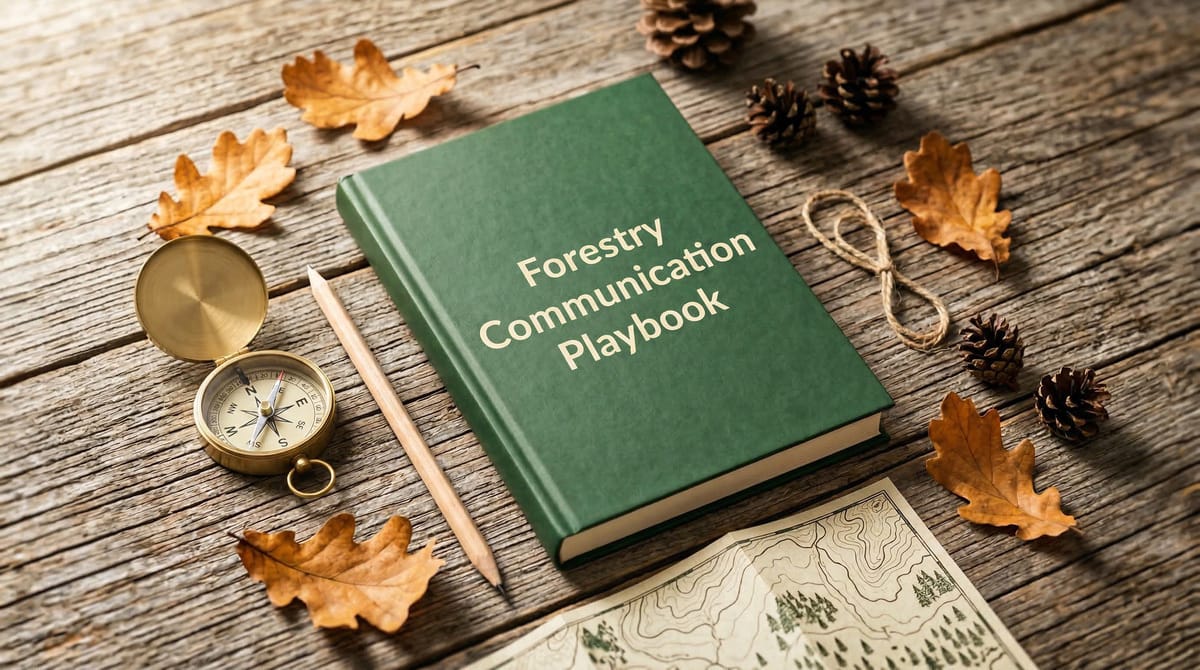
📖 The Forestry Communication Playbook
This issue gave you the story — the seesaw, the record, the carbon, the gap. What it did not give you is the harder part. The exact words. The right order. The answers to the questions that catch you off guard on a forest path.
That is what the Playbook is for.
Ten chapters. Fifteen tools you can print and carry. The eleven core messages every forester should know. Tested answers to the toughest questions the public asks. A step-by-step way to tell this story — with no PR department, no budget, and no communication degree.
The story is free because everyone needs it. The method is the book.
The Forestry Communication Playbook — Part 1
For every forester who's been ambushed by a question they couldn't answer well. Journalists. Neighbours. Council meetings. Answer them like you meant to.
🤝 ForestryBrief Services
If your organisation needs more than a book — a communication strategy, stakeholder messaging, or media preparation — that is what a ForestryBriefing delivers. The story above is general. Your stakeholders, your media, and your political context are not. That is the part we build with you.
Intelligence: EUDR compliance, timber market analysis, carbon market monitoring, forest investment due diligence.
Communication: Content strategy, trade publication articles, stakeholder messaging, staff training. Three languages: EN | DE | HU.
Sources
Forest area, growth and harvest
Eurostat — Forests, forestry and logging (Statistics Explained, 2024 / 2022 data) — 160M ha, 39% of EU land, 66% of net annual increment harvested in 2022
Eurostat — 39% of the EU is covered with forests (2021) — +10% / +14M ha since 1990
European Forest Institute — How have forest resources in the EU developed? (open in a browser) — +37% area and +138% growing stock since 1950; fellings below increment since 1961
Carbon and climate
JRC — European forest carbon sink is declining (2025) — ~330 Mt CO₂/yr; ~6% of EU emissions today, down from ~10%. Underlying paper: Migliavacca et al. (2025), Nature, DOI 10.1038/s41586-025-08967-3
Leskinen et al., 2018 — Substitution effects of wood-based products — substitution effect on the scale of the forest sink
EEA, 2022, as reported in Bozzolan et al., 2024 (GCB Bioenergy) — wood products store ~40 Mt CO₂/yr, ~10% of the sink
Perception, condition, and trust
Two Sides Europe — Trend Tracker 2023 — 60% think forests shrinking, 15% know they grow
Maes et al., 2023, Nature Communications (JRC) — one third of EU forest area in declining condition
Franks et al., 2014, PNAS — community conflict costs ~$20M/week in delayed production
Li, Q. (2010), Effect of forest bathing trips on human immune function, Environ Health Prev Med — NK cell activity raised, effect lasting 30+ days
Forest Research, 2021 — Mental health benefits of visiting UK woodlands — £141M England / £185M UK saved per year
History, economics and quote
Hans Carl von Carlowitz, Sylvicultura Oeconomica (1713) — origin of sustainability
Hungary forest cover ~22% (World Bank, 2023) and the Hungarian Forestry Directorate (NÉBIH) — over 2M ha today, up from ~1.1M ha after Trianon (1920)
Eurostat / European Commission — forest-based sector ~3.5M jobs, >€100B value added
István Ripszám — "The product of the forester's work is the forest" (Erdő-Mező interview, 2020)
Until Tuesday!
Wish you all the best: Peter
🤝 Need help with forestry communication, intelligence, or due diligence? See what we offer → ForestryBrief Services
📩 Got this email forwarded to you? Subscribe to ForestryBrief here.
📚 Missed an issue? Browse the ForestryBrief archive
P.S. What’s the biggest challenge you’re facing in forestry right now?
Hit reply and let me know — I read every message personally.
P. P. S. Know a forest professional who’s drowning in EUDR complexity or missing out on timber market shifts? Forward this email to them!
Shauna Matkovich's Forest Invest Podcast is one of the best resources for understanding where forest finance is heading. If you are interested in Forest Investments, start there.
If you like FB be sure to subscribe to Boreal Tech Brief, a newsletter of my friend Axel covering tech in forestry with a Nordic angle:
