
What Three Americans Came to Brussels to Say
And what the European data on small forest owners says next.
Hello,
On Wednesday, March 25, NAFO and the Intertribal Timber Council held a public briefing in Brussels titled "Making EUDR Workable: Simplification to Support Tribes & Forest Landowners." The venue was the Thon Hotel EU Bruxelles, two blocks from the European Commission. The briefing ran from 10am to 12pm. Anyone could register on Eventbrite (event listing).
I had been invited. Brittney, NAFO's communications representative and a ForestryBrief reader, had emailed me a week earlier. I missed the briefing because I was still in the air to Brussels — a Hungarian forest engineer with a newsletter, on a plane, late.
The delegation could have written me off. Instead they made time in their afternoon. Three Americans and a NAFO consultant walked into a café in central Brussels and ordered coffee. I joined them. They had spent the morning in front of a public audience two blocks from the European Commission. Now they wanted to sit down with a guy who runs a forestry newsletter from Tata, Hungary.
That guy was me. The conversation lasted about an hour over a long coffee in a busy café full of people who had no idea what we were talking about.
The European Commission's deforestation review window opens on April 30, 2026. Before it does, the people most directly affected by EUDR in low-risk countries wanted the conversation to reach a wider audience. They came to Brussels to give it. They held a public briefing. They sat down with me afterwards because I had missed it.
This issue reports what was said in the café, with the formal NAFO/ITC briefing as the public context. It then sets that account alongside the European data on small forest owners that the same review will need to consider.
I am not making the political case for or against EUDR in this issue. I am reporting and presenting. The reader can decide.
Who Came to the Café
The delegation was led by Kate Gatto, Chief Strategy Officer of the National Alliance of Forest Owners (NAFO). NAFO represents private US landowners, from family forest owners to timber investment organizations and large forest businesses, who own and manage roughly 18 million hectares of working forest across the United States — an area roughly twice the size of Portugal (NAFO).
She was joined by Cody Desautel, Executive Director of the Confederated Tribes of the Colville Reservation and elected President of the Intertribal Timber Council (ITC), and Philip H. Rigdon, Superintendent of the Yakama Nation Natural Resources Department and Vice President of the ITC. The Intertribal Timber Council represents Native American tribes that produce timber across the United States (ITC). Both men hold their ITC roles alongside full-time leadership positions in their respective tribes. Both introduced themselves as Cody and Phil, and I refer to them that way through the rest of this issue.
A fourth person joined them: a stakeholder engagement consultant retained by NAFO. His comments below are attributed through Kate, who can speak to the substance of work done on her organization's behalf.
There were no European policymakers at our café table. Whether any attended the morning briefing two blocks from the Commission, I do not know. The Eventbrite listing was public. The invitation was open.
NAFO's Starting Point: Support for the Law
The first thing Kate said was that NAFO supports the objectives of EUDR. US forest owners do not want deforestation. US forest owners do not want forest degradation. The political case for the regulation, she said, is one her members broadly support.
This matters. EUDR was written to address a real problem. Independent investigations by groups such as Earthsight and ClientEarth have documented illegal timber, soy, beef, and palm oil reaching European supply chains through opaque sourcing routes (Earthsight | ClientEarth). The political mandate for the regulation is not invented. It is on the record.
NAFO's argument, as Kate framed it, is not with the goal. It is with how the regulation is operating in countries the European Commission itself has classified as low-risk.
The United States is one of those countries. So is most of the European Union. The deforestation EUDR was written to stop is concentrated, by FAO data and by the EU's own impact assessment, in a small number of tropical countries. None of them are in the EU or in North America (FAO Forest Resources Assessment 2025).
What Cody Said About Market Access
Cody walked through the economics of timber on tribal land in three steps.
Step one. A forest only generates revenue if there is a mill close enough to truck the logs to. Take the mill away, and the forest stops generating cash. The trees keep growing. The wildfire risk keeps rising. The money to manage either is gone.
Step two. On tribal land, that revenue funds law enforcement, schools, and healthcare. The link between timber markets and tribal services is not metaphorical. It is a line in a budget.
Step three. Infrastructure is asymmetric. After the 2008–2009 housing downturn, US milling capacity in some regions dropped by 20 to 30 percent. Mills that closed in that period largely did not reopen. The point was not about the recession. It was about how quickly mills can disappear and how slowly they come back.
He also said the tribes had not been consulted during the development of EUDR. Not by the European Commission. Not by the US federal government either. The first awareness of the regulation, in his account, came after timber purchasers started to enforce the requirements in the law based on the expected date for enforcement. The law includes a dozen references and commitments to consultation with indigenous communities. There are 575 Native American tribes recognized by the US federal government, and according to the ITC, not one has been consulted about EUDR or its implementation.
What Phil Said About Data Sovereignty
Phil raised a different concern.
EUDR requires geolocation data for every plot of land where wood is harvested. For most European forest owners, this is a paperwork burden. For Native American tribes, he argued, it is a question of data sovereignty.
Tribal land data, in his account, carries cultural information that tribes have spent generations protecting. Like all landowners, tribes are required by EUDR to share sensitive geolocation information with their customers, unsecured and unprotected, who then pass it along the supply chain to the operator responsible for entering it into the European Information System. Submitting that data for compliance with a law that tribes had no role in designing is, in his words, difficult to reconcile with the autonomy tribal governments have worked to establish.
He also raised an operational point. Tribal forestry uses prescribed burning to reduce wildfire risk. Active forest management depends on revenue from timber sales. If markets close, prescribed burning programs become harder to fund, and the wildfire risk rises.
Cody added a number for context. Since 2015, fires have burned more than 360,000 hectares of the 560,000-hectare Colville Reservation — the land Cody manages as Executive Director of his tribe. The figure is consistent with public Bureau of Indian Affairs and Intertribal Timber Council reporting on tribal wildfire history.
According to the ITC, the wildfire-compliance link is one of many "blind spots" in the law that remain unaddressed.
"Regulatory Colonialism"
This phrase did not come from anyone at our table.
Kate attributed it to Carla Keene, Chair of the Cow Creek Band of Umpqua Tribe of Indians, who used it in a Wall Street Journal opinion piece on December 26, 2025. The op-ed was titled "The EU Tells Native Americans How to Manage Our Forests" (WSJ).
The phrase is on the public record. It is being used by elected tribal leaders, not by activists. That is the fact I am reporting. I am not endorsing it and I am not contesting it.
The Numbers Kate Brought From the United States
Kate cited results from a recent NAFO member survey of US forest landowners. Two figures stood out.
About 30 percent of landowners surveyed — mostly small forest owners — reported losing sales or contracts because of EUDR-related sourcing decisions made upstream by buyers.
Approximately 43 percent said they are considering permanent conversion of their forest land to a different use as a direct result of EUDR-related compliance or market pressures.
The second number is the one that connects directly to the stated purpose of EUDR. The regulation is designed to prevent forest land from being converted. In low-risk countries, the early NAFO data suggests the compliance load is driving conversion among the smaller landowners who cannot absorb yet another expense. Large, well-resourced owners can meet the polygon data and due-diligence requirements. Smaller landowners and tribes often cannot, and are being sidelined from supply chains as a result.
When the next buyer in the chain says "I cannot take wood from a small owner because the risk of non-compliance is too high," the small owner cannot sell the harvest and cannot earn a return on an investment made decades ago. The small owner is not pushed toward better forestry. The small owner is pushed toward selling the land for non-forest use. Conversion happens because forestry stops paying.
This is what the NAFO survey is measuring.
EUDR, however, is only one of several problems stacked on top of US forest owners right now.
Zooming Out: Forestry Economics
Context matters. Pulpwood prices in the United States are at historic lows. More than 35 mills have closed in the US over the last eleven years. Landowners are facing some of the worst market conditions in decades.
In a market-based forest economy like the United States, forest owners are most likely to convert their land when they cannot sell their harvests. And when they do convert, it is most often to development — the leading cause of forest conversion in the US. EUDR is written to prevent conversion to agriculture. It arrives during a particularly challenging economic time for US forest owners, stacking additional compliance cost on top of high input costs and low output prices.
According to Kate, Phil, and Cody, the United States is a natural supplier of wood and fiber for the European Union. Kate put it this way:
"We have abundant forest resources, we manage to the highest sustainability standards in the world, and we have the data to back it up. We can provide sustainably produced wood and fiber to the EU, which is also the best way to support forest landowners and prevent deforestation in the United States. It could be a win/win for everyone, if only the EU would reconsider its requirements."
Keeping American forest landowners whole and keeping US forest land in forest use, in their view, is a shared objective with EUDR itself. That pathway, they argue, is available if the EU is willing to reconsider how the requirements fall on low-risk suppliers.
The Engagement Gap
Through Kate, the consultant retained by NAFO described months of attempts by US tribal representatives to open a dialogue with the European Commission. Promises to include tribal voices in the EU Multi-Stakeholder Platform on Protecting and Restoring the World's Forests had not, at the time of our conversation, been followed up.
I am repeating this because it was said over coffee and confirmed by Kate on behalf of her team. I have not independently reviewed the underlying correspondence.
The point is not whether one specific email got a reply. The point is that a community on another continent, directly affected by an EU regulation, walked into a Brussels café and said: we tried to open a conversation, and we did not get one back. That is information the April 30 review process can act on if it chooses to.
Now Turn the Camera East
Everything above is the American account. It is the account that flew across an ocean to be heard.
Here is the European context the American visitors did not need to explain to me, because I live inside it.
The compliance squeeze they described — small owners cut off from buyers, compliance costs that exceed annual revenue, infrastructure that quietly disappears — has a European version. On a much larger scale than most of the Brussels review process has measured.
The numbers are not classified. They are public.
Sixteen Million Owners
The European Union has roughly 16 million private forest owners. Together they hold about 60 percent of EU forest area. They are the majority constituency in European forestry, not a fringe (CEPF | FOREST EUROPE — State of Europe's Forests 2020).
The average holding sounds reasonable: about 13 hectares. That number is misleading.
The actual distribution is not a bell curve. It is a cliff.
Based on UNECE Private Forest Ownership Enquiry data, roughly 61 percent of private forest holdings in the surveyed EU countries are smaller than one hectare (UNECE).
Roughly 86 to 88 percent are smaller than ten hectares.
A small minority of larger owners pulls the average up to 13.
Country by country:
Finland: ~620,000 private forest owners. Average holding ~30 hectares.
Germany: ~2 million private forest owners. Average holding ~3 hectares.
Poland: 2 million+ private forest owners. Average holding ~1 hectare.
Romania: ~800,000 private forest owners. Average holding 1–2 hectares.
Portugal: 400,000+ private forest owners. Average holding under 1 hectare.
These are the people EUDR will reach. Most of them have never heard the four letters E-U-D-R spoken aloud. Many inherited a fragment of land from a grandparent and have not visited it in years. They are not non-compliant. They are not aware.
What Compliance Actually Costs a Small European Owner
The European Commission's own impact assessment put one-off EUDR compliance costs at between €5,000 and €90,000 per operator (European Commission EUDR impact assessment).
National figures fill in the picture.
The German wood industry association HDH has estimated EUDR compliance for German forestry at roughly €1.8 billion in initial costs and €1.2 billion annually (Interior Daily).
The Finnish economic research institute PTT (Pellervon taloustutkimus) has put Finnish costs at roughly €207 million startup and €65 million annually (Global Wood Markets Info).
Now do the arithmetic for one specific owner.
A small European forest owner with 20 hectares earns roughly €5,000 to €15,000 in a normal year. The bottom of the European Commission's compliance cost estimate is €5,000.
In the lowest-cost scenario, compliance eats between 30 and 100 percent of one year's revenue from the forest.
For a 2-hectare Romanian owner, the math gets worse. For a sub-hectare Portuguese cork producer, it gets worse still. At some point on that curve, the rational decision is not to comply. The rational decision is to stop.
This is the European version of the 43 percent number Kate brought from the United States.
What European Voices Have Already Said in Public
I am being careful here not to put words in any specific company's mouth. I do not need to. The named industry voices have been on the public record for months. The quotations below are paraphrased from published interviews and press statements.
Markus Schmölzer, of the Austrian Sawmill Association (Fachverband der Holzindustrie), has called EUDR "not implementable" in its current form (original German: "nicht umsetzbar"). He has projected a roughly 10 percent drop in Austrian sawn wood output if the regulation is enforced as currently written (Holzindustrie Österreich | Lesprom English summary).
Marko Mäki-Hakola, Director of Forestry at MTK (the Central Union of Agricultural Producers and Forest Owners of Finland), has described EUDR as well-intentioned regulation that has proven unworkable in practice (MTK).
Maria Pohjala, also at MTK, has publicly questioned the logic of the data collection requirements for owners whose land is already in national forest databases.
Schwörer, chairman of HDH, has called the bureaucratic load "superfluous" for countries where EU-relevant deforestation is not occurring.
These are not anti-environmental voices. They are forestry professionals from the countries with the strongest forest management traditions in Europe. The substance of what they are saying matches what NAFO and the ITC said over coffee in Brussels: we support the goal, but the implementation is breaking the system that already worked.
Two Letters Brussels Has Already Received — Pulling in Opposite Directions
Before April 30, Brussels has already received two very different letters on EUDR. They do not agree on what the Commission should do next. That is the point.
Letter one — reopen the regulation. In July 2025, the agriculture ministers of 18 EU member states sent a joint letter to the European Commission asking for substantial changes to EUDR, including reopening the core text. The signatories: Austria, Bulgaria, Croatia, Czech Republic, Estonia, Finland, Hungary, Ireland, Italy, Latvia, Lithuania, Luxembourg, Poland, Portugal, Romania, Slovakia, Slovenia, and Sweden. Eighteen out of twenty-seven (Reuters | Euronews | Letter PDF).
Letter two — do not reopen the regulation. In March 2026, a coalition of major European food and chocolate brands and leading sustainability NGOs sent a joint letter to Commissioner Roswall urging the Commission not to reopen EUDR following the April review, and instead to focus on implementation support. The signatories include Nestlé, Danone, Barry Callebaut, Ferrero, Tony's Chocolonely, Rainforest Alliance, and Solidaridad (Sustainability Online | Business & Human Rights Resource Centre).
Two letters. One asks Brussels to reopen the text. The other asks Brussels to leave the text alone and fix implementation. Commissioner Roswall has those two asks on her desk.
The unusual part of the second letter is the alignment it represents. Global food brands most associated with deforestation-risk supply chains and the NGOs most associated with watching them signed the same paper. Their shared preference is the opposite of what the eighteen EU agriculture ministers asked for. That is not a common configuration in Brussels forestry policy.
The Numbers Nobody Disputes
It is worth grounding all of this in figures that everyone — including the European Commission — agrees on.
Forest area in Europe has grown by roughly 10 percent since 1990. That is about 14 million hectares added — Hungary plus Slovakia, give or take (FOREST EUROPE — SoEF 2020).
The volume of wood and the carbon stored in European forest biomass have grown by roughly 50 percent over the past three decades (FOREST EUROPE State of Europe's Forests 2020).
Europe currently harvests only about 75 percent of its annual net forest growth. The forest is getting bigger every year, even as it is being used (FAO European Forest Sector Outlook).
The overwhelming majority of global deforestation is concentrated in a small number of tropical countries. None of them are in the EU. None of them are in North America (FAO FRA 2025; EU EUDR impact assessment).
These are the foundations the EU itself used to design EUDR.
The question they raise is uncomfortable. If European forests are growing, if European harvest is below growth, and if European deforestation is statistically negligible — then what, exactly, is the EUDR compliance burden on a Romanian smallholder solving?
That is a question for Brussels, not for me.
The Trust Question
A Fern survey, cited in a March 2026 Bruegel policy brief, found that 82 percent of Europeans believe EU businesses should not sell products that contribute to forest destruction (Fern poll | Bruegel policy brief).
The political mandate for EUDR is real. It is large. It is not going away.
The question is not whether Europeans want deforestation-free products. They do. The question for the April 30 review is whether the current implementation of EUDR delivers that outcome — or whether it delivers something else, in places where the original problem was already small or absent.
That is what NAFO and the ITC came to Brussels to discuss. That is what 18 EU agriculture ministers wrote down in July 2025. That is what Nestlé, Danone, Barry Callebaut, Ferrero, Rainforest Alliance, and Solidaridad wrote down together in March 2026.
The trust the public extended in writing the law is real. So is the compliance burden on the people closest to the forests on both sides of the Atlantic. The April 30 review window is where those two facts have to meet.
What Is Actually on the Table on April 30
A precision note, because there is some optimism on this point that I think is misplaced.
The core text of EUDR is not being reopened. Commissioner Jessika Roswall has said this twice on the record, in January and again in February 2026.
What is on the table is narrower:
Revisions to the FAQ document.
Revisions to the Guidance document.
A Delegated Act that may amend Annex I (the list of products in scope).
Revisions to the Implementing Regulation.
That is a real toolkit. It can clarify ambiguous definitions. It can remove some products from scope. It can address some of the duplicate-paperwork problems for owners whose data already sits in national databases.
It cannot reopen the core text. It cannot change the cost-benefit calculation for a 2-hectare Romanian owner. It cannot put a chair in the room for the Intertribal Timber Council.
The EUDR Information System has been in limited read-only access since February 16, 2026. No new due diligence statements or registrations are being accepted. Reopening is expected shortly after mid-April. Large-operator enforcement begins in late December 2026 under Regulation (EU) 2025/2650 (Sourcemap on TRACES suspension | European Parliament press release).
That leaves roughly eight months between the system being available and the law biting. For an upstream operator on either continent, eight months is not a long time to learn a new compliance regime from scratch.
Why I Am Publishing This
The people I had coffee with in Brussels asked me to make sure their account reached ForestryBrief readers in Brussels and across European forestry. They did not ask me to advocate. They did not ask me to lobby. They asked me to report.
I am publishing the European numbers in the same issue because the two halves are the same story. The Oregon tribal forester, the Finnish family owner, and the Romanian smallholder are all looking at the same compliance bill, and the same survey question: is the forest still worth keeping?
What the reader does with this information is up to the reader. If you are a policymaker, you have a few weeks. If you are a forest owner, large or small, you already know whether this story sounds familiar. If you are an investor, the question this raises about regulatory risk in low-risk jurisdictions is one I will return to in the Investment Dictionary later this spring.
The forest is still growing. The math still works. The goal of the law is still right. The question is whether the implementation, on April 30, can be brought closer to the people who have to live inside it.
Next Week's Professional
🦋 Deep Dive Pillar — Butterfly Effect Part 1: The Expectations Gap
Society expects forests to do everything at once: store carbon, produce timber, host biodiversity, host recreation, cool cities, prevent floods, employ rural communities, and stay beautiful. Physics and biology impose hard limits on which of those can be maximized at the same time.
Part 1 of the Butterfly Effect series maps the gap between what the public asks of European forests and what European forests can physically deliver. With Munich Re and Swiss Re data, the Storm Éowyn aftermath, and the bark beetle insurance gap.
Sources
The Brussels briefing and café conversation (March 25, 2026): Public NAFO/ITC briefing "Making EUDR Workable: Simplification to Support Tribes & Forest Landowners," Thon Hotel EU Bruxelles, 10am–12pm. Eventbrite event listing. Organizers: NAFO and the Intertribal Timber Council. Café conversation with the delegation took place separately the same day, after the formal briefing. AI-assisted transcript and conversation notes on file. This issue was reviewed and cleared by Kate Gatto (NAFO) on behalf of NAFO and ITC — including Phil Rigdon and Cody Desautel — on April 9, 2026.
"Regulatory colonialism": Carla Keene, Chair, Cow Creek Band of Umpqua Tribe of Indians. "The EU Tells Native Americans How to Manage Our Forests," The Wall Street Journal, December 26, 2025. See also Cow Creek tribal press summary.
European smallholder data: CEPF | FOREST EUROPE — State of Europe's Forests 2020 (PDF) | UNECE Private Forest Ownership Enquiry (PDF) | European forest owner scene-setter (PDF).
Compliance cost estimates: European Commission EUDR impact assessment | HDH €1.8B figure (Interior Daily) | Fastmarkets — EUDR rising costs | PTT Finnish estimate (Global Wood Markets Info).
European industry voices: Holzindustrie Österreich press release (German) | Lesprom English summary of Schmölzer 10% drop | MTK | HDH (Interior Daily). Quotations paraphrased from published interviews and press statements; original-language sources available on request.
Letters to the Commission: 18-minister joint letter, July 7, 2025 — Letter PDF, via Reuters and Euronews. March 2026 buyer/NGO coalition letter via Sustainability Online and Business & Human Rights Resource Centre.
Forest data: FOREST EUROPE — State of Europe's Forests 2020 (PDF) | JRC summary of SoEF 2020 | FAO FRA 2025 summary | FAO Global Forest Resources Assessment 2020 interactive.
Public opinion: Fern poll page, via Bruegel policy brief — Extra time for deforestation.
EUDR process and timing: European Commission — Deforestation policy | European Parliament press release on amending regulation (Dec 2025) | Sourcemap — TRACES suspension through mid-April | Commission Green Forum newsletter. Commissioner Roswall public statements, January and February 2026. Regulation (EU) 2025/2650.
Background investigations cited: Earthsight | ClientEarth — Forests stories.
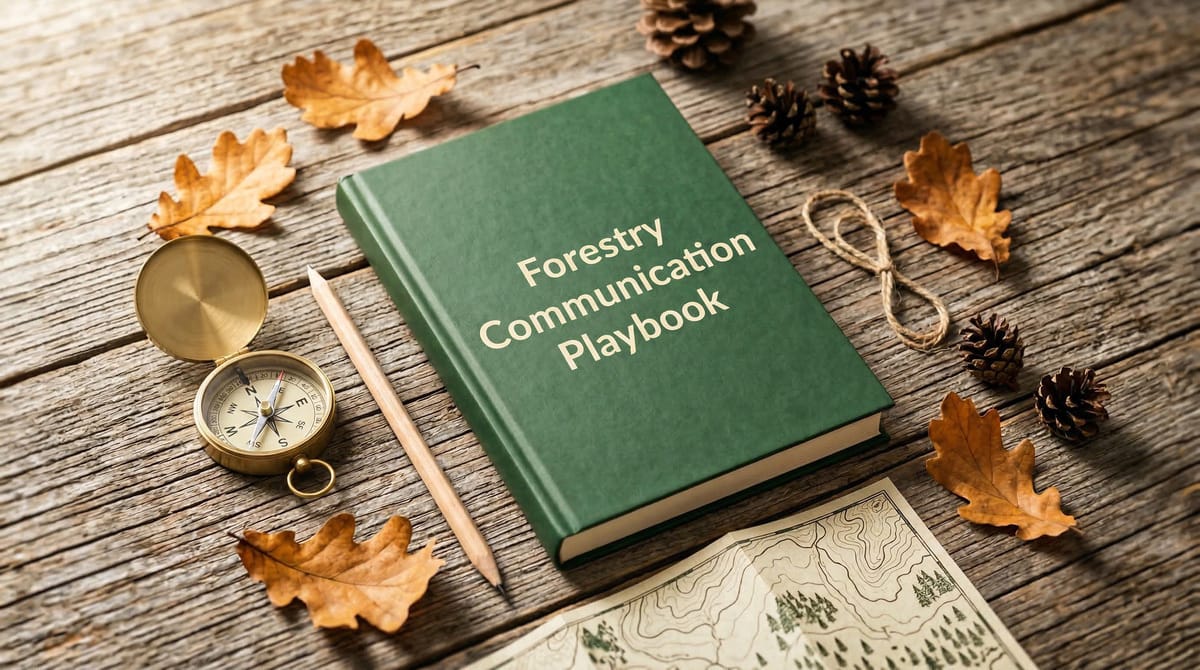
📖 The Forestry Communication Playbook
Everything I know about forestry communication. In one book. 10 chapters. 15 tools. Ready-to-use messages and answers. €29. Instant download.
🤝 ForestryBrief Services
European forestry needs better communication and smarter capital. We deliver both.
Intelligence: EUDR compliance, timber market analysis, carbon market monitoring, forest investment due diligence.
Communication: Content strategy, trade publication articles, stakeholder messaging, staff training. Three languages: EN | DE | HU.
The Forestry Communication Playbook: A complete guide to building your organisation's communication strategy. Coming soon.
Until Tuesday!
Wish you all the best: Peter
🤝 Need help with forestry communication, intelligence, or due diligence? See what we offer → ForestryBrief Services
📩 Got this email forwarded to you? Subscribe to ForestryBrief here.
📚 Missed an issue? Browse the ForestryBrief archive
P.S. What’s the biggest challenge you’re facing in forestry right now?
Hit reply and let me know — I read every message personally.
P. P. S. Know a forest professional who’s drowning in EUDR complexity or missing out on timber market shifts? Forward this email to them!
Shauna Matkovich's Forest Invest Podcast is one of the best resources for understanding where forest finance is heading. If you are interested in Forest Investments, start there.
If you like FB be sure to subscribe to Boreal Tech Brief, a newsletter of my friend Axel covering tech in forestry with a Nordic angle:
