
Why I Believe in European Forest Investments
Hello,
In March, I published an investment analysis that took the sector apart. I examined five risks that pitch decks skip. I questioned data gaps. I flagged fraud warnings. A respected colleague told me the piece felt "off-putting from an investment perspective."
She was right.
Not about the facts. Every number was verified. Every risk was real. But the framing was wrong. I wrote like a prosecutor. I should have written like a believer who reads the fine print.
So here is the other side. Not the soft side. The structural side.
I believe in European forest investments. This is why.
The Only Asset That Grows By Itself
Every other asset class depends on human decisions. Stocks need management. Bonds need repayment. Real estate needs tenants.
Trees grow.
European forests add roughly 3–5% in volume every year. Rain or shine. Bull market or crash. Zero board meetings required.
This is biological compounding. The forest is both factory and warehouse. It produces timber continuously. It stores value on the stump until the market price is right. Unlike wheat or corn, standing timber doesn't spoil. You can delay harvest by years without losing the product.
The NCREIF Timberland Index — the closest thing to a forestry benchmark — has delivered approximately 8–10% annualized returns over multi-decade periods. With roughly one-third the volatility of equities. The exact number depends on which period you measure. But the direction doesn't change.
European returns run lower. Manager underwriting assumptions typically target mid-single-digit real returns. Finland provides the clearest audited data point. Private forest timber production returned 6.9% in 2025 according to Indufor. Biological growth contributed 4.4 percentage points. That's before carbon optionality, before land price appreciation, and before the EU's regulatory machinery pushes more capital into Article 9 products.
The inflation hedge is the strongest of any real asset. TIR Europe's February 2025 paper showed timberland returns scale positively with inflation — outperforming real estate and farmland in high-CPI environments. Manulife's data shows near-zero correlation with equities. For a pension fund looking to hedge inflation without adding equity risk, there is no cleaner instrument.
The Money Is Moving
European forestry is no longer a niche. Multiple major fund vehicles reached first or final close in 2025 alone. Here's what the biggest moves look like.
Gresham House Forest Fund VI closed at £375 million in May 2025. The largest forestry fundraise in UK history. Backers include London CIV, several Welsh pension funds, and South Yorkshire Pensions Authority (£50 million). Target return: 8%. Focus: UK afforestation and established forestry. According to company materials, Gresham House manages approximately £3.4 billion in forestry assets — the UK's largest forestry manager.
France Valley now manages over €1.3 billion across 69,000 hectares in 12 countries, according to company materials. IPE Real Assets ranked them Top 3 among European natural capital managers. Their French forestry fund crossed €600 million. NAV grew 6.33% in 2024 per France Valley reporting. They also launched a €200 million Carbon & Biodiversity Fund targeting greenfield afforestation across Europe.
SLM Partners closed its Silva Europe Fund at €30 million in January 2025. It is the first dedicated continuous cover forestry (CCF) investment vehicle in Europe. The European Investment Bank committed €12.5 million.
BNP Paribas Asset Management launched its Future Forest Fund after acquiring a majority stake in International Woodland Company (€5.5 billion under oversight). First close around $130–145 million. Target: $500 million. SFDR Article 9 classified.
Stafford Capital Partners established a $1.2 billion timberland continuation vehicle in December 2025. Global, not Europe-specific. But it shows where institutional capital is flowing.
And this is just the publicly reported activity.
Foresight Group: From Welsh Woodland to European Platform
Foresight Group is a FTSE 250 listed infrastructure and private equity manager. Its Natural Capital division — co-led by Robert Guest from Edinburgh and Richard Kelly from London — has been active since 2019.
The UK strategy tells a compelling story. Foresight Natural Capital manages approximately £300 million in net asset value across 20,000+ hectares. About 11,000 hectares are new afforestation — recently planted or in development. The rest is established forestry. The programme accounts for roughly 28% of total UK afforestation in the year to March 2024. Backers include East Riding and West Yorkshire pension funds, which doubled their commitments in January 2025 to a combined £50 million.
The Banc Woodland exit proved the model. This 145-hectare Welsh site was acquired in 2021, planted in 2022, and sold after 4.75 years at a 15.5% IRR and 1.8× MOIC. The package included 16,550 Woodland Carbon Code units. Foresight reported "strong competitive interest" from buyers — notable in a period of elevated interest rates.
This was Foresight's first natural capital exit. The numbers speak for themselves.
Now comes the European chapter. Foresight Natural Capital II (FNC II) targets €500 million. Target IRR: 12%. Geographic scope: UK and EU. Asset types include afforestation, permanent tree crops, peatland restoration, and biodiversity net gain. Marketing began in FY26.
In January 2026, Foresight co-published the Natural Capital Report 2026 with Mallowstreet, BNP Paribas AM, and Rebalance Earth. The study surveyed 68 UK institutional asset owners representing over £3 trillion. Its finding: natural capital is approaching a "critical inflection point." Three-quarters of UK local government pension funds have already allocated. One-third of existing investors plan allocations exceeding 3% by 2030.
Robert Guest put it simply: “Supply of sustainable timber in Europe forms the core underpinning of our natural capital strategies. We combine ownership of established forestry with investments focussed on development (e.g. new woodland creation), enhancement, and aggregation to deliver double digit returns for shareholders in parallel with the delivery of environmental services such as carbon sequestration, nature restoration and positive community initiatives.”
That's the opportunity. Sustainable timber supply with institutional-grade returns.
All Foresight data sourced from publicly available press releases, regulatory filings, Foresight FY25 Annual Report, and published interviews. Full source index available on request.
CapMan Natural Capital: One of Europe's Largest Forest Investment Managers
CapMan Natural Capital — operating under the Dasos brand it acquired in 2024 — is one of Europe's largest dedicated forest investment managers. The numbers: approximately €1.5 billion in assets, 215,000 hectares across eight EU countries, and a track record spanning multiple fund cycles.
In December 2025, CapMan announced the first close of European Forest Fund IV. The fund targets investments in forest assets mainly in Northern Europe, the UK, and Ireland. It is classified SFDR Article 9 — the highest sustainability classification in Europe. It carries a 100% FSC/PEFC certification mandate and a target net IRR above 8%.
The same period demonstrated CapMan's ability to execute the full investment cycle. Dasos Timberland Fund II sold approximately 24,000 hectares of Baltic forest to Inter IKEA Group. A complete cycle: acquisition, value creation, institutional exit.
In a recent conversation with ForestryBrief, CapMan's investment team noted that investor education remains essential. Regional differences across Europe are significant. A bad experience in one geography does not reflect the continent as a whole. Both sides agreed that improving data transparency in European forest property markets is a shared interest.
The team also observed that the forestry sector's message has not yet reached its full potential, even within existing coalitions like the International Sustainable Forestry Coalition (ISFC). Communication between forestry and capital markets remains a gap that the industry needs to close.
What makes CapMan's track record significant for the "why Europe" argument is its geographic breadth. Operating across Finland, Baltics, Ireland and Iberia, the platform demonstrates that European forestry is not one homogeneous asset class. It is a continent of distinct markets — each with different species, return drivers, risk profiles, and regulatory frameworks.
Public data sourced from CapMan announcements (December 2025), Dasos Capital press releases, and Carbon Pulse reporting. Conversation-sourced content approved by CapMan.
Not Apples. Fruits.
This is the point most "why Europe" presentations miss.
European forestry is not one market. It is five.
Nordic industrial forestry in Finland and Sweden is the institutional core. Pine, spruce, and birch feed integrated value chains. Finland's Tornator posted €232 million revenue in FY2025 on 800,000+ hectares. Finnish forest land prices hit €4,400 per hectare — the highest this century.
Baltic forestry in Estonia, Latvia, and Lithuania offers entry prices four to six times lower than Western Europe. Prices have risen sevenfold in 25 years. Swedish companies now draw up to 40% of their timber from the Baltics. This is the growth play.
French luxury timber operates on a different planet. Sessile oak from forests planted on Colbert's orders in 1670 feeds the wine barrel cooperage market. A French oak barrel costs $1,200+. Rotation cycles run 200+ years. France Valley's 69,000-hectare, 12-country portfolio demonstrates that patient hardwood management generates returns uncorrelated with commodity timber.
UK and Scottish afforestation is a creation play. Sitka spruce plus Woodland Carbon Code credits. Foresight's Banc Woodland exit — 15.5% IRR on a planted site — validates the dual-income model. Carbon credit prices averaged £26.85 per unit in 2024, up from £11.01 in 2020.
Iberian cork in Portugal is unique. The country produces roughly half the world's cork from 720,000+ hectares. Bark is harvested every nine years without felling the tree. The trees live 150–200 years. It's a billion-dollar industry built on the world's most patient harvest cycle.
Five markets. Five risk-return profiles. Five different reasons to invest. That's not a problem. That's a portfolio.
The Symbiosis: Why Forestry Needs Capital and Capital Needs Forestry
This is not a one-way relationship. Investors don't do forestry a favour. Forestry doesn't do investors a favour. Both sides need what the other has.
Forestry needs the money. Society wants forests to do everything. Produce timber. Store carbon. Protect biodiversity. Filter water. Prevent floods. Provide recreation. Fight climate change. And look beautiful while doing it.
That's not a wish list. That's an expectations gap.
No single hectare of forest can maximize all of these at once. But a well-managed forest can deliver most of them — if it has the right tools. Climate adaptation costs money. Replanting after a storm costs money. Species diversification costs money. EUDR compliance costs money. Certification costs money. The transition from monoculture to mixed-species resilient forests costs money.
Europe has 16 million forest owners. Most hold fewer than 10 hectares. They cannot fund this transition alone. Institutional capital is the only source large enough to equip European forests for everything society demands of them.
Capital needs forestry. Pension funds face a simple problem: their liabilities grow with inflation, but their assets don't. Bonds lose value when rates rise. Equities crash together. Real estate correlates with GDP. Forests grow regardless. A pension fund with a 30-year liability horizon and a forest with a 30-year rotation cycle are a natural match. No other asset class offers biological compounding, inflation protection, carbon optionality, and Article 9 classification in one instrument.
The gap between the two is communication. Foresters don't speak finance. Investors don't speak forestry. The forester sees a well-managed stand of Norway spruce. The investor sees an illiquid alternative with no Bloomberg terminal. Both are looking at the same asset. Neither understands the other's language.
That's the gap ForestryBrief exists to close. And it's the gap that makes European forestry the most under-allocated quality asset class on the continent.
The Structural Case That Doesn't Change
Three things about European forests are true today, were true a decade ago, and will be true a decade from now.
The forests are growing. Europe's forest area has expanded roughly 10% since 1990. Growing stock — the total volume of wood standing — has increased about 50% in three decades. Only about 75–84% of annual growth is harvested. The biological capital base is compounding. This is not a depleting resource. This is a growing one.
The regulatory framework is the deepest in the world. European forest law is among the oldest legislation on the continent. Germany's forest laws trace to the 18th century. Finland has refined its forest legislation continuously since 1886. Hans Carl von Carlowitz articulated the principle of sustainable yield in 1713 — harvest only what can regrow. That principle is now embedded in EU law, national constitutions, and institutional practice. For an investor, this means stability. Rules don't change overnight. Forests managed under European law have centuries of proven track record.
Carbon is a new revenue layer that did not exist a decade ago. The UK Woodland Carbon Code has validated over 760 projects. Credit prices more than doubled between 2020 and 2024. France's Label Bas Carbone has certified nearly 2,000 projects. The EU's Carbon Removals Certification Framework is operationalizing. Carbon revenue adds an estimated 0.5–2% to annual returns in most European markets — more in UK afforestation. This is supplemental income, not the core driver. But it didn't exist ten years ago. It will be bigger ten years from now.
What I'd Ask Before Signing
I believe in this asset class. I also believe in reading the fine print. Here are five questions I would ask any European forestry fund manager before investing.
1. Where's your benchmark? Europe has no pan-European forest price index. No equivalent to NCREIF. How do you measure performance against peers?
2. What's your disturbance risk model? Climate change will increase European forest disturbances. Seidl et al. (2026) projects a doubling under a 4°C scenario. How is this priced into your valuation?
3. How do you handle EUDR compliance costs? Regulation is a structural advantage for large, organized operators. But it's a cost. What is your compliance infrastructure?
4. What's your exit? Forest investments are illiquid. You can't sell half a forest on a Friday afternoon. What's the exit strategy and timeline?
5. Show me your worst year. Every fund has one. The honesty of the answer tells you more than the best-year numbers ever will.
These questions aren't designed to kill a deal. They're designed to find the deals worth making. The managers who answer them clearly are the ones building portfolios that last.
The Gap Is the Opportunity
European forests represent an estimated €100 billion in non-state assets, based on ForestryBrief's cross-referenced research. Yet Europe accounts for a small fraction of global institutional timberland allocation. The vast majority of institutional forest capital has historically been deployed in North America and Oceania.
That gap is closing. The Mallowstreet/Foresight Natural Capital Report 2026 shows three-quarters of UK pension schemes already allocated. The UNEP State of Finance for Forests 2025 says private forest finance needs to triple to $300 billion annually by 2030.
The capital is moving. The asset class is maturing. The forests are growing.
I believe in European forest investments. Not because they're perfect. Because they're structural.
Next Month's Professional
🌍 Transatlantic Pillar — April 10, 2026
ForestryBrief was in Brussels when NAFO and the Intertribal Timber Council testified on EUDR. The numbers are striking. The stories are on the record. The implications reach far beyond trade policy.
Sources: NCREIF Timberland Index, TIR Europe — Inflation Risks and Timberland Investments (Feb 2025), Manulife Investment Management, Tornator FY2025 Results (GlobeNewswire, Feb 2026), National Land Survey of Finland (Feb 2026), Swedish Forest Agency — Forest Land Prices, Gresham House — Forest Fund VI, Foresight Group — £50m Milestone, Foresight — Banc Woodland Exit, Foresight Natural Capital II, Foresight/Mallowstreet Natural Capital Report 2026, CapMan — European Forest Fund IV (Dec 2025), CapMan/Dasos — Inter IKEA Divestment, France Valley — Institutional Natural Assets, France Valley — Top 3 IPE Ranking, SLM Partners — Silva Europe Fund, BNP Paribas AM — Future Forest Fund, Stafford Capital Partners — Timberland Continuation Fund, Woodland Carbon Code — Annual Report 2024-25, FOREST EUROPE — State of Europe's Forests 2025, Seidl et al. (2026) — Science, DOI: 10.1126/science.adx6329, UNEP — State of Finance for Forests 2025, Agri Investor — H1 2025 Natural Capital Fundraising, Scotsman — Robert Guest Interview (Aug 2023).
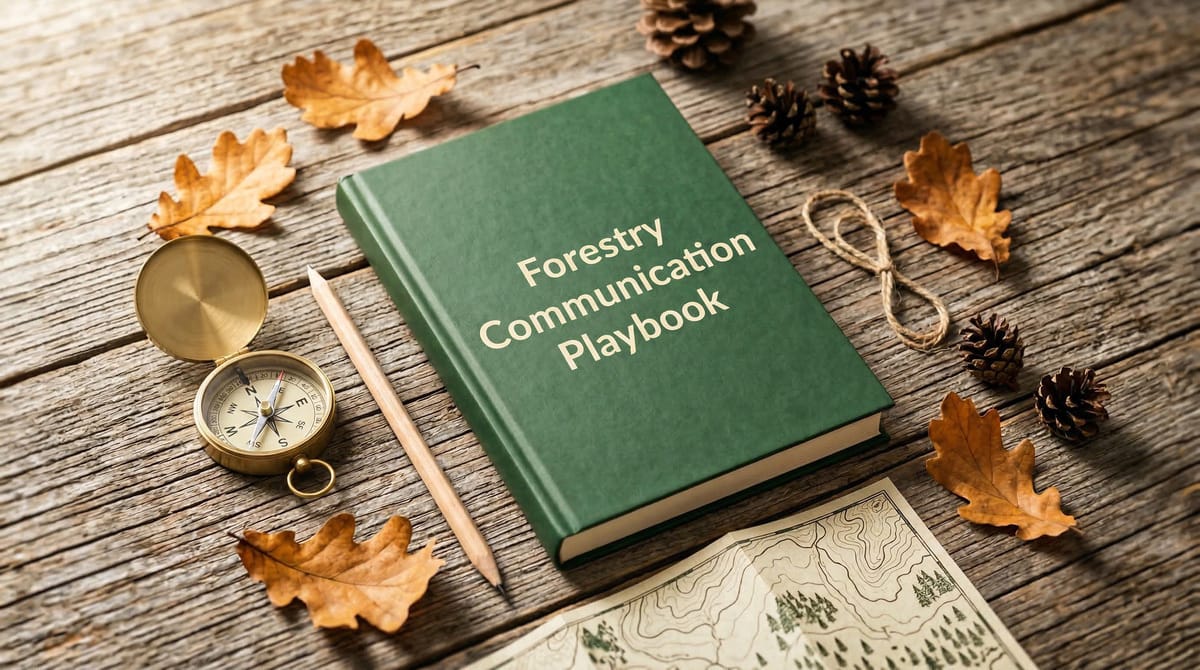
📖 The Forestry Communication Playbook
Everything I know about forestry communication that will help you close the above-mentioned gap. In one book. 10 chapters. 15 tools. Ready-to-use messages and answers. €29. Instant download.
🤝 ForestryBrief Services
European forestry needs better communication and smarter capital. We deliver both.
Intelligence: EUDR compliance, timber market analysis, carbon market monitoring, forest investment due diligence.
Communication: Content strategy, trade publication articles, stakeholder messaging, staff training. Three languages: EN | DE | HU.
The Forestry Communication Playbook: A complete guide to building your organisation's communication strategy. Coming soon.
Until Tuesday!
Wish you all the best: Peter
🤝 Need help with forestry communication, intelligence, or due diligence? See what we offer → ForestryBrief Services
📩 Got this email forwarded to you? Subscribe to ForestryBrief here.
📚 Missed an issue? Browse the ForestryBrief archive
P.S. What’s the biggest challenge you’re facing in forestry right now?
Hit reply and let me know — I read every message personally.
P. P. S. Know a forest professional who’s drowning in EUDR complexity or missing out on timber market shifts? Forward this email to them!
Shauna Matkovich's Forest Invest Podcast is one of the best resources for understanding where forest finance is heading. If you are interested in Forest Investments, start there.
If you like FB be sure to subscribe to Boreal Tech Brief, a newsletter of my friend Axel covering tech in forestry with a Nordic angle:
