
Why Your Best Argument Is Your Worst Strategy
Hello,
A forester stands up at a public meeting. Someone in the audience asks: "Why are you destroying our forests?"
The forester opens a laptop. Pulls up a slide. Shows a chart. Annual increment versus harvest. Growth rates. Certification percentages. Satellite data. European forests grew 9% in thirty years.
The data is perfect. Every number is correct. Every source is solid.
The audience nods politely.
And nobody changes their mind.
I've watched this scene play out dozens of times. At public hearings. At stakeholder meetings. At conferences. At school visits. The forester brings the best data in the room. And leaves with the worst result.
This article explains why. And it starts with research from an industry that learned this lesson before us.
The Wrong Currency
Agriculture went through the same crisis. Farmers improved practices for decades. Yields went up. Environmental footprints went down. The science was clear. And public trust kept falling.
The Center for Food Integrity (CFI) wanted to know why. Their peer-reviewed research programme, led by Charlie Arnot, studied what actually builds public trust in food and agriculture. The finding was devastating.
Shared values are three to five times more important than demonstrated expertise in building public trust.
Three to five times.
That means when a forester responds to "you're destroying the forest" with harvest-to-increment ratios, they're paying in the wrong currency. The audience isn't asking a data question. They're asking a values question.
"Do you care about this forest the way I care about it?"
No chart answers that.
The agriculture researchers put it bluntly. The debate is not about knowledge. It's about whether we should be doing what we're doing. A conversation about values and ethics. Not about data. (Source: Center for Food Integrity (CFI), peer-reviewed trust research, Charlie Arnot)
A separate study confirmed this from a different angle. Moffat and Zhang published research in Resources Policy in 2014 examining what builds trust between extractive industries and communities. Their finding: quality of contact — not quantity — predicted trust. It doesn't matter how many brochures you distribute. What matters is whether the person you're talking to feels heard, respected, and connected to shared values. (Source: Moffat & Zhang, "The Paths to Social Licence to Operate," Resources Policy, 2014)
Two separate research programmes. Two different industries. The same conclusion. Facts don't build trust. Values do.
Why Foresters Get This Wrong
It's not stupidity. It's training.
Foresters are scientists. We measure. We quantify. We manage by numbers. Cubic metres. Hectares. Growth curves. Rotation periods.
So when someone challenges us, we reach for what we know best. Data. Evidence. Proof.
The problem is not the data. The data is right. The problem is the sequence. Leading with data feels like a correction. It signals: "You don't understand. Let me educate you."
Nobody wants to be educated by a stranger at a public meeting. Nobody wants to be corrected when they're expressing a genuine concern about a place they love.
Science communication researchers have a name for this instinct. The information deficit model. The assumption that if people just had more facts, they'd agree with you.
It has been debunked across every industry that tried it. Medicine. Agriculture. Climate science. Energy. Forestry.
More data doesn't change minds. Connection changes minds.
The Price Tag of Getting It Wrong
This isn't abstract. The cost of leading with data instead of values is measurable. In euros.
The EU Deforestation Regulation applies the same due diligence regime to sustainable European forestry as it does to high-risk imports from regions with genuine deforestation. European foresters — who grew their forests by 9% in thirty years — now have to prove they're not destroying forests. Every shipment. Every operator. Every piece of wood.
How did this happen?
The conversation about deforestation took place without European foresters in the room. Environmental groups presented their case. Politicians listened. The public supported action. And the regulation was written for the worst case — because nobody made the case for the best case.
European forestry wasn't excluded from that conversation. It excluded itself. By staying silent. By assuming that good management would be recognised without explanation. By retreating into technical language that policymakers don't speak.
EUDR compliance costs are the invoice for thirty years of poor communication. Not the only invoice. But the most visible one.
What Actually Works
Values-led communication opens doors that data can't.
"I care about the same forests you care about."
"I want clean water, healthy wildlife, and a stable climate. Just like you."
"I plant trees my grandchildren will walk through."
That's not spin. That's the truth. Foresters do care about forests. They do want healthy ecosystems. They do think in generations, not quarters.
The problem is that we never say it. We skip the values and jump straight to the data. The audience never hears what they actually need to hear first: that we share their concerns.
Values first. Data second. The data supports the relationship. It doesn't create it.
Finland Figured This Out
The Finnish Forest Association has invested in communication as core infrastructure since 1877. Not as a side project. Not when there's budget left over. As a function as essential as roads and seedlings.
Their Forest Academy programme brings politicians, journalists, NGO representatives, and business leaders into the forest together. Not to lecture them. To walk with them. To build relationships. To find shared values. To create trust before disagreements arise.
The result: Finnish surveys consistently show that a strong majority of citizens view the forest industry positively. In a country with strong environmental movements and intense media scrutiny.
Finland didn't win public trust by having better data than everyone else. Every European country has the data. Finland won by leading with values and investing in relationships — systematically, for decades. (Source: Finnish Forest Association – Forest Academy communication concept)
The Window Is Open
Climate anxiety changed everything. For the first time in decades, the public actively wants what foresters provide. Not just wood. Forests themselves. Carbon storage. Biodiversity. Clean water. Recreation. A sense of stability in an unstable world.
People want to know someone trustworthy is managing their forests. That's us. But only if we stop lecturing and start connecting.
The window won't stay open forever. If foresters don't step through it with empathy and clear messages, someone else will claim the role. Someone who talks about forests but doesn't know them.
One Test
Next time someone challenges you about forestry — at a meeting, on a forest path, at a family dinner — resist the urge to correct them with data.
Instead, try one sentence that shows you share their concern. Just one. Before the numbers. Before the charts. Before the defence.
"You're right to care about this forest. I do too."
Then see what happens to the conversation.
📖 The Full Framework
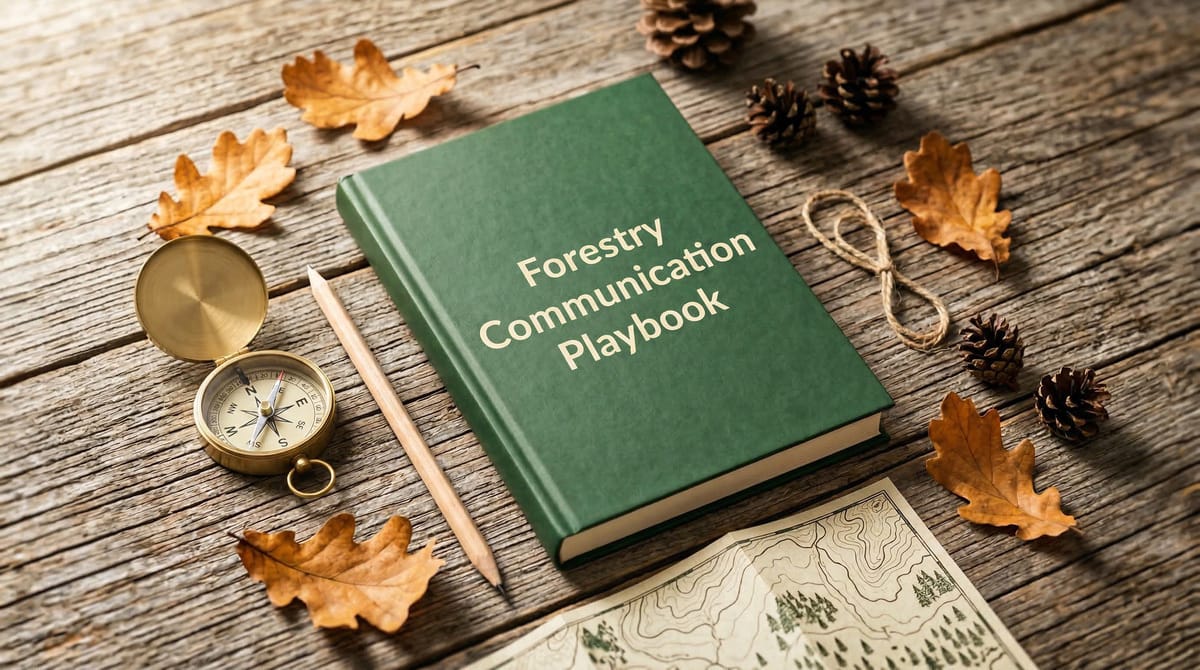
This issue covers one concept from The Forestry Communication Playbook — a practical guide I wrote for forest professionals who know they need to communicate better but don't know where to start.
Ten chapters. Fifteen ready-to-use tools. Prepared messages you can use Monday morning. Tested answers to the toughest questions the public asks. A step-by-step plan for building trust — even without a PR department, a budget, or a communication degree.
The Playbook turns "values beat facts" from a nice idea into a structured framework. With specific words, specific sequences, and specific tools you can print, laminate, and carry in your pocket.
€29. Money-back guarantee. If it doesn't change how you think about forestry communication, I'll refund you. No questions.
What's Coming Next
💰 Investment Pillar — April 2026
Forestry can be one of the best investments you never considered. Next month I show you why — and how the best deals benefit the forest as much as the investor. A beautiful symbiosis when done right.
🤝 ForestryBriefing - Services
If your organisation needs more than a book — strategic communication consulting, stakeholder messaging, or media strategy — that’s what a ForestryBriefing delivers.
Intelligence: EUDR compliance, timber market analysis, carbon market monitoring, forest investment due diligence.
Communication: Content strategy, trade publication articles, stakeholder messaging, staff training. Three languages: EN | DE | HU.
The Forestry Communication Playbook: A complete guide to building your organisation's communication strategy.
Until Tuesday!
Wish you all the best: Peter
🤝 Need help with forestry communication, intelligence, or due diligence? See what we offer → ForestryBrief Services
📩 Got this email forwarded to you? Subscribe to ForestryBrief here.
📚 Missed an issue? Browse the ForestryBrief archive
P.S. What’s the biggest challenge you’re facing in forestry right now?
Hit reply and let me know — I read every message personally.
P. P. S. Know a forest professional who’s drowning in EUDR complexity or missing out on timber market shifts? Forward this email to them!
Shauna Matkovich's Forest Invest Podcast is one of the best resources for understanding where forest finance is heading. If you are interested in Forest Investments, start there.
If you like FB be sure to subscribe to Boreal Tech Brief, a newsletter of my friend Axel covering tech in forestry with a Nordic angle:
