
Why Digitalization Keeps Failing in Forestry
And the one test that predicts which projects survive
Today is a first for ForestryBrief.
Most of what you read here comes from me. But not every useful view fits one desk. So I'm opening a new slot: ForestryBrief Guest.
The idea is simple. Now and then, I hand the page to an outside voice. Someone with a view from inside the work. The rules stay the same. Facts checked. Sources named. Plain language. No sales talk.
Our first guest is Johannes Brötz.
Johannes is a forester first. He worked on Germany's National Forest Inventory at the Thünen Institute. He spent years on UN and FAO projects across three continents. Now he helps forest operations go digital — the right way.
His piece asks a question most software projects skip. Who actually uses this on a Monday morning?
It is honest, sharp, and built on real cases. I think you'll like it.
Over to Johannes.
ForestryBrief Guest — by Johannes Brötz, Broetzens IT Cattles & Cows
1. The Monday Morning Test
Most digitalization projects in forestry do not fail because of bad software. They fail because of a question nobody asked. Who will actually use this on a Monday morning?
Picture the scene. A district forester stands in the rain. There is one bar of signal. A log truck waits nearby. The driver is impatient.
Will the new system help in that moment? Or will it get in the way? This is the only test that matters. I call it the Monday Morning Test. Most projects never take it.
The numbers are sobering. The Standish Group has tracked IT projects for decades. Only about a third of them succeed. And one finding has held for decades. The biggest predictor of success is user involvement. Not the software. Not the budget. The users.
Large consulting firms report high failure rates for digital transformation too. The problem is not unique to forestry. But forestry has its own reasons. We will get to those.
2. The WhatsApp-and-Excel Reality
So what does forestry digitalization actually look like today? Walk into most operations in Central Europe. You will not find one clean system. You will find a patchwork.
There are WhatsApp groups. There are shared Excel files. There are PDF maps sent by email. People retype the same data by hand, again and again. The data does not flow through interfaces. It flows through people.
This works, in a way. But it is fragile. Knowledge sits in one person's phone. When that person leaves, the knowledge leaves too.
A private forest manager in the German uplands told me this plainly. His operation runs a few thousand hectares. The hardest part, he said, is just starting. Data sits scattered across systems and departments. Specific knowledge gets lost. And map data still travels as PDF files by email. Someone then types it back in by hand.
The official systems feel the strain as well. Germany runs a national benchmarking network for forest enterprises. It is called the Testbetriebsnetz Forst. Each participating enterprise reports around 650 figures a year.
Pulling those numbers together is hard work. When the data sits in scattered tools, the work piles up. Someone must collect and reconcile every figure by hand. So even this national system hits the same wall.
And it is not only this one report. The same problem hits every reporting duty. Tax reporting is one example today. And new rules add to the load. The EU Deforestation Regulation (EUDR) is the next big one. Each duty gets harder when the data is scattered. Island solutions do not talk to each other.
3. Why Forestry Is a Particularly Hard Case
Forestry is a hard case for digitalization. It combines almost every difficulty at once.
Ownership is fragmented. Germany has about 10 million hectares of forest. Private owners hold 43% of it. There are around 760,000 of them. Many holdings are tiny. Owners with under 20 hectares hold about half of all private forest. Each one is too small for an expensive system.
Workflows follow the seasons. Connectivity in the forest is poor. The workforce is aging. And planning horizons run for decades, not quarters.
User habits matter too. A survey of registered foresters in the United States found something telling. Around half used no digital tools at all. The study points to two reasons. They did not see a clear use for the tools on their land. And they did not know what options existed.
A note on those numbers. The ownership figures are German. The survey figures are American. The two are not directly comparable. But the direction is familiar on both sides of the Atlantic.
None of this is an excuse. It is a diagnosis. You cannot fix what you refuse to name.
4. The Pattern: How Projects Actually Fail
Most failures follow the same script. Management buys software from the top down. Nobody studies the existing process first. The users are never involved. There is no training budget. And there is no feedback loop.
Let me give you a real example. I have anonymized it. A private forest enterprise in the DACH region hired me. The task was to digitalize its forest planning unit. The operation covered several thousand hectares, with district managers out in the field.
The core job went well. We digitized old map data. We moved map production from paper to screen. We cleaned and documented everything for handover. On the technical level, it worked.
Then I went a step further. I built two prototypes for the district managers. One was a desktop map tool, built on open-source software. The other was a simple browser-based map system. Both worked. Both were shown to management and to staff.
Neither was adopted. And here is the strange part. Nobody said no. There was no rejection. No bad review. No budget vote against them. There was only silence.
The tools were noted, then quietly shelved. No feedback. No next step. No decision. The keen district managers were frustrated. The doubters felt proven right. Everyone else returned to business as usual.
So why did it stall? Not for technical reasons. The reasons were structural. Management showed real interest. But it never set aside a budget. Interest without budget is a wish, not a strategy.
There were no milestones. No acceptance criteria. No roadmap. Good ideas entered a vacuum. The users received finished products, not a say in the design. And the field devices were never sorted out.
One contrast is worth naming. In private operations, a failing project gets cancelled fast. In state forestry, it rarely dies. It gets extended, or quietly reshaped, year after year. A manager at a state enterprise described exactly this to me.
5. What Change Management Means in a Forest
Change management in forestry is not a workshop with slides. It is far more physical than that.
It means riding along with a district manager for a day. It means watching how the work really happens. Then you build the tool around that work. Not the other way around.
Researchers and educators in forest informatics have made this point for years. Tools must fit field practice, not fight it. The idea sounds obvious. It is rarely followed.
There is one adoption move that works. Find one respected field leader. Win that person over. If they use the tool, the rest will follow. People trust a colleague more than a memo from headquarters.
6. What Good Looks Like: Principles, Not Products
I will not name products here. I will name principles.
Start with the process, not the software. Fix the messy process first. A digital version of a bad process is just a faster mess.
Build on what people already use. If they live in WhatsApp and Excel, meet them there. Then improve from that base.
Demand open interfaces. Systems that cannot share data will trap you. You will pay for that later.
Budget for training, not just licenses. The license is the cheap part. The learning is the real cost.
Treat hardware as infrastructure. A great app on a weak phone helps no one.
And think hard about make versus buy. One practitioner was blunt with me on this. Building your own tools rarely works for a forest operation. Promised features arrive late. Costs creep upward. Checking and approving the work eats more time than anyone has. His advice was clear. Buy proven software. Then adapt your process to fit it.
A state forestry manager said something similar. His long-term goal is to stop building in-house. He wants a handful of specialist apps instead. One for each main task. Each one bought, not built.
Small wins beat grand visions. A tool that solves one Monday-morning problem will spread. A tool that promises everything will sit in the demo room.
7. The Job Is Changing But The Forest Isn't
The forester's job is changing. It is becoming part data manager, part systems integrator. The tools will keep changing. The forest will not.
So the question is not whether to digitalize. That ship has sailed. The question is how. And how comes down to this. How do we do it without losing the people who do the real work?
That brings us back to the start. To the forester in the rain. One bar of signal. A truck waiting.
If your new system helps that person, in that moment, it will be used. If it does not, it will not. Everything else is detail. The Monday Morning Test is the only test that matters.
About the author
Johannes Brötz spent 18 years in forestry practice before moving into digitalization consulting. His background spans Germany's National Forest Inventory and forest greenhouse-gas reporting at the Thünen Institute, UN/FAO project work across Africa, Asia, and the Americas, and a role at INTEND in Kassel. Through his consultancy, Broetzens IT Cattles & Cows, he helps forest enterprises close the gap between management decisions and field reality. More at broetzens.de.
Sources
Published sources
Bettinger, P., Merry, K., Fei, S., Weiskittel, A., & Ma, Z. (2023). Usefulness and Need for Digital Technology to Assist Forest Management: Summary of Findings from a Survey of Registered Foresters. Journal of Forestry, 121(1), 1–11. https://doi.org/10.1093/jofore/fvac028
Damaševičius, R., et al. (2024). Digital transformation of the future of forestry: an exploration of key concepts in the principles behind Forest 4.0. Frontiers in Forests and Global Change. https://doi.org/10.3389/ffgc.2024.1424327
Hoppen, M., et al. (2024). Smart forestry – a forestry 4.0 approach to intelligent and fully integrated timber harvesting. International Journal of Forest Engineering, 35(2), 137–152. https://doi.org/10.1080/14942119.2024.2323238
Jaeger, D., Paul, C., et al. (2023). Digitalisierung der Forst-Holz-Bereitstellungskette — ein Positionspapier. Georg-August-Universität Göttingen.
Paul, C., Möbius, F., & Dög, M. (2023–2026). TBN Forst² — Weiterentwicklung Forstbetrieblicher Kennzahlenvergleich. Georg-August-Universität Göttingen / FNR.
Sekot, W. (2017). Forest Accountancy Data Networks as a Means for Investigating Small-Scale Forestry: A European Perspective. Small-scale Forestry, 16, 435–449. https://doi.org/10.1007/s11842-017-9371-4
Standish Group (2020). CHAOS 2020 Report. The Standish Group International.
Tiebel, M., et al. (2024). Understanding small-scale private forest owners is a basis for transformative change towards integrative conservation. People and Nature. https://doi.org/10.1002/pan3.10579
DigiTrans — Digitalisierung der Forstwirtschaft in Bayern. Cluster Forst und Holz in Bayern / LWF aktuell 131.
Primary sources — interviews and field reports
Practitioner observations in this article draw on interviews and field notes gathered by the author in 2026.
Interview with Lucas von Fürstenberg, Fürstenberg-Brabecke Forstbetriebe (private forest, Hochsauerland), 2026. On starting points for digitalization, georeferenced data, long-term data collection, and data exchange with public authorities. (Referenced in §2 and §6.)
Interview with Andre Schulenberg, Kommunalwald Waldeck-Frankenberg GmbH, on make-versus-buy decisions for forest operations, 2026. (Referenced in §6.)
Interview with a forester at a German state forest enterprise, on public-sector procurement and a modular software strategy, 2026. Source's name withheld at their request. (Referenced in §4 and §6.)
Brötz, J. (2026). Field notes from the LIECO Forum, Göttingen. Forum statements referenced include a large private forest owner on the inventory- and planning-software gap (§2) and a private forest owner on data collection as a strategic pre-investment (§6).
That's the first ForestryBrief Guest. My thanks to Johannes for a sharp, honest piece.
What did you think? Hit reply — I read every message.
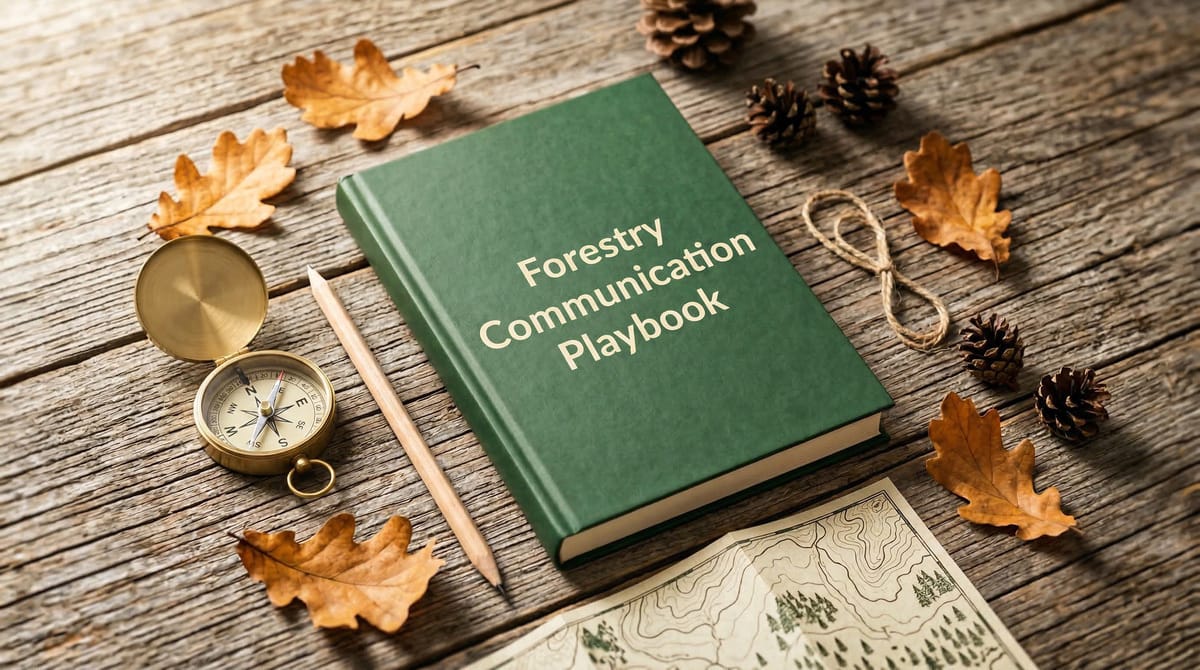
📖 The Forestry Communication Playbook
The next time someone asks why you cut trees, you'll have thirty seconds to answer.
Right now — what do you say?
If the answer isn't ready, the Playbook is. Everything I know about forestry communication.
🤝 ForestryBrief Services
European forestry needs better communication and smarter capital. We deliver both.
Intelligence: EUDR compliance, timber market analysis, carbon market monitoring, forest investment due diligence.
Communication: Content strategy, trade publication articles, stakeholder messaging, staff training. Three languages: EN | DE | HU.
The Forestry Communication Playbook: A complete guide to building your organisation's communication strategy. Coming soon.
Until Tomorrow!
Wish you all the best: Peter
🤝 Need help with forestry communication, intelligence, or due diligence? See what we offer → ForestryBrief Services
📩 Got this email forwarded to you? Subscribe to ForestryBrief here.
📚 Missed an issue? Browse the ForestryBrief archive
P.S. What’s the biggest challenge you’re facing in forestry right now?
Hit reply and let me know — I read every message personally.
P. P. S. Know a forest professional who’s drowning in EUDR complexity or missing out on timber market shifts? Forward this email to them!
Shauna Matkovich's Forest Invest Podcast is one of the best resources for understanding where forest finance is heading. If you are interested in Forest Investments, start there.
If you like FB be sure to subscribe to Boreal Tech Brief, a newsletter of my friend Axel covering tech in forestry with a Nordic angle:
