
Hello,
The world's biggest planetary science prize just named a Hungarian forest ecologist a finalist.
His paper says trees alone won't fix the climate.
Hungarian science. Nature Geoscience. Davos in January. And a stronger story for European foresters than the one we've been telling.
Here's what's moving European forestry this week:
🔍 The Big Story
Right Tree, Right Place — Hungarian Science Reaches the World Stage
On Earth Day (April 22), the Frontiers Planet Prize named Dr. Csaba Tölgyesi of the University of Szeged (SZTE) one of 25 National Champions worldwide.
The Hungarian press picked up the story this past week. Most of European forestry has not yet noticed.
What the prize is
The Frontiers Planet Prize is the world's largest scientific competition for planetary-health solutions. A 100-person jury — chaired by Professor Johan Rockström of the Potsdam Institute, the scientist who developed the Planetary Boundaries framework — selected one national champion per country across 25 countries.
Three of those 25 national champions will be named international winners at Davos on January 18, 2027. Each receives US$1 million to advance their research.
Hungary's nominating body was the Hungarian Academy of Sciences (MTA) Sustainable Development Presidential Committee. Three Hungarian scientists were submitted. Tölgyesi's research was selected.
What the paper says
The basis of the prize is a peer-reviewed study published in Nature Geoscience in August 2025:
Tölgyesi, C., Csikós, N., Temperton, V. M., Buisson, E., Silveira, F. A. O., Lehmann, C. E. R., Török, P., Bátori, Z., Bede-Fazekas, Á. (2025). "Limited carbon sequestration potential from global ecosystem restoration." Nature Geoscience, 18, 761–768.
DOI: 10.1038/s41561-025-01742-z (Open Access)
The headline finding is direct.
The maximum possible carbon sequestration from global ecosystem restoration by 2100 is 96.9 gigatonnes. That equals 3.7 to 12.0% of anthropogenic emissions until 2100.
The best optimistic scenario: ~12%.
If current emission trends continue: less than 4%.
That is close to one order of magnitude less than several earlier global studies suggested.
What Tölgyesi himself says
The published Hungarian press coverage (MTA, SZTE, Szeged.hu, Délmagyar, HVG, Radio88) quotes Tölgyesi consistently. Three lines stand out.
On trees: Trees are useful in many places. In some places they can amplify climate change.
On the carbon math: Whatever we plant, its carbon capture is close to one order of magnitude less than previously thought.
On the implication: The motivation for habitat restoration should not be climate mitigation. It should be climate adaptation.
The third quote is the one that matters most for European forestry.
Why this is GOOD news for foresters
Read quickly, the headline sounds bearish for forestry. "Tree planting doesn't solve climate change."
Read carefully, it is the opposite.
First, Tölgyesi is not anti-tree. His own research group at SZTE works on forest-steppes and wood-pastures — mosaic landscapes where trees, native grasslands, and grazing animals coexist. He introduced the concept of ecovoltaics: combining solar generation with grassland restoration. He works at the interface of forestry, energy, and conservation. The Frontiers Planet Prize biography page is explicit on this.
Second, the paper's real argument is "right ecosystem, right place." Trees belong in many places. They do not belong in every place. Planting trees on native grasslands or peatlands can reduce net carbon storage and amplify warming through soil-moisture and albedo effects.
This is what European foresters have been saying for two centuries. The right species. The right site. Mixed structures. Honest biogeography.
Tölgyesi's paper just put that argument in Nature Geoscience.
Third, the paper gives the sector a stronger story than the one we've been telling. Carbon math has been the dominant pitch for European forestry investment, restoration, and policy for a decade. That pitch is brittle. Every new modelling exercise can revise the tonnage downward.
The Tölgyesi story — adaptation, biodiversity, fossil-fuel substitution, resilient working landscapes — is durable. It will not be downgraded by the next Nature paper.
What this means for you
If you manage a forest carbon project: Track the methodology debate (see Quick Hit 3 on Verra). Position your project's value proposition around durability, ecological fit, and adaptation co-benefits, not headline tonnage.
If you raise capital for European forestry: The carbon-only pitch is losing scientific ground. The adaptation, biodiversity, and material-substitution pitch is gaining it. Update your deck.
If you communicate forestry to public audiences: "Right tree, right place" now has Nature Geoscience behind it. So does "restoration is about adaptation, not just carbon." Use both.
If you advise policymakers: The EU Forest Strategy targets and the Nature Restoration Regulation should be read alongside this paper. The targets are not wrong. The framing around them needs work.
The takeaway: A Hungarian forest ecologist just gave European forestry permission to lead with its real strengths. The Davos finals are January 18, 2027. Three international winners. One could be Hungarian. Sources: Nature Geoscience paper (DOI) | Frontiers Planet Prize 4th edition page | Frontiers Planet Prize official announcement | Hungarian Academy of Sciences (MTA) release | EurekAlert international wire
📊 Quick Hits
1. 🇪🇺 WRI Backs the Commission's EUDR Simplification Package
On May 5, the World Resources Institute issued a named statement supporting the European Commission's May 4 EUDR Simplification Review Package — the package we covered in EFP #83.
WRI EU Director Janneke de Vries called the package a "practical, sensible plan to advance EUDR implementation." The statement explicitly says clarity is now in place and companies should move quickly to build compliance systems.
This matters because WRI and downstream operators usually sit on opposite sides of EUDR debates. Operators have asked for postponements. NGOs have asked for stricter enforcement. On this package, both are aligned that the path forward is now usable.
The takeaway: When environmental NGOs and downstream operators both back the same implementation plan, the December 30, 2026 deadline gets harder to challenge. Stop planning for further delay. Start building. Source: WRI — STATEMENT: European Commission Delivers Clear Plan to Advance EUDR Implementation
2. 🇺🇸 Rayonier Q1 — First Full Quarter Post-PotlatchDeltic Merger
On May 5, Rayonier (NYSE: RYN) reported Q1 2026 results — its first full quarter operating as the combined entity following the January 30, 2026 completion of its merger with PotlatchDeltic.
The combined Rayonier now owns over 4 million acres of timberland across the US South, Pacific Northwest, and New Zealand.
Revenue: US$276.8M (vs US$82.9M Q1 2025 standalone)
Adjusted EBITDA: US$94M (vs US$27M)
Net loss: US$12.4M (reflecting US$69.5M of merger-related costs)
Northwest Timber Adjusted EBITDA: US$8.6M (45% higher YoY)
Rayonier confirmed on March 31, 2026 that it will retain its corporate name and ticker.
Why a US merger matters for European forestry
The listed US timberland peer set was effectively three companies last year — Weyerhaeuser, Rayonier, PotlatchDeltic. It is now two — Weyerhaeuser and Rayonier+PotlatchDeltic.
European institutional LPs benchmark fund returns against this peer set. The benchmark just changed. So has the implied scale at which "institutional timberland" gets measured. 4 million acres is the new floor for a combined-entity reference point.
The takeaway: If you raise European forestry capital, your North American comparison set now contains one mega-cap and one super-mega-cap. The "scale required to be taken seriously" conversation just moved up a notch. Source: Rayonier Q1 2026 Results — Business Wire
3. 🌳 Verra Opens Consultation on Dynamic Baselines for Forest Carbon
On May 6, Verra opened a 33-day public consultation on a new methodology: Methodology for Enhanced Forest Sequestration with Dynamic Baselines using Randomized Control Trials (development ID M0274).
The consultation closes June 8, 2026, at 11:59 pm UTC-12.
What is new in M0274
Two design choices stand out.
Co-located control plots. Each project must designate an area within its own project boundary where no intervention occurs. The control plot serves as a direct baseline for measuring carbon benefits.
Randomized control trials. The methodology applies experimental design — long the gold standard in medicine and economics — to forest carbon project measurement.
The scope: practices that actively increase tree growth rates and survival beyond business-as-usual forest management.
Why this matters
The dynamic-baseline conversation has moved through Verra's portfolio for two years. The ARR methodology that uses dynamic baselines (VM0047) went live in 2026 with BTG Pactual TIG's Latin American Reforestation Strategy as its first global project (covered in EFP #84). M0274 extends the approach to Improved Forest Management.
If you are designing a forest carbon project in Europe right now, the methodology landscape is shifting underneath you. CRCF Permanent Removals entered into force May 7 (EFP #82, #84). EU CRCF carbon farming methodology expected before summer recess. Now Verra's M0274 consultation runs through early June.
The takeaway: Methodology choice is now consequential. Read the M0274 consultation document if you have any IFM project on the drawing board. The window for submission feedback closes June 8. Source: Verra — Consultation: Methodology for Enhanced Forest Sequestration
4. 🇫🇮 Stora Enso Clears Environmental Permit for Imatra Giant Sawmill
In early May, the Finnish Licensing and Supervision Agency (Lupa- ja valvontavirasto) issued the essential environmental permit for Stora Enso's planned giant sawmill at Imatra — to be located within the existing Imatra Mills complex at the Tainionkoski site.
The investment is not yet finally decided. The permit clears the regulatory path. The capital decision is still ahead.
Scale and supply
This would be the largest sawmill in Finland. The site would absorb sawlog volumes currently flowing to Stora Enso's Joutseno Honkalahti sawmill in eastern Finland, and would require incremental wood supply on top of that.
Imatra Mills today produces over 1 million tonnes of chemical pulp and consumer packaging board annually. More than 90% of that output is exported. A new giant sawmill at the same site would add solid-wood processing to a complex that has been a Stora Enso pulp and board operation since 1935.
Why this matters
Read alongside the Bergslagets Skogar demerger announcement (covered in EFP #84 and EFP #85), Stora Enso is doing something coherent. Forest assets are being moved out. Wood-processing capacity is being doubled down on at core sites.
Forest assets OUT. Wood-processing capacity IN. Both decisions made while the cycle is still soft.
That is a strategic posture worth understanding regardless of whether you operate in Nordic pulp, European sawmilling, or institutional timberland.
The takeaway: The Stora Enso Capital Markets Day on November 3, 2026 is the moment to watch for an FID announcement. If Imatra clears its final investment decision then, it becomes the centrepiece of Stora Enso's industrial strategy through 2030. The supply-chain implications for eastern Finland's log market alone are material. Sources: Global Wood Markets Info — Giant sawmill in Finland gets green light | Stora Enso — Imatra Mill location page
📅 The Weeks Ahead
Today, May 14, 2026: PEFC Forest Forum — Istanbul
Wednesday, May 20, 2026, 10:00 CEST: FBIA 2026 Q&A Webinar (online)
Wednesday–Thursday, May 20–21, 2026: EU CRCF Days — Brussels (DG CLIMA stakeholder event)
Friday, May 22, 2026: SoEF 2025 Webinar — Forest Resources and Carbon, 12:00–13:00 CEST (FOREST EUROPE) | Gold Standard STARR consultation closes
Monday, June 1, 2026: EUDR Annex I Delegated Act feedback deadline
Tuesday–Wednesday, June 2–3, 2026: 10th FOREST EUROPE Ministerial Conference — Stockholm
Tuesday–Thursday, June 2–4, 2026: Carrefour International du Bois — Nantes, France
Monday, June 8, 2026: Verra M0274 Enhanced Forest Sequestration methodology consultation closes (see QH3)
Tuesday–Wednesday, June 9–10, 2026: FAIS — Forestry & Agriculture Investment Summit — London, UK
Friday, June 12, 2026: FBIA 2026 — application deadline
Wednesday, June 17, 2026: SoEF 2025 Webinar — Bioeconomy, 12:00–13:00 CEST (FOREST EUROPE)
Wednesday–Friday, September 16–18, 2026: EFI Annual Conference — Växjö, Sweden (European Forest City 2026)
Tuesday, September 22, 2026: CINEA LIFE Calls 2026 — Standard Action Projects deadline | SoEF 2025 Webinar — Biological Diversity, 12:00–13:00 CEST
Sunday, September 27, 2026: EU EmpCo Directive applies — generic green claims become unlawful
Monday, October 5, 2026: WAN-IFRA World Printers Summit — Rotterdam (ForestryBrief presenting)
Wednesday–Thursday, October 7–8, 2026: 19th European Congress (FOGE) — Cologne, Germany
Tuesday–Wednesday, October 13–14, 2026: CIFB London — London, UK
Thursday–Sunday, October 15–18, 2026: INTERFORST 2026 — Munich (quadrennial forestry technology trade fair)
Tuesday–Wednesday, October 20–21, 2026: Global Bioeconomy Summit 2026 — Dublin, Ireland
Thursday, October 22, 2026: SoEF 2025 Webinar — Green Jobs, 12:00–13:00 CEST (FOREST EUROPE)
Thursday–Friday, November 5–6, 2026: 11th International Hardwood Conference — Antwerp (ATIBT)
Wednesday, November 25, 2026: FBIA 2026 final event, EIB Brussels (by invitation only)
Wednesday, December 30, 2026: EUDR application date for large and medium operators
Monday, January 18, 2027: Frontiers Planet Prize International Champions announced — Davos (see Big Story)
💡 One Thing to Try This Week
Write a one-paragraph answer to this question before someone asks it.
"If trees don't actually solve climate change, why should I invest in forestry?"
You have one paragraph. Maximum five sentences. No jargon. No carbon math. No defensive crouch.
Make the case from durability. Make it from adaptation. Make it from material substitution — every cubic metre of wood that builds a wall is a cubic metre that did not require concrete or steel. Make it from biodiversity, water cycles, soil health, rural livelihoods. Make it from the fact that European forestry has matched species to site for two hundred years before anyone in the climate finance world started thinking about it.
Now read your paragraph aloud.
If you stumbled on a sentence, that sentence is not yet yours. Rewrite it. Read it aloud again.
This exercise takes ten minutes. It produces an answer you will need within the next six months — at a board meeting, a dinner party, a journalist's voicemail, a Brussels coffee. The Tölgyesi paper has put this question into general circulation. You will get asked.
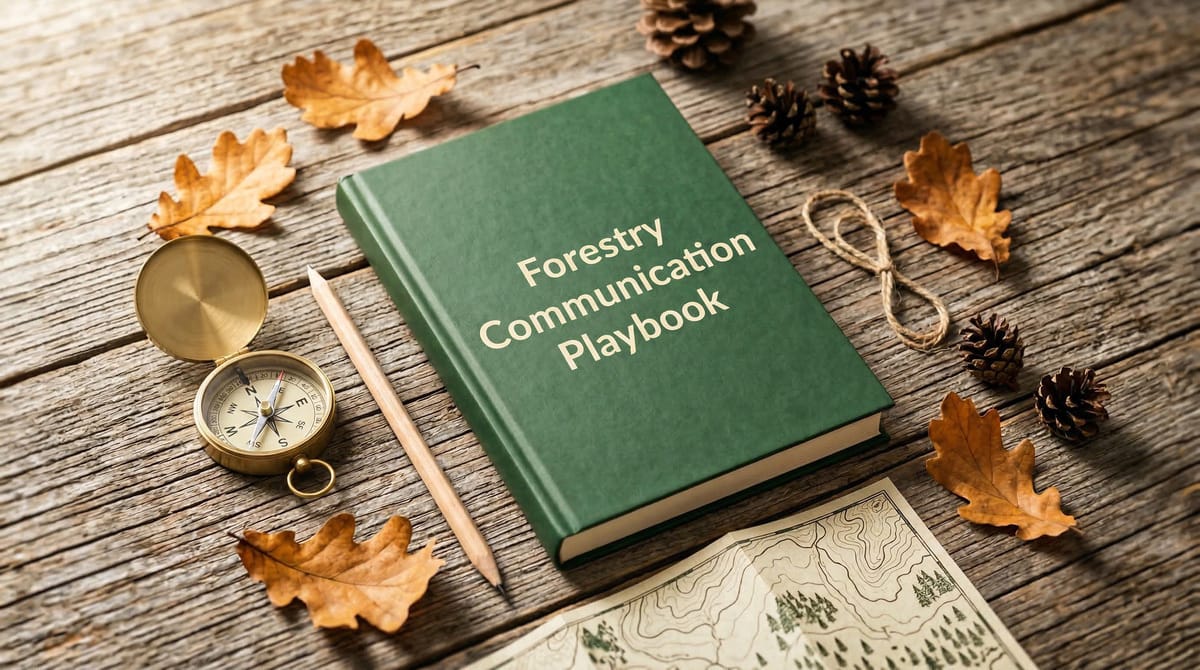
Chapter 1 of the Forestry Communication Playbook calls this "the thirty-second answer." Write yours this week, while the question is still fresh.
📖 The Forestry Communication Playbook
The next time someone asks whether planting trees actually solves climate change, you'll have thirty seconds to answer.
Right now — what do you say?
If the answer isn't ready, you need this Playbook.
🤝 ForestryBriefing
The brief is free. The briefing is not.
ForestryBrief publishes verified intelligence — free, three times a week, in 25+ countries. When you need that intelligence applied to your specific situation, that's a ForestryBriefing.
Intelligence — Investment due diligence, market intelligence, EUDR compliance, cross-sector risk analysis, background verification in three languages.
Communication — Strategy, trade publication articles, stakeholder messaging, newsletters that people actually open. EN | DE | HU.
Live — Conference presentations, panel moderation, keynotes. Next: WAN-IFRA World Printers Summit, Rotterdam, October 2026.
First briefing guarantee: if it doesn't deliver intelligence you can act on, you don't pay.
Until Thursday!
Wish you all the best: Peter
🤝 Need help with forestry communication, intelligence, or due diligence? See what we offer → ForestryBriefing
📩 Got this email forwarded to you? Subscribe to ForestryBrief here.
📚 Missed an issue? Browse the ForestryBrief archive
P.S. What’s the biggest challenge you’re facing in forestry right now?
Hit reply and let me know — I read every message personally.
P. P. S. Know a forest professional who’s drowning in EUDR complexity or missing out on timber market shifts? Forward this email to them!
Shauna Matkovich's Forest Invest Podcast is one of the best resources for understanding where forest finance is heading. If you are interested in Forest Investments, start there.
If you like FB be sure to subscribe to Boreal Tech Brief, a newsletter of my friend Axel covering tech in forestry with a Nordic angle:
