
Hello,
A Finnish forest-machine maker just told the market two opposite things in the same press release.
Order intake is up. Operating profit is down nearly 90%. That's not a typo. That's the European forest economy in one stock exchange release.
Here's what's moving European forestry this week:
🔍 The Big Story
Ponsse Q1 — Order Books Up 4.8%, Operating Profit Down 88.6%
On April 21, Ponsse Plc released its Q1 2026 interim report. Two numbers tell the whole story.
Order intake: €193.3 million. Up from €184.5 million a year earlier. That's +4.8%.
Operating profit: €1.5 million. Down from €13.2 million a year earlier. That's −88.6%.
Net sales fell 10.1% to €166.8 million. Earnings per share dropped from €0.51 to €0.09. The operating margin collapsed from 7.1% to 0.9%.
This is what a market in transition looks like.
What CEO Juho Nummela said
In the release, Juho Nummela described forest machine sales as developing strongly during the quarter. Sales were particularly strong in Sweden, Central Europe, and Latin America. The Finnish home market was described as challenging, hit by an unusually early spring and a difficult thawing period.
The Vieremä factory ran below capacity for the first nine weeks of 2026. Order books at the start of the year were too thin to justify full shifts. The factory returned to two shifts and a five-day week on March 9. Capacity utilisation is now back to normal.
The company's full-year 2026 operating profit guidance was held: in line with 2025's €41.6 million.
Why this is a Big Story, not a quarterly footnote
Ponsse is one of the cleanest leading indicators of European forest activity. When forest owners and contractors plan harvests, they buy machines. When the calendar shifts, they wait.
This quarter shows both happening at once.
Order intake up = forest professionals are committing to 2026. Sweden and Central European contractors are placing orders. The cycle is turning.
Operating profit down = the order book that drove invoicing in Q1 was thin. The factory ran below capacity for nine weeks. Finland's early thaw cost field days. Margin compression matched the volume gap one-to-one.
So the European forest machine cycle is not in recession. It is in the gap between two cycles. The new order book is being built right now. The invoicing of those new orders sits in Q2 and Q3.
What this means for you
If you sell timber in Sweden or Central Europe: Your contractor is buying machines. That signals your contractor expects work in 2026 and 2027. Pricing power for forest owners stays put for at least the rest of this year.
If you manage forests in Finland: The early-thaw signal is real. Plan for shorter operational windows in 2027 and beyond. Mechanisation choices made today will be tested by warmer winters tomorrow.
If you process wood: The processor side of the chain looks worse than the owner side. SCA's Q1, published Friday, showed operating profit down 51%. Forest owners are winning. Sawmills, pulp mills, and integrated players are not. That gap will close — but probably through processor pain, not owner generosity.
If you hold European forest assets in a fund: Track Ponsse's Q2 invoicing. If the order book that Q1 just built converts to revenue in Q2, the recovery thesis is intact. If invoicing lags again, something deeper is wrong. Sources: Ponsse Q1 2026 stock exchange release | Inderes coverage
📊 Quick Hits
1. 🇩🇪 NRW Private Forest Owners: €1.7 Billion Gone
At a Düsseldorf conference on the state's forest strategy last week, the chair of the North Rhine-Westphalia Forest Owners' Association put a number on the damage.
Eberhard Freiherr von Wrede: €1.7 billion in private-forest asset losses. The math behind the headline, as reported by Rheinische Post: gross damage of €1.85 billion across 88,000 hectares of private forest, minus €135 million in state subsidies received since 2018.
Wrede's words on the loss: "Weg, Windhauch, nicht mehr da." Gone. A breath of wind. No longer there.
Ralf Petercord, head of the forestry department in the state agriculture ministry, told dpa the great Fichtensterben is "over — for the moment."
For the moment.
The takeaway: Private owners hold the majority of NRW's forest. That means the cost of climate disruption sits on private balance sheets first, public budgets second. Storm Dave (covered in EFP #79) added its bill last month. The €1.7 billion number now has a name attached. The next question — whether NRW forest owners can afford the climate-adapted replanting their state Waldstrategie demands — has not been answered yet. Sources: Rheinische Post | n-tv / dpa wire
———————————————————————————
2. 🇳🇱 Treevive Bankruptcy — A Carbon-Market Reality Check
On April 24, Carbon Pulse and Quantum Commodity Intelligence reported that Dutch forest carbon developer Treevive had been declared bankrupt. A trustee is now exploring options to either restart operations or sell individual tropical forest carbon projects.
Treevive was set up as a subsidiary of Form International in 2022. Its mission: 2 million hectares of tropical forest under sustainable management by 2030. Backers included FMO (Dutch development bank — €2.5 million via Mobilising Finance for Forests), Triodos Regenerative Money Centre, and FSC Netherlands.
CEO Liesbeth Gort had been the public voice of the platform.
Why this matters more than a single bankruptcy: Treevive was one of the cleanest cases of European institutional capital backing tropical forest carbon. FMO. Triodos. FSC. The names that voluntary-market reformers point to as the right kind of buyers.
If this is the platform that fails, the rebuild is harder than it looks.
The contrast is sharp. Eleven days before the trustee notice, Triodos Investment Management and Fondaction launched the Value Nature Fund I — a €300 million Article 9 nature fund covering Europe and North America (covered in EFP #77). New money is moving into nature capital. Old structures are not all surviving.
The takeaway: The voluntary carbon market is not broken — it is sorting itself. The platforms with the cleanest origin stories are not automatically the platforms that survive the new integrity bar. If you are a European forest owner being approached by a carbon project developer this month, ask one question: "Show me your last three audited years." That answer separates the next Treevive from the next Value Nature Fund. Sources: Quantum Commodity Intelligence | Carbon Pulse | Triodos earlier partnership context
———————————————————————————
3. 🌍 Verra VM0047 Goes Live — First Forest Carbon Issuance
While Treevive was wound down, Verra issued the first credits in history under its new high-integrity ARR methodology.
On April 20, the Brazil Cerrado 1 project (VCS Project ID 5511) received approval for issuance of 230,120 Verified Carbon Units under VM0047 v1.0. The validation/verification body was AENOR. The project sponsor representative was Tom Hodgman, Senior Portfolio Manager at BTG Pactual Timberland Investment Group.
VM0047 is the Afforestation, Reforestation, and Revegetation methodology that ICVCM approved for Core Carbon Principles labelling in 2025. It uses dynamic baselines drawn from national forest inventory data — the technical fix for the baseline-inflation problem that broke earlier ARR methodologies.
In parallel: Gold Standard opened public consultation on its STARR methodology (Sustainable Transformation through Afforestation, Reforestation and Revegetation) on April 22. Consultation runs until May 22.
Why European foresters should care: VM0047 was originally built around US Forest Service FIA data. Verra is adapting it for European conditions. That work is expected to complete in late 2026 at the earliest. Brazil Cerrado 1 sets the documentation and verification template European ARR developers will follow.
The takeaway: First-mover proof is now in. The plumbing works. European projects are next in line. Sources: Verra press release | Gold Standard STARR consultation
———————————————————————————
4. 🇪🇺 PEFC Confirmed Compliant With EU EmpCo Directive
PEFC International published a formal compliance assessment on April 20. Its certification system meets all requirements of the EU Empowering Consumers for the Green Transition (EmpCo) Directive.
Why this matters now: The EmpCo Directive (EU) 2024/825 applies across the EU from September 27, 2026. After that date, any sustainability label not based on a recognised certification scheme or public authority will be unlawful in commercial communications. Member states had to transpose by March 27, 2026.
PEFC's confirmation means companies using PEFC trademarks on wood and paper products in the EU can keep using their sustainability claims after September. Self-declared "green" claims cannot.
The takeaway: The EU's strictest green-claims law lands in five months. PEFC users are protected. Non-certified suppliers and self-declarers have a narrowing window to fix their messaging. If your wood comes from a non-certified forest, your buyers' communications team is already asking questions. Source: PEFC International news
📅 The Weeks Ahead
Today, April 28, 2026: Day 1 — CIFB Europe — Corporate Investments into Forestry & Biodiversity — Frankfurt, Germany
Wednesday April 29, 2026: Day 2 — CIFB Europe Frankfurt
Thursday April 30, 2026: EUDR simplification review package due to Parliament & Council | Weyerhaeuser Q1 2026 results (after market close) | EFI Young Leadership Programme application deadline | Metsä Group nature funding application deadline (€300k)
Friday May 1, 2026: ForestryBrief Professional #16 — Butterfly Effect #2: Energy
Thursday May 7, 2026: CRCF Permanent Carbon Removal methodology enters into force | Stora Enso Q1 2026 results (08:30 EET) | Galicia post-harvest reforestation grant deadline
Wednesday May 6, 2026: Rayonier Q1 2026 results (after market close)
Thursday May 14, 2026: PEFC Forest Forum — Istanbul
Thursday May 22, 2026: SoEF 2025 Webinar — Forest Resources and Carbon, 12:00–13:00 CEST (FOREST EUROPE) | Gold Standard STARR consultation closes
Tuesday–Wednesday June 2–3, 2026: 10th FOREST EUROPE Ministerial Conference — Stockholm
Tuesday–Thursday June 2–4, 2026: Carrefour International du Bois — Nantes, France
Tuesday–Wednesday June 9–10, 2026: FAIS — Forestry & Agriculture Investment Summit — London, UK
Wednesday June 17, 2026: SoEF 2025 Webinar — Bioeconomy, 12:00–13:00 CEST (FOREST EUROPE)
Tuesday September 22, 2026: CINEA LIFE Calls 2026 — Standard Action Projects deadline | SoEF 2025 Webinar — Biological Diversity, 12:00–13:00 CEST
Wednesday–Friday September 16–18, 2026: EFI Annual Conference — Växjö, Sweden (European Forest City 2026)
Sunday September 27, 2026: EU EmpCo Directive applies — generic green claims become unlawful
Monday October 5, 2026: WAN-IFRA World Printers Summit — Rotterdam (ForestryBrief presenting)
Wednesday–Thursday October 7–8, 2026: 19th European Congress (FOGE) — Cologne, Germany
Tuesday–Wednesday October 13–14, 2026: CIFB London — London, UK
Tuesday–Wednesday October 20–21, 2026: Global Bioeconomy Summit 2026 — Dublin, Ireland
Thursday October 22, 2026: SoEF 2025 Webinar — Green Jobs, 12:00–13:00 CEST (FOREST EUROPE)
Thursday–Friday November 5–6, 2026: 11th International Hardwood Conference — Antwerp (ATIBT)
Wednesday December 30, 2026: EUDR application date for large and medium operators
💡 One Thing to Try This Week
Read one stock exchange release out loud — then explain it to a non-expert in 60 seconds.
Pick Ponsse Q1. Or SCA Q1. Or any forestry-sector quarterly published in the last two weeks.
Read it once. Then close the document. Then explain to your partner, your neighbour, or your child what the company actually did this quarter.
If you say "operating profit down 88%" without explaining what operating profit is, you have lost them. If you skip the order intake number, you have lost the story. If you cannot say in one sentence why this matters for a Finnish forest owner, you do not yet understand the report.
Why this matters for you, professionally: Every forester managing a fund-owned property will face this conversation in 2026. Lenders. Boards. Buyers. Family members who own the forest with you. Each will ask different questions. Each needs a different version of the same answer.
The skill is not financial analysis. The skill is translation.
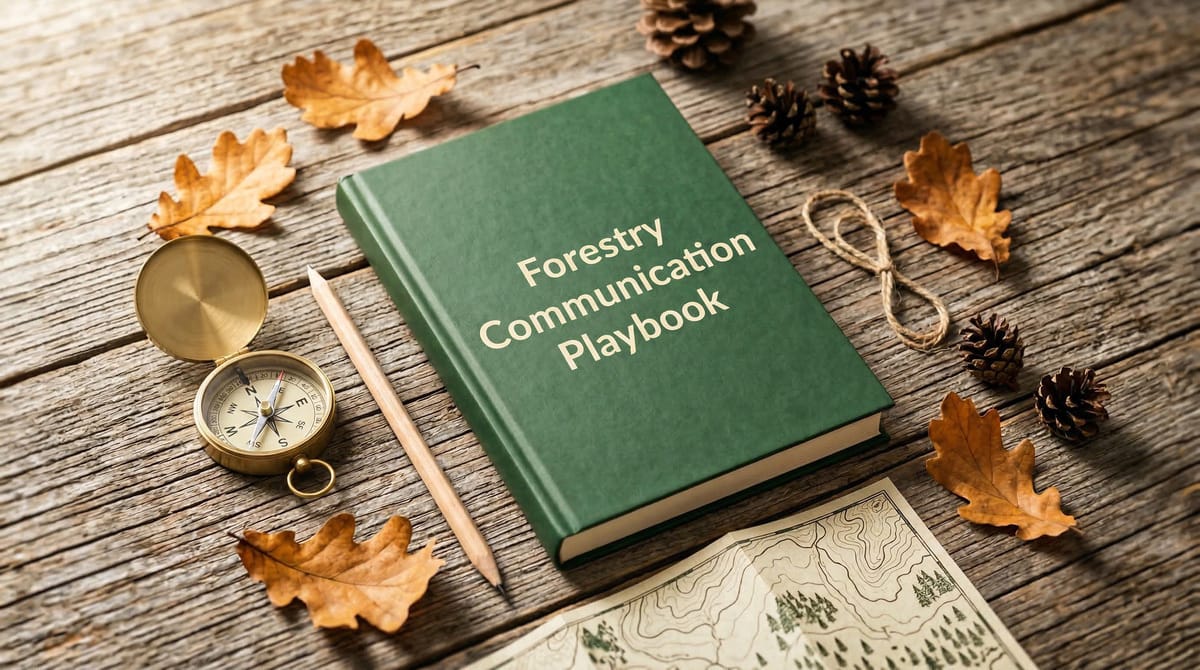
If your stakeholder communications keep coming out heavier than they need to, the Forestry Communication Playbook gives you the templates to fix it. Chapters 4 and 7 cover the exact translation problem above — taking a complex technical position and turning it into something a non-specialist can act on.
📖 The Forestry Communication Playbook
The next time someone asks why you cut trees, you'll have thirty seconds to answer.
Right now — what do you say?
If the answer isn't ready, you need the Playbook.
🤝 ForestryBriefing
The brief is free. The briefing is not.
ForestryBrief publishes verified intelligence — free, three times a week, in 25+ countries. When you need that intelligence applied to your specific situation, that's a ForestryBriefing.
Intelligence — Investment due diligence, market intelligence, EUDR compliance, cross-sector risk analysis, background verification in three languages.
Communication — Strategy, trade publication articles, stakeholder messaging, newsletters that people actually open. EN | DE | HU.
Live — Conference presentations, panel moderation, keynotes. Next: WAN-IFRA World Printers Summit, Rotterdam, October 2026.
First briefing guarantee: if it doesn't deliver intelligence you can act on, you don't pay.
Until Thursday!
Wish you all the best: Peter
🤝 Need help with forestry communication, intelligence, or due diligence? See what we offer → ForestryBriefing
📩 Got this email forwarded to you? Subscribe to ForestryBrief here.
📚 Missed an issue? Browse the ForestryBrief archive
P.S. What’s the biggest challenge you’re facing in forestry right now?
Hit reply and let me know — I read every message personally.
P. P. S. Know a forest professional who’s drowning in EUDR complexity or missing out on timber market shifts? Forward this email to them!
Shauna Matkovich's Forest Invest Podcast is one of the best resources for understanding where forest finance is heading. If you are interested in Forest Investments, start there.
If you like FB be sure to subscribe to Boreal Tech Brief, a newsletter of my friend Axel covering tech in forestry with a Nordic angle:
