
Hello,
Two courts. Two rulings. Same answer.
Last September, the EU General Court dismissed ClientEarth's challenge to the EU Taxonomy's forestry rules. On March 18, the same court threw out a second attempt — this time by Robin Wood and six other NGOs.
Forest bioenergy stays taxonomy-aligned. For now, that's settled law.
Here's what's moving European forestry this week:
🔍 The Big Story
EU Court Upholds Forest Biomass in EU Taxonomy — Second NGO Challenge Dismissed
On March 18, the EU General Court delivered its judgment in Case T-575/22. Robin Wood and six other environmental NGOs had asked the court to annul the European Commission's decision to include forestry and bioenergy in the EU Sustainable Finance Taxonomy.
The court said no. Unanimously.
What the court decided
The Sixth Chamber (Extended Composition) ruled that the Commission acted within its legal authority. The court found two things:
First, the Commission has wide discretion in setting technical screening criteria for the Taxonomy. The NGOs argued the criteria were too weak. The court disagreed.
Second, the Commission cannot be faulted for declining to tighten standards beyond what EU law requires. The Taxonomy Regulation sets a floor, not a ceiling. But going beyond it is the Commission's choice.
This follows the September 2025 ruling in Case T-579/22, where ClientEarth brought a nearly identical challenge against the same Delegated Regulation (EU) 2021/2139. That case was also dismissed.
Two cases. Two different plaintiff groups. Same result.
Why this matters for European forestry
The EU Taxonomy is the gatekeeper for sustainable finance in Europe. If an activity is taxonomy-aligned, it can attract green bonds, ESG-labelled investment, and preferential financing. If it's not, the money goes elsewhere.
Forest biomass for energy was always controversial. Environmental groups argued that burning wood for energy cannot be "sustainable" under any criteria. The Commission disagreed. Now the court has backed that position. Twice.
For forest owners and bioenergy operators, this removes near-term legal uncertainty. Your operations can continue carrying the taxonomy-aligned label. Banks and investors don't need to reclassify forest bioenergy assets.
For institutional investors, the signal is clear. Forest assets that include bioenergy revenue streams remain eligible for green finance products under current EU law.
What could still change
Both rulings can be appealed to the Court of Justice of the EU. Appeals are possible within two months. If Robin Wood or ClientEarth escalate, the legal question reopens at the highest level.
The Commission could also revise the Delegated Regulation itself. Political pressure hasn't disappeared. But today, the law is settled.
What this means for you
If you own forests that supply biomass: Your revenue stream just got legal confirmation. Taxonomy alignment makes your product more attractive to regulated buyers.
If you invest in forestry or bioenergy: Two court victories reduce regulatory risk. Factor this into your ESG positioning.
If you work in forest policy: The court gave the Commission broad discretion. That means future changes will come through politics, not litigation. Watch the next revision cycle. Sources: CURIA — Case T-575/22, Robin Wood and Others v Commission, search T-575/22, Judgment of 18 March 2026 | CURIA — Case T-579/22, ClientEarth v Commission, search T-579/22, Judgment of 10 September 2025 | EU Sustainable Finance Taxonomy — Delegated Regulation (EU) 2021/2139
📊 Quick Hits
1. 🇪🇺 EU Omnibus I Enters Into Force — Sustainability Reporting Gets Simpler
The EU Omnibus I Directive entered into force on March 18. It simplifies two major regulations: the Corporate Sustainability Due Diligence Directive (CS3D) and the Corporate Sustainability Reporting Directive (CSRD). Fewer companies now fall under mandatory sustainability reporting. Thresholds have been raised. Reporting requirements have been reduced.
Why it matters: Forest-based companies that previously faced CSRD reporting obligations may now be exempt. The simplification also reduces the compliance burden on buyers of forest products who needed to report on their supply chains.
The takeaway: Check whether your company still falls under CSRD after the threshold changes. If you're newly exempt, that frees up compliance resources. If you're still covered, the reporting is lighter. Source: Official Journal of the EU — Omnibus I Directive (EU) 2026/470, published 26 February 2026, in force 18 March 2026
2. 🇨🇳 China's Softwood Lumber Imports Crash 29% in February
China imported 29% less softwood lumber in February 2026 compared to the same month last year. Prices were unchanged. Russia is increasing its share of the Chinese market. Nordic exporters are losing ground.
Why it matters: China is the world's largest wood importer. A 29% drop in one month signals weak construction demand. For European exporters who compete in Asian markets — especially Scandinavian producers — this tightens an already difficult trade environment.
The context: Nordic lumber exports have been declining. Russia is filling the gap with cheaper supply. US mills are stepping up domestic output instead of exporting. The global lumber trade is reshuffling.
The takeaway: If you export to Asia, watch Q1 2026 totals closely. One bad month could be timing. Two months is a trend. Source: Lesprom — Imports of Softwood Lumber to China Lose 29% in February
3. 🇺🇸 LEGO Plans Mass Timber Office at Virginia Plant — Opening 2027
LEGO will build a mass timber office building at its new Chesterfield County manufacturing plant in Virginia. The company chose engineered wood to reduce embodied carbon compared with steel and concrete. The office is scheduled to open in 2027.
Why it matters: When a global brand like LEGO chooses mass timber over conventional materials, it signals demand. Corporate mass timber adoption drives engineered wood consumption. Every new project normalises wood as a construction material for commercial buildings.
The takeaway: If you produce CLT, glulam, or other engineered wood products, watch the corporate construction pipeline. LEGO is not the first. It won't be the last. Source: Lesprom — LEGO Plans Mass Timber Office at Virginia Plant
4. 🇪🇺 Nestlé, Ferrero, Danone Lead Coalition Defending EUDR Text
On March 17, a coalition of major companies including Nestlé, Ferrero, Barry Callebaut, Tony's Chocolonely, Danone, and Bel — joined by environmental NGOs — urged the European Commission not to reopen the EUDR legal text. The coalition supports simplification of implementation, but opposes weakening the regulation's core requirements.
Why it matters: This is significant because these are the companies that actually have to comply. When Nestlé and Ferrero say "don't reopen it," the message to the Commission is clear: industry has invested in compliance systems. Changing the rules now wastes that investment.
The takeaway: The EUDR text is likely safe. Expect tweaks to implementation guidance in the April 2026 simplification package, not changes to the law itself. Plan your compliance accordingly. Source: Joint letter to Commissioner Roswall — EU Sustainable Supply Chains Coalition, 17 March 2026 | Business & Human Rights Resource Centre — Coverage
📅 The Weeks Ahead
March 25, 2026: 🔴 PEFC Brussels policy event — "Forest-based bioeconomy and ecosystem services: friends or foes?" ForestryBrief is there. Register via PEFC
March 25, 2026: Brussels — NAFO and the Intertribal Timber Council host "Making EUDR Workable: Simplification to Support Tribes & Forest Landowners." In-person only, 10:00–12:00. Free registration via Eventbrite. The US perspective on EUDR — worth watching ahead of the April simplification review.
March 24–27, 2026: Holz-Handwerk — Nuremberg, Germany
March 25, 2026: Germany's Climate Action Programme 2026 — cabinet adoption deadline
March 26, 2026: EURAF Policy Dialogue — Upscaling Agroforestry in Europe, Brussels
March 27, 2026: 🔴 State of Europe's Forests 2025 (SoEF) launch — FOREST EUROPE webinar 10:00–12:00 CET
April 28–29, 2026: CIFB Europe — Corporate Investments into Forestry & Biodiversity — Frankfurt, Germany (CE Events & Media)
April 30, 2026: EUDR simplification review package due from Commission
May 14, 2026: PEFC Forest Forum — Istanbul
June 9–10, 2026: FAIS — Forestry & Agriculture Investment Summit — London, UK (CE Events & Media)
June 2026: Forest Europe Ministerial Conference
September 16–18, 2026: EFI Annual Conference — Växjö, Sweden (European Forest City 2026)
October 5, 2026: WAN-IFRA World Printers Summit — Rotterdam (ForestryBrief presenting)
October 13–14, 2026: CIFB London — Corporate Investments into Forestry & Biodiversity — London, UK (CE Events & Media)
December 30, 2026: EUDR deadline for large and medium operators
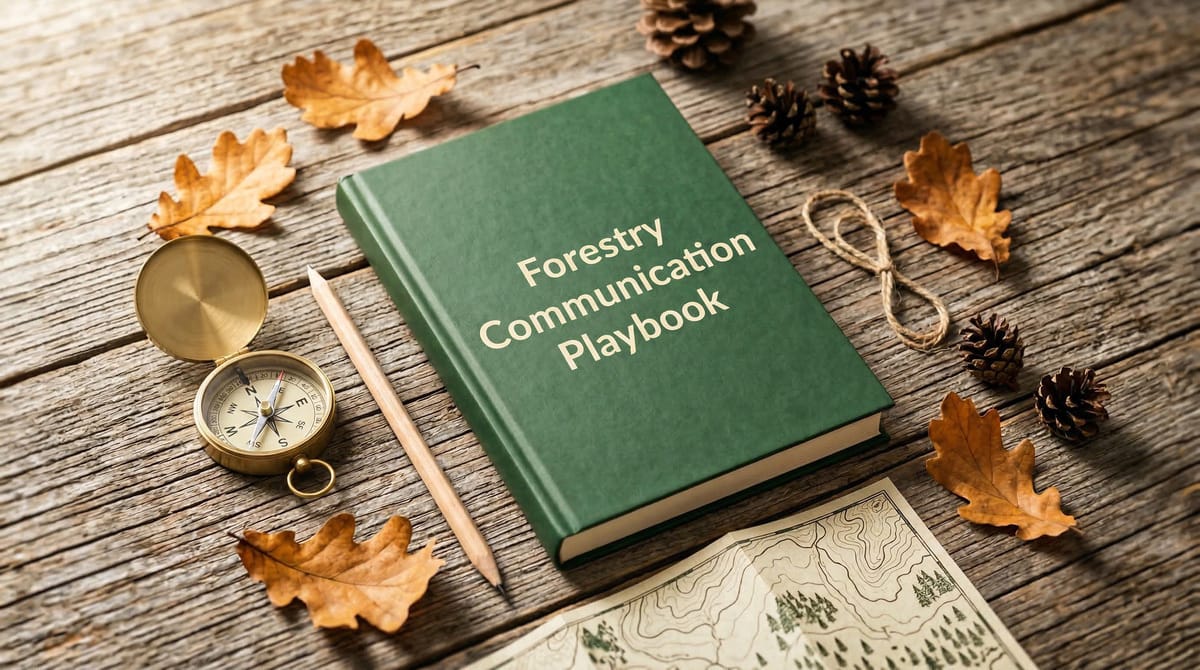
📘 NEW: The Forestry Communication Playbook Is Here
Ten chapters. Fifteen tools. One mission: teach forestry to talk.
Every forester knows the frustration. You manage forests sustainably. The public thinks you're destroying them. Politicians make rules based on Netflix documentaries. And nobody in the sector has a plan to fix it.
Now there is one.
The Professional Communication Playbook for Foresters (Part 1) is the first practical guide to forestry communication in English. It covers why communication fails, how to fix it, and gives you the tools to do it yourself.
What's inside:
Why 54% of Europeans think forests are shrinking (they've grown by 58,390 km²)
The ACE method for answering hard questions without getting defensive
15 ready-to-use tools: wallet cards, Q&A scripts, media checklists, clearcut explainers
Written by a forest engineer who's spent 25 years translating between languages and a decade translating between the forest and the public
€29. One book (plus a whole bunch of goodies). No subscription. No upsell.
💡 One Thing to Try This Week
Check whether the EU Taxonomy ruling changes anything for your financing.
The court confirmed that forest biomass stays taxonomy-aligned. That has practical consequences.
Ten minutes:
Look at your current financing or investment structure
Check if any of it references EU Taxonomy alignment for forestry or bioenergy
If yes — the legal risk you may have been tracking just got smaller
If you're applying for green financing — reference both court rulings (T-575/22 and T-579/22) in your documentation
Two rulings in six months. That's a pattern, not a fluke.
🤝 ForestryBriefing
The brief is free. The briefing is not.
ForestryBrief publishes verified intelligence — free, three times a week, in 25+ countries. When you need that intelligence applied to your specific situation, that's a ForestryBriefing.
Intelligence — Investment due diligence, market intelligence, EUDR compliance, cross-sector risk analysis, background verification in three languages.
Communication — Strategy, trade publication articles, stakeholder messaging, newsletters that people actually open. EN | DE | HU.
Live — Conference presentations, panel moderation, keynotes. Next: WAN-IFRA World Printers Summit, Rotterdam, October 2026.
First briefing guarantee: if it doesn't deliver intelligence you can act on, you don't pay.
Until Thursday!
Wish you all the best: Peter
🤝 Need help with forestry communication, intelligence, or due diligence? See what we offer → ForestryBriefing
📩 Got this email forwarded to you? Subscribe to ForestryBrief here.
📚 Missed an issue? Browse the ForestryBrief archive
P.S. What’s the biggest challenge you’re facing in forestry right now?
Hit reply and let me know — I read every message personally.
P. P. S. Know a forest professional who’s drowning in EUDR complexity or missing out on timber market shifts? Forward this email to them!
Shauna Matkovich's Forest Invest Podcast is one of the best resources for understanding where forest finance is heading. If you are interested in Forest Investments, start there.
If you like FB be sure to subscribe to Boreal Tech Brief, a newsletter of my friend Axel covering tech in forestry with a Nordic angle:
