
Hello,
When log prices fall, someone gets less and someone saves. This week's Nordic results showed who. Forest owners got less for their wood. One sawmill group cut its loss sharply. Others still lost ground. And in Finland, wood trade woke up again.
Here's what's moving European forestry this week:
One question for you
What's the one forest-market question your team must answer before 2027 budgets close?
Hit reply with one line. I read every answer and never name who asked.
Want the answer for your own business? Add "briefing" to your reply, and I'll send a one-page
🔍 The Big Story
🇳🇴 🇫🇮 🇸🇪 Log prices fell. Who gained?
What happened: the prices
Norway. In #132, I reported the third-quarter average from Statistics Norway (SSB). It was NOK 640 per m³, down 26% on a year earlier. SSB also gives prices by assortment. An assortment is a log grade, such as sawlog or pulpwood. Here is the change on a year earlier:
Spruce sawlogs: NOK 861 (−21%)
Pine sawlogs: NOK 686 (−30%)
Spruce pulpwood: NOK 423 (−31%)
Pine pulpwood: NOK 402 (−31%)
SSB's figures are preliminary. Prices exclude VAT, and harvest costs are not taken off.
Finland. On 21 October, Luke published its September figures. Luke is the Natural Resources Institute Finland.
Buyers bought twice as much wood as in August.
That is 50% more than a year earlier. It is also 6% above the five-year September average.
January to September is still 14% below last year.
Prices in standing sales, where the buyer does the harvest, in € per m³:
Spruce logs: 83.26
Pine logs: 77.08
Spruce pulpwood: 24.21
Pine pulpwood: 22.42
Birch pulpwood: 22.34
Luke compares prices after inflation. Against August, logs fell 1% and pulpwood 3–4%. Against the 2025 average, the gap is wider. Pine logs are 6% lower and spruce logs 1% lower. Pulpwood is 28–30% lower.
What happened: the companies
Four Swedish groups reported their third quarter, July to September. All figures are company-reported. EBITDA is profit before interest, tax and depreciation.
SCA (23 October) owns forest and runs sawmills, pulp and paper mills.
Forest EBITDA fell 23% on a year earlier. SCA names lower pulpwood prices and higher fuel prices.
Wood (sawmills) EBITDA: SEK 117 million, down from 232 million. Deliveries of wood products fell to 489,000 m³, from 532,000 m³.
Group EBITDA: SEK 1,631 million, close to last year's 1,644 million. Net sales rose to SEK 5,248 million.
SCA's report was not reviewed by its auditors.
Holmen (22 October) also owns forest and mills.
Operating profit: SEK 549 million, down from 737 million a year earlier.
Against the second quarter, profit fell SEK 140 million. Holmen puts that down to a maintenance shutdown at its Iggesund mill.
Holmen also split its forest business in two. More on that on Thursday.
Södra (22 October) is owned by forest owners in southern Sweden.
Södra Wood, its sawmill business, made an operating loss of SEK 256 million. A year earlier, the loss was 103 million.
Group operating profit was SEK 267 million. That includes a SEK 288 million gain from selling its Sunpine holding.
Without that gain, the group lost SEK 21 million.
Setra (26 October) is a sawmill group. Mellanskog, a forest owners' association, owns 99.5% of it.
Operating result: SEK −12 million, against −148 million a year earlier.
EBITDA: SEK 41 million, up from −89 million. Net sales rose to SEK 1,286 million.
Setra names three reasons: falling timber prices, efficiency work and a favourable currency effect. It says prices for finished goods are still under pressure.
CEO Marcus Westdahl links the lower timber prices to storm Johannes.
What the numbers do not say
Norway's and Finland's prices use different bases. Compare the changes, not the levels.
Södra's group result includes a one-off gain. Setra is still loss-making.
I could not check Holmen's sawmill result at its source. So it is left out.
One quarter is not a trend. Setra links part of its cheaper timber to a storm.
Why this matters
A lower log price moves money along the chain. Owners got less per cubic metre. A pure sawmill group lost much less.
But SCA's and Södra's sawmill units did worse than a year ago. So cheaper logs alone did not fix sawmilling.
My read, and it is a read rather than a finding: A sawmill earns on two prices, logs in and timber out. Setra says the second is still under pressure. Until it recovers, cheaper logs help only part of the way.
One more point. Many owners are also co-op members. Mellanskog's members own Setra through their association. So they sit on both sides of the log price.
The bright spot is Finland. Buyers came back in September, even at lower prices.
What this means for you
If you own forest in Finland: Buyers are active again. My advice: check Luke's price tables for your region before you sign.
If you own forest in Norway or Sweden: Pulpwood fell furthest. Know your stand's sawlog share before you sell.
If you are a co-op member: Read your co-op's report from both sides. What did it pay you? What did its mills earn?
If you invest: Forest and sawmill units moved differently this quarter. Read them separately, because a group total can hide both. (I can help you read those numbers, see below.)
If you speak for forestry: Falling log prices are not bad news for everyone. Some sawmills lost much less. And wood is moving again in Finland. Sources: SSB — Tømmerprisene fortsetter å falle (21 Oct 2026, Norwegian) | Luke — Volumes and prices in roundwood trade, 9/2026 (21 Oct 2026) | SCA — Interim report Q3 2026 (23 Oct 2026) | SCA — Q3 presentation (23 Oct 2026, PDF) | Holmen — Interim report January–September 2026 (22 Oct 2026) | Södra — Q3 2026 results (22 Oct 2026) | Setra — Interim report for the third quarter of 2026 (26 Oct 2026) | Setra — End of period commentary 2025, ownership (23 Feb 2026)
📊 Quick Hits
1. 🇸🇪 Stora Enso closes its CLT line at Gruvön
On 22 October, Stora Enso concluded negotiations over its CLT line at Gruvön, Sweden. CLT is cross-laminated timber: wooden panels glued in crossing layers. The company decided to close the line permanently by the end of 2026.
About 80 positions are affected, Stora Enso says.
Sawn timber deliveries from Gruvön continue as usual.
CLT customers will be served from three other sites. They are Ždírec in Czechia, and Ybbs and Bad St. Leonhard in Austria.
Why it matters: Stora Enso gives three reasons. The market grew slower than expected. Wood costs rose. And fixed costs were high.
The context: Stora Enso keeps making CLT at its three Central European sites. So the company still sells CLT. It is closing this one line.
The takeaway: New wood products need demand growth to carry their fixed costs. My advice: if you plan around CLT, track orders, not announcements. Source: Stora Enso — Concludes negotiations on the permanent closure of Gruvön CLT production line (22 Oct 2026)
2. 🇫🇮 Ponsse: more orders, lower profit
On 20 October, Ponsse reported its third quarter. Ponsse is a Finnish maker of forest machines.
Order intake: €170.4 million, up from 143.4 million. That is about 19% more, my calculation.
Net sales: €159.8 million, down from 172.7 million.
Operating profit: €5.9 million, down from 9.6 million. It includes €3.5 million of US customs-duty refunds.
Ponsse also opened negotiations with 1,109 employees in Finland. They cover possible temporary layoffs of up to 90 days in 2027. Ponsse says redundancies are not part of them. Its Epec unit is not included.
Why it matters: Orders are the early signal in a machine maker's report. They show what customers plan to buy.
The context: Without the duty refunds, operating profit would have been €2.4 million. That is my calculation.
The takeaway: Read orders and profit together. Customers are still ordering machines, even in a weak quarter for profit. Source: Ponsse — Interim report 1 January–30 September 2026 (20 Oct 2026) | Ponsse — Cooperation negotiations in Finland (20 Oct 2026)
The Forisk Timber REIT Index fell 0.93% in the week to 23 October. A REIT is a listed company that owns property, here timberland. The index holds two US companies, Rayonier and Weyerhaeuser.
Year to date, the index is down 16.15%. The S&P 500 is up 11.37%.
On 21 October, Chile's CMPC agreed to sell about 60,000 hectares of radiata pine plantations. The land is in the Maule Region. The buyer is J.P. Morgan Natural Capital. The price is US$365.5 million.
CMPC signed a long-term wood-supply contract with the buyer. The wood helps supply its board mill in Maule.
The sale is agreed, not completed. CMPC expects the effects in its results within three months.
Why it matters: Listed timber shares fell this year. Private buyers still pay for plantation land.
The context: The price covers land with a supply contract attached. So it is not a clean price per hectare. And Chilean plantations are no benchmark for European forest.
The takeaway: Share prices and land deals tell different stories. Weyerhaeuser reports on 29 October, Rayonier on 4 November. Source: Forisk Timber REIT Index weekly summary, week ending 23 October 2026 (subscriber email, 26 Oct 2026, no public permalink) | CMPC — Acuerda venta de activos forestales en el Maule por US$365,5 millones (21 Oct 2026, Spanish)
📅 The Weeks Ahead
Sun 18 – Fri 30 October: COP17 Biodiversity — Yerevan, Armenia
Wed–Thu 28–29 October: International Softwood Conference — Malahide, Dublin (sold out)
Thu 29 October: Weyerhaeuser third-quarter results | Metsä Board January–September results
Fri 30 October: Stora Enso third-quarter report | Brazil's approach to the EUDR, presented by ATIBT — Paris
Sat 31 October: UPM's target date for completing its plywood demerger into WISA Group
November: Commission EUDR Information System trainings, all at 14:00 CET. Upstream operators: 3, 10, 17 and 24 November. Micro and small primary operators: 12, 19 and 26 November. Register here
Mon 2 November: Biometria's VIOL starts rejecting integration calls without version information (Sweden) | WISA shares expected to start trading in Helsinki, on or about this date
Tue 3 November: Bergslagets Skogar Capital Markets Day — Stockholm
Wed 4 November: TDUK Global Market Conference — London | Rayonier third-quarter results
Thu 5 November: WRI webinar: agriculture and forests in the Congo Basin, 14:00 CET — online, in French with English interpretation
Thu–Fri 5–6 November: 🌳 11th International Hardwood Conference — Antwerp
Mon–Thu 9–12 November: ITTC 62 — Yokohama (ITTO)
Mon 9 – Fri 20 November: COP31 UN Climate Change Conference — Antalya, Türkiye
Tue 10 November: BiodivFuture pre-proposals due, 12:00 CET (Biodiversa+)
Tue–Fri 10–13 November: FIMMA + Maderalia — Valencia
Wed–Thu 11–12 November: Puupäivä — Helsinki (Puuinfo)
Thu 12 November: ATIBT and UICCB workshop on assessing EUDR deforestation risk with WHISP and forest management documents
Wed–Thu 18–19 November: German Timber Congress 2026 (DeSH) — Wiesbaden
Thu 19 November: Luke's October roundwood trade statistics (Finland)
Wed 25 November: Forest Bioeconomy Investment Accelerator (FBIA) 2026 final event — EIB, Brussels (by invitation)
Fri 27 November: Timber and Circular Economy CPD — online and free (PEFC via TDUK)
Mon 30 November: Södra's temporary birch premium window closes. See #126 | Södra's browsing-damage challenge closes
Tue 1 December: SMURF Carbon Standard consultation closes, 17:00 CET
Wed 2 December: FOREST Partnership first joint call: pre-proposals due, 13:00 CET (up to €40 million)
Wed 9 December: 📌 European Commission deadline for a decision on the UPM/Sappi joint venture (Case M.12270). See #128
Wed 30 December: EUDR applies to large and medium operators, and to micro and small operators already covered by the EU Timber Regulation
Mon 1 February 2027: GHG Protocol request for information on forest carbon accounting closes. See #132
Wed 30 June 2027: EUDR applies to other micro and small operators set up by 31 December 2024
💡 One Thing to Try This Week
Read your wood buyer's quarterly report in 15 minutes.
A buyer's report shows how it gains or loses from today's log price. Most listed buyers publish one every quarter.
Open the latest interim report on your buyer's investor page. The four from the Big Story are linked below.
Find the segment table. Look for the forest unit and the sawmill unit.
Copy what the company says about wood prices. Use its own words.
Compare its sawn timber deliveries with a year earlier.
Write one line: is your buyer gaining or losing from today's log price? Take that line to your next price talk.
Co-ops publish reports too. Södra's is linked below.
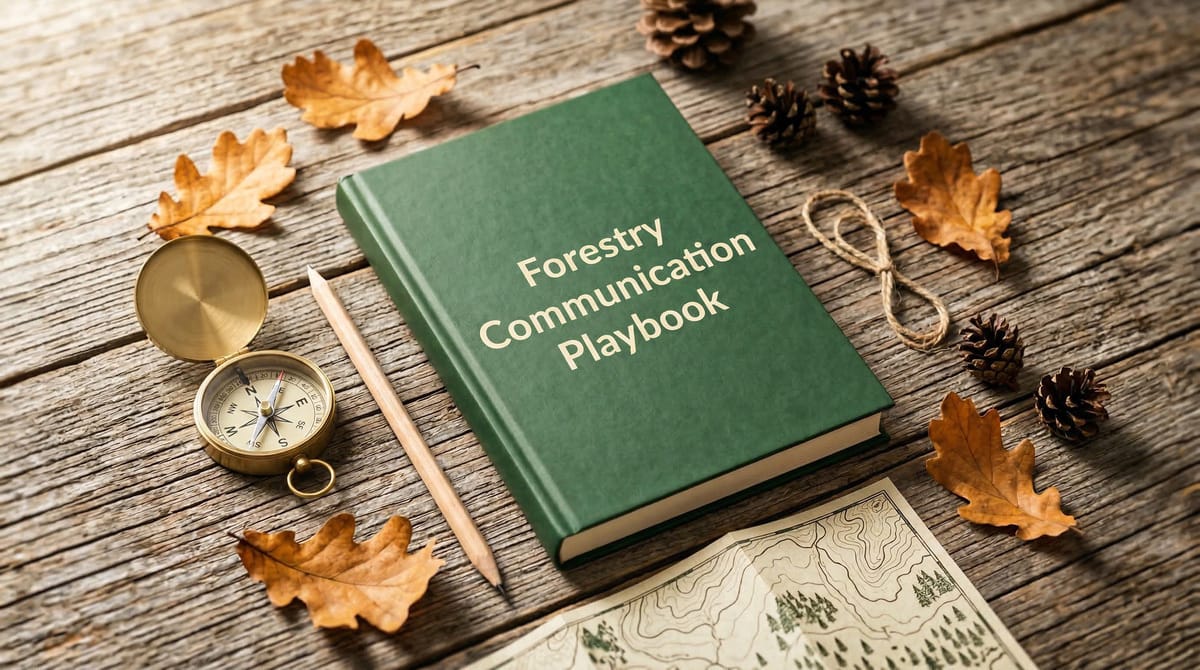
📖 The Forestry Communication Playbook
"Why sell now, when prices are down?"
A family member may ask. Or a neighbour, or someone at a co-op meeting. The calm answer is about the forest, not the quarter. A thinning has its own timing. Saying that in one breath takes practice.
Part 1 covers the questions that arrive without warning.
📗 The Forest-Investment Dictionary
One group total can hide two stories.
This quarter, owners sold for less, and one sawmill group lost much less. Investors read that in segment tables. Foresters read it on the timber contract.
I wrote the Forest-Investment Dictionary with Danish forest economist Anders Tærø Nielsen. It has 151 pages, 11 chapters, 14 printable tools, and 3 calculators. Investors learn to read a forest. Foresters learn to read a term sheet.
When the market turns, the people who can read the numbers make the better calls. The price is €99. Get yours below.

📘 The Organization — Playbook Part 3
Co-op members sit on both sides of a log price.
Someone has to explain that to them. Part 3 is about who does it, and whether they have the time.
I wrote The Organization, Part 3 of the Playbook. It has 165 pages, 10 chapters, 10 printable tools, and a survey. It shows what it takes to be heard, and who does the work.
Almost nobody in European forestry publishes what communication costs. The survey inside starts the count. The price is €149. Get yours below.

🤝 ForestryBriefing
The brief is free. The briefing is not.
ForestryBrief publishes verified intelligence — free, three times a week, in 25+ countries. When you need that intelligence applied to your specific situation, that's a ForestryBriefing.
Intelligence — Investment due diligence, market intelligence, EUDR compliance, cross-sector risk analysis, background verification in three languages.
Communication — Strategy, trade publication articles, stakeholder messaging, newsletters that people actually open. EN | DE | HU.
Live — Conference presentations, panel moderation, keynotes. Most recent: WAN-IFRA World Printers Summit, Rotterdam, October 2026.
First briefing guarantee: if it doesn't deliver intelligence you can act on, you don't pay.
Until Thursday!
Wish you all the best: Peter
🤝 Need help with forestry communication, intelligence, or due diligence? See what we offer → ForestryBriefing
📩 Got this email forwarded to you? Subscribe to ForestryBrief here.
📚 Missed an issue? Browse the ForestryBrief archive
P.S. What’s the biggest challenge you’re facing in forestry right now?
Hit reply and let me know — I read every message personally.
P. P. S. Know a forest professional who’s drowning in EUDR complexity or missing out on timber market shifts? Forward this email to them!
Independent since issue one. Read the charter.
Shauna Matkovich's Forest Invest Podcast is one of the best resources for understanding where forest finance is heading. If you are interested in Forest Investments, start there.
If you like FB be sure to subscribe to Boreal Tech Brief, a newsletter of my friend Axel covering tech in forestry with a Nordic angle:
