
Hello,
On Tuesday we gave you the fire numbers, with sources you could quote.
Today, as promised, the policy side.
Here is the thing about policy documents. Everyone reports the headline. Almost nobody reads to the end.
In this one, the useful part is near the bottom.
Here's what's moving European forestry this week:
🔍 The Big Story
Europe's wildfire rulebook is finished. The line that matters is about insurance.
What happened
Europe now has a formal wildfire framework. It was built in two steps.
Step one was 25 March 2026. The European Commission published a Communication on integrated wildfire risk management. That is the strategy. It covers prevention, preparedness, response and recovery.
Step two was 29 June 2026. The Council adopted a Recommendation on integrated wildfire risk management. It was agreed at the Council's 4188th meeting. The document reference is 11280/26.
These are two different instruments. The Communication is the Commission's plan. The Recommendation is what Member States agreed among themselves.
One point matters more than the rest. A Council Recommendation is not binding. Nobody has to do anything. Member States are invited to act in line with their own risk profiles.
So did it work this summer? That is the wrong question.
It was adopted about two weeks before the worst of the July fires. Nothing agreed in June changes July. What it changes is what gets funded next.
The line worth reading twice
The Recommendation runs to 41 numbered points. Point 35 is the one to write down.
It says Member States should consider encouraging private insurance against wildfire and other climate risks. Then it goes further.
It says they should promote the recognition by insurers of adaptation, preparedness and prevention measures when setting premiums.
Read that slowly.
That is a policy line saying your firebreaks should show up in your premium. Your thinning. Your access roads. Your fuel-load work.
Today most forest insurance prices risk by region and species. Prevention work is rarely rewarded directly. Point 35 asks governments to change that.
It is an invitation, not a rule. But it is the first time this has been set down at EU level in this form.
Three more points that reach your gate
Point 1. Member States should strengthen incentive schemes for prevention and restoration in fire-prone regions, and make EU funding easier to reach.
Point 2. Member States should promote sustainable forest management using Forest Europe criteria. That includes diverse forest structures and, where possible, alternatives to blocks of highly flammable single species.
Point 3. Member States should consult forest owners and managers when mapping fuel load. They are also asked to review permitting rules for prescribed and controlled burning.
A free tool just got named in the text
Point 41 asks Member States to work with Forest Europe and its Forest Risk Facility, known as FoRISK.
FoRISK is a pan-European network for forest risk management. Forest Europe agreed to create it at its Bonn Ministerial Conference in 2024. The secretariat sits at the European Forest Institute in Bonn. It began work in January 2025.
It is not untested. Forest Europe ran FoRISK as a pilot from 2021 to 2024 first.
It covers wind, fire, pests and disease. Not just fire.
In December 2025 it launched a free Intelligence Hub. That is an open-access library on windstorms, wildfires and biotic agents. Anyone can use it.
Being named in a Council Recommendation matters for a young facility. It usually brings more national engagement and steadier funding.
One housekeeping note. FoRISK, the Forest Europe facility, is not Forisk, the American timber analytics firm listed twice in our calendar below. Same sound, two organisations.
What this means for you
If you insure forest: ask your insurer one question this month. Does documented prevention work affect my premium? Point 35 gives you a reason to ask. Nobody gets a discount they never requested.
If you own forest in a fire-prone region: your national plan is about to be rewritten. Point 36 asks Member States to build tailored regional and national action plans. It names the relevant authorities as partners. It does not name owners. Owners are named in point 3, on fuel-load mapping. So aim your association at both tables, not just the second one.
If you apply for public funding: the route named here is the Common Agricultural Policy. Point 4 points at EIP-AGRI calls. The next programming period is where this becomes money.
If you value forests: fire risk belongs in the discount rate, not in the weather section. Insurance cost, salvage discount and rotation risk all sit inside the valuation.
Europe spent fifteen months turning a hard summer into a written framework. Every Member State has now agreed it. It asks for many of the things foresters have asked for. The next step is national — and that is where owners get a say. Sources: Council Recommendation on integrated wildfire risk management, 11280/26 | Council press release, 29 June 2026 | Commission Communication, 25 March 2026 | FoRISK
📊 Quick Hits
1. 🇬🇧 The world's widest newsprint machine is becoming a box machine
Palm Group will convert PM 7 at its King's Lynn mill in the UK. Today it makes newsprint. It will make corrugated case material instead.
PM 7 is 10.6 metres wide. Palm says that makes it the world's widest newsprint machine. The mill was built new in 2009.
Capacity today is up to 400,000 tonnes of newsprint a year. After conversion it becomes up to 700,000 tonnes of lightweight recycled corrugated case material, from 60 g/m² upward.
The work happens in the first quarter of 2027. Supply starts in March 2027.
Palm gave the reason plainly. Newsprint demand in Western Europe has fallen 60% in ten years. Palm calls the trend structural.
Palm is not leaving newsprint. Its two machines at Eltmann in Germany keep 550,000 tonnes of annual capacity.
Why it matters: This is fibre demand moving, not disappearing. The same recovered paper still gets used. It just leaves the mill as a box instead of a newspaper.
The takeaway: If you sell pulpwood or recovered fibre, watch the end-use mix rather than the total. This is exactly the shift I am presenting on in Rotterdam in October, to the people who print the world's newspapers. Sources: Palm Group press release | Lesprom, 30 July
2. 🌍 A free forest carbon dataset is being built. It is not ready yet.
On 30 July, carbon data firm Sylvera announced the Open Carbon Data Project.
Funding is $900,000 combined, from The Rockefeller Foundation and Meta. Partners include the State University of Santa Cruz in Brazil, the World Resources Institute and the Symbiosis Coalition.
The target area is the Brazilian Atlantic Forest. The method mixes ground measurement with laser scanning and remote sensing.
The goal is an open-access, benchmark-grade forest carbon dataset. The stated aim is to cut the entry cost for smaller and community-led projects.
One caution. This is an announcement, not a product. The dataset does not exist yet.
Why it matters: Carbon measurement is where most forest carbon disputes begin. Free benchmark data changes who can afford to take part.
The takeaway: Do not cite this dataset in a project plan yet. Do note who funds open measurement data, because that shows where verification standards are heading. Sources: Sylvera announcement | The Rockefeller Foundation
3. 🇨🇦 Canada lends C$100 million to protect a pulp supply
On 27 July, Canada's federal government confirmed a C$100 million loan to Millar Western Forest Products.
The money comes from the Large Enterprise Tariff Loan facility. That is a C$10 billion fund created in March 2025 for companies exposed to tariffs. The Canada Enterprise Emergency Funding Corporation runs it.
Millar Western makes bleached chemi-thermo mechanical pulp. It runs three mills — Slave Lake and Whitecourt in Alberta, and Quesnel in British Columbia. Capacity is about one million air-dried tonnes a year.
Canada's funding corporation says Millar Western supplies close to one fifth of global demand for that grade. That is the lender's own figure.
One stated use of the loan is rebuilding log inventory.
Why it matters: Trade policy now moves through government balance sheets, not only tariff schedules. When a state lends to protect a pulp supply, that supply has been reclassified as strategic.
The takeaway: If you buy or sell pulp, a fifth of a global speciality grade just gained a state backstop. That changes the downside case. Watch whether European grades attract similar treatment. Sources: Government of Canada, Department of Finance | Wood Business, 29 July
📅 The Weeks Ahead
Today, Thursday, August 6, 2026: EU formaldehyde limit for wood panels takes effect (0.062 mg/m³) | Metsä Group Q2 2026 report
Ongoing: EUDR Information System virtual training sessions — new dates published on the Commission implementation page
Tuesday, August 11, 2026: Ponsse Half-Year Report, January–June 2026
August 2026: Forisk Research Quarterly Q3 — forest supply challenges and pellet sector risk
Ongoing to late September: EUDR Delegated Act two-month scrutiny period (European Parliament and Council)
Expected Q3 2026: European Commission adoption of the revised EU Taxonomy Climate and Environmental Delegated Acts (advisory target, not a binding deadline)
Wednesday–Friday, September 16–18, 2026: EFI Annual Conference — Växjö, Sweden (European Forest City 2026)
Tuesday, September 22, 2026: CINEA LIFE Calls 2026 — Standard Action Projects deadline | SoEF 2025 webinar — Biological Diversity, 12:00–13:00 CEST
Sunday, September 27, 2026: EU EmpCo Directive applies — generic green claims become unlawful
Wednesday–Thursday, September 30 – October 1, 2026: Forisk Timber Market Analysis class — virtual (Registration)
🔴 Sunday–Tuesday, October 4–6, 2026: WAN-IFRA World Printers Summit — Rotterdam (I present on October 5)
Wednesday–Thursday, October 7–8, 2026: 19th European Congress (FOGE) — Cologne, Germany | RFSI Forum — Denver
🔴 Tuesday–Wednesday, October 13–14, 2026: CIFB London: Corporate Investments into Forestry & Biodiversity — London, UK
Thursday–Sunday, October 15–18, 2026: INTERFORST 2026 — Munich (quadrennial forestry technology trade fair)
Tuesday–Wednesday, October 20–21, 2026: Global Bioeconomy Summit 2026 — Dublin, Ireland
Tuesday, November 3, 2026: Bergslagets Skogar Capital Markets Day — Stockholm
Wednesday, November 4, 2026: TDUK Global Market Conference — London
Thursday–Friday, November 5–6, 2026: 11th International Hardwood Conference — Antwerp (ATIBT)
Wednesday, November 25, 2026: FBIA 2026 final event, EIB Brussels (by invitation)
Wednesday, December 30, 2026: EUDR applies to large and medium operators, and to all timber-sector operators
Friday, January 1, 2027: Revised EU Taxonomy technical screening criteria expected to apply
During 2027: Commission guidance and portal on integrated wildfire risk management due (commitment made in the March 2026 Communication)
Wednesday, June 30, 2027: EUDR applies to micro and small operators outside the timber sector
Thursday, July 17, 2031: FRM Regulation (EU) 2026/1392 applies
💡 One Thing to Try This Week
Ask your insurer one question. Ten minutes.
The Big Story showed that EU Member States have agreed insurers should reward prevention work. You do not have to wait for that to filter down.
Find your forest insurance policy. Note what it covers for fire.
Write one email to your broker or insurer. Ask this: does documented prevention work — firebreaks, thinning, access roads, fuel-load management — change my premium or my excess?
Add one line for weight: point 35 of the Council Recommendation on integrated wildfire risk management, adopted 29 June 2026, asks Member States to encourage exactly this.
File the answer, whatever it is. A written "no" today is useful evidence for your association tomorrow.
Then spend five minutes on the FoRISK Intelligence Hub. It is free. Search your own main risk — wind, fire, or bark beetle.
By the weekend you will know whether your prevention work carries any financial value beyond the forest itself.
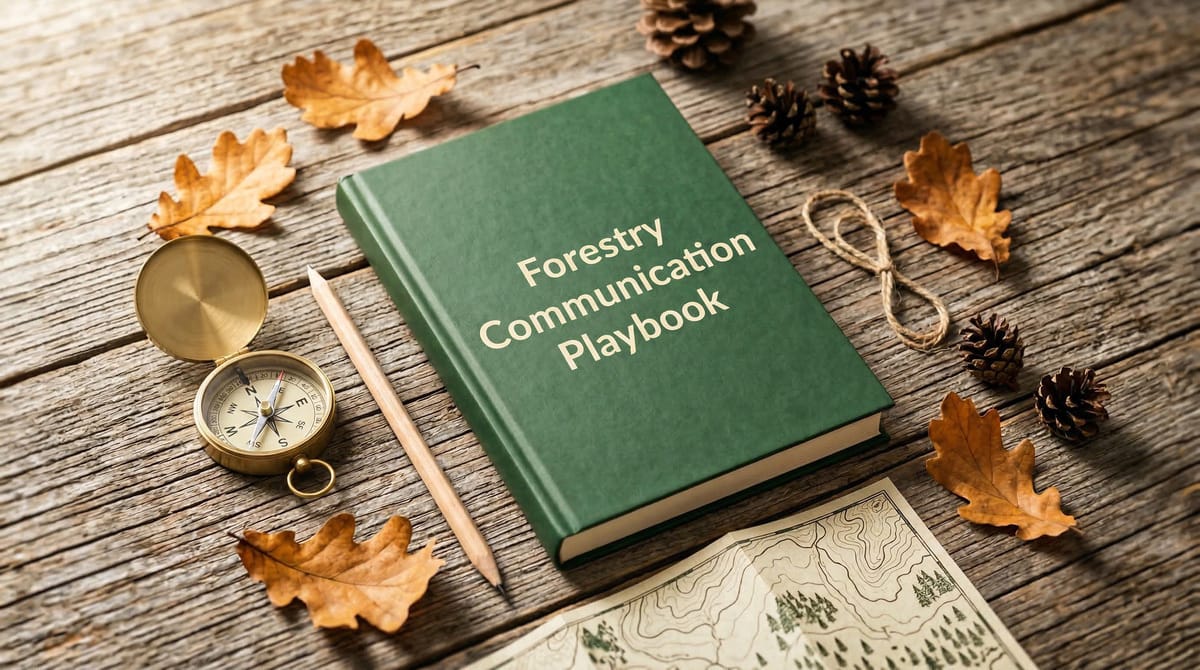
📖 The Forestry Communication Playbook
The next time a neighbour asks whether your forest is a fire risk to the village, you'll have thirty seconds to answer.
Right now — what do you say?
If the answer isn't ready, the Playbook is.
📗 The Forest-Investment Dictionary
Fire risk is not a weather story. It is a number inside your valuation.
Insurance cost. Salvage discount. Rotation risk. Each one moves the value of a stand. Most people never see where.
I wrote the Forest-Investment Dictionary with Danish forest economist Anders Tærø Nielsen. It has 151 pages, 11 chapters, 14 printable tools, and 3 calculators. Investors learn to read a forest. Foresters learn to read a term sheet.
When the market turns, the people who can read the numbers make the better calls. The price is €99. Get yours below.

🤝 ForestryBriefing
The brief is free. The briefing is not.
ForestryBrief publishes verified intelligence — free, three times a week, in 25+ countries. When you need that intelligence applied to your specific situation, that's a ForestryBriefing.
Intelligence — Investment due diligence, market intelligence, EUDR compliance, cross-sector risk analysis, background verification in three languages.
Communication — Strategy, trade publication articles, stakeholder messaging, newsletters that people actually open. EN | DE | HU.
Live — Conference presentations, panel moderation, keynotes. Next: WAN-IFRA World Printers Summit, Rotterdam, October 2026.
First briefing guarantee: if it doesn't deliver intelligence you can act on, you don't pay.
Until Tomorrow!
Wish you all the best: Peter
🤝 Need help with forestry communication, intelligence, or due diligence? See what we offer → ForestryBriefing
📩 Got this email forwarded to you? Subscribe to ForestryBrief here.
📚 Missed an issue? Browse the ForestryBrief archive
P.S. What’s the biggest challenge you’re facing in forestry right now?
Hit reply and let me know — I read every message personally.
P. P. S. Know a forest professional who’s drowning in EUDR complexity or missing out on timber market shifts? Forward this email to them!
Shauna Matkovich's Forest Invest Podcast is one of the best resources for understanding where forest finance is heading. If you are interested in Forest Investments, start there.
If you like FB be sure to subscribe to Boreal Tech Brief, a newsletter of my friend Axel covering tech in forestry with a Nordic angle:
