
Hello,
Every forest you will ever own started as a seed in somebody's hand.
Last month, Europe rewrote the rules for that seed. The new law went into the Official Journal on 26 June. The trade press barely touched it.
I ran five research tools across European forestry news this month. Not one of them found it.
So let's fix that.
Here's what's moving European forestry this week:
🔍 The Big Story
Europe has new rules for forest seed. They apply in 2031.
What happened
Regulation (EU) 2026/1392 is now law. People call it the FRM Regulation.
FRM means forest reproductive material. In plain words: seeds, cuttings and young trees.
Parliament approved the text on 19 May. It was signed in Strasbourg on 20 May. The Council had adopted its position on 21 April.
It was published in the Official Journal on 26 June 2026. It enters into force twenty days after that.
It replaces Council Directive 1999/105/EC. That rule is 26 years old.
It also amends the EU plant health rules and the official controls rules.
And it applies from 17 July 2031.
What it actually covers
The scope is narrower than the headline suggests.
It covers seed units, parts of plants and planting stock. Only for the tree species listed in Annex I, plus their hybrids.
It covers only certain uses. Afforestation, reforestation, diversification inside a forest plot, other tree planting and direct seeding. Agroforestry is left out.
The four quality categories survive: source-identified, selected, qualified and tested.
The real change is the plumbing:
Full traceability from collection to marketing. Operators keep records for at least 10 years.
Every country keeps an electronic register of approved basic material. The Commission publishes a Union list.
Labels may be electronic. A QR code is allowed.
Countries may write voluntary contingency plans for seed shortages after storms, fires or pest outbreaks. They can ask the Commission for technical help.
There is also a stock rule. Material produced before 17 July 2031 under the old Directive can still be sold until stocks run out. It must carry a label saying it is not approved under the new Regulation. Old master certificates stay valid for that material.
Why 2031 is closer than it looks
Five years sounds generous. The Council said the long runway exists for a reason. It lets over 25 years of national practice adjust. It gives countries time to build the new control system.
Now read recital 32 of the Regulation itself.
Assessing basic material for the tested category takes on average ten years.
That is the Regulation's own number. Article 23 then lets a country approve that material provisionally for up to ten years while the testing runs.
So the sector's slowest approval process is twice as long as the adaptation window.
That is the whole story in one line.
Here is the part almost nobody has spotted. Article 15(4) says basic material already sitting in a national register before 17 July 2031 moves straight into the new register. No re-approval.
Read that again if you run a nursery.
It means the next five years are not a waiting room. They are a window. Every approval you bank before July 2031 carries over for free.
What this means for you
If you own forest and will regenerate this decade: the seedlings you plant after July 2031 arrive with an official label and a stated category. Nothing changes before then. But the question you should be asking your supplier is already answerable today.
If you run a nursery or sell seed: your build-out starts now, not in 2030. Registration, traceability records and the label system all take time. Article 15(4) is the cheapest opportunity in this Regulation. (Working out what to register first is exactly the kind of question a ForestryBriefing answers — see below.)
If you develop restoration or afforestation projects: you are already specifying material for planting seasons that fall inside the new regime. Check whether your sourcing clauses survive the label rule.
If you trade seed or plants across borders: this is the point of the whole exercise. The Regulation exists to remove internal-market obstacles for FRM. That should make your life easier, not harder. Sources: EUR-Lex — Regulation (EU) 2026/1392 | European Commission — Future of EU rules on plant and forest reproductive material | Council of the EU — press release, 21 April 2026
📊 Quick Hits
1. 🇩🇪 Germany keeps stepping back from the log export market
Germany exported 1.59 million m³ of softwood logs from January to May. That is 28% less than a year earlier, or around 609,000 m³ of lost volume.
This is not a one-month wobble. First-quarter exports were already down 26% at 931,000 m³.
Look further back and the scale shows up. In the first quarter of 2024, Germany still exported 1.54 million m³. The same quarter this year came in at 931,000 m³.
That is a 40% fall in two years.
For the whole of 2025, exports came to 3.397 million m³. That was 26.8% below 2024. Export value fell 21.1% to €350.5 million.
Meanwhile imports are climbing. First-quarter softwood sawlog imports rose 15.1% to 659,648 m³.
Why it matters: Europe's largest sawnwood producer is turning from a log seller into a log buyer. The damaged-wood surplus that fed those exports is gone.
The takeaway: If you sell logs into Austria, the Czech Republic or Poland, German competition is thinner than your 2024 model assumes. Reprice accordingly. If you buy in Germany, expect to compete with German mills, not supply them. Sources: Destatis figures via Timber-Online — Log exports down by a quarter | Timber-Online — Softwood log exports decreased by over 30% | EUWID — Sawlog imports rising, exports significantly lower
2. 🇪🇺 Europe's forest owners told Brussels the Taxonomy does not work for them
The Confederation of European Forest Owners filed feedback on the revised EU Taxonomy climate delegated act on 14 April.
Its message was blunt. Uptake of the forestry criteria among forest owners is very limited. In some countries it appears absent altogether.
The reason it gave: reporting is unappealing and financially unworkable for many owners. Monitoring, reporting and verification cost real money. That money is unlikely to be covered by any extra income.
CEPF did credit progress. It welcomed the idea of stacking Taxonomy audits onto audits owners already run.
Its main ask is practical. Accept forest management plans written under national law. And stop treating "has a management plan" as an eligibility test, because not every owner has one.
The Commission closed the consultation on 14 April. It planned to adopt the revised criteria by the summer.
As of this week, it has not. The Commission's own delegated-acts register still lists both drafts as open for feedback. The page notes they are not yet adopted. Nothing is in force until the Official Journal publishes it.
Advisers now expect adoption in the third quarter. That is a target, not a binding deadline.
The revised criteria are aimed at applying from 1 January 2027.
Why it matters: Forest owners are the people who actually hold the carbon. If the Taxonomy stays unusable for them, green forest finance keeps routing around them.
The takeaway: If you report Taxonomy alignment, watch for adoption this quarter. If you own forest and have ignored the Taxonomy so far, nothing in this revision yet changes that maths. Sources: CEPF — feedback on EU taxonomy draft act, 14 April 2026 | European Commission — delegated and implementing acts to the Taxonomy Regulation | European Commission — consultation on revision of criteria
3. 🇮🇪 Ireland is chairing the Council, and it is running on simplification
Ireland took over the rotating Presidency of the Council of the EU on 1 July. It holds it until 31 December.
This is Ireland's eighth presidency. The motto is Ní neart go cur le chéile — strength with unity.
Three priorities: competitiveness, values and security.
The competitiveness pillar rests on the One Europe, One Market Roadmap. Cutting regulatory burden sits inside it.
Why it matters: Ireland holds the gavel while three forestry files move. The EUDR delegated act is in scrutiny. The Taxonomy revision is heading for adoption. And the first delegated acts under the new FRM Regulation now need writing.
The takeaway: Simplification is the official mood in the Council for the next five months. If your association has a burden-reduction ask, this is the window to make it. Sources: Irish Presidency — programme | European Parliament Think Tank — Ireland's priorities
📅 The Weeks Ahead
Thursday, July 30, 2026: Weyerhaeuser Q2 results, call on July 31 (Announcement)
Ongoing to late September: EUDR Delegated Act two-month scrutiny period (European Parliament and Council)
Tuesday–Wednesday, August 4–5, 2026: Carbon Forestry 2026 — Rotorua, New Zealand
Wednesday, August 5, 2026: Rayonier Q2 results (first full quarter as the merged Rayonier–PotlatchDeltic entity)
Thursday, August 6, 2026: EU formaldehyde limit for wood panels takes effect (0.062 mg/m³) | Metsä Group Q2 2026 report
Tuesday, August 11, 2026: Ponsse Half-Year Report, January–June 2026
August 2026: Forisk Research Quarterly Q3 — forest supply challenges and pellet sector risk
Expected Q3 2026: European Commission adoption of the revised EU Taxonomy Climate and Environmental Delegated Acts (advisory target, not a binding deadline)
Wednesday–Friday, September 16–18, 2026: EFI Annual Conference — Växjö, Sweden (European Forest City 2026)
Tuesday, September 22, 2026: CINEA LIFE Calls 2026 — Standard Action Projects deadline | SoEF 2025 webinar — Biological Diversity, 12:00–13:00 CEST
Sunday, September 27, 2026: EU EmpCo Directive applies — generic green claims become unlawful
Wednesday–Thursday, September 30 – October 1, 2026: Forisk Timber Market Analysis class — virtual (Registration)
🔴 Sunday–Tuesday, October 4–6, 2026: WAN-IFRA World Printers Summit — Rotterdam (I present on October 5)
Wednesday–Thursday, October 7–8, 2026: 19th European Congress (FOGE) — Cologne, Germany | RFSI Forum — Denver
🔴 Tuesday–Wednesday, October 13–14, 2026: CIFB London: Corporate Investments into Forestry & Biodiversity — London, UK
Thursday–Sunday, October 15–18, 2026: INTERFORST 2026 — Munich (quadrennial forestry technology trade fair)
Tuesday–Wednesday, October 20–21, 2026: Global Bioeconomy Summit 2026 — Dublin, Ireland
Tuesday, November 3, 2026: Bergslagets Skogar Capital Markets Day — Stockholm
Wednesday, November 4, 2026: TDUK Global Market Conference — London
Thursday–Friday, November 5–6, 2026: 11th International Hardwood Conference — Antwerp (ATIBT)
Wednesday, November 25, 2026: FBIA 2026 final event, EIB Brussels (by invitation)
Wednesday, December 30, 2026: EUDR applies to large and medium operators, and all timber-sector operators
Friday, January 1, 2027: Revised EU Taxonomy technical screening criteria expected to apply
Thursday, July 17, 2031: FRM Regulation (EU) 2026/1392 applies
💡 One Thing to Try This Week
Ask your nursery one question. It takes ten minutes.
Find your most recent delivery note or invoice for seed or planting stock.
Look for the category. It should say source-identified, selected, qualified or tested.
If it is not written anywhere, email your supplier and ask which one it was.
From 17 July 2031 that category must appear on an official label. Not on request. On the label.
A supplier who answers in one line is already close to ready. A supplier who cannot answer at all has just told you something useful about the next five years.
If you are the nursery, run the same check inward. Pull your national register entries and see what is already listed. Anything registered before July 2031 carries into the new system automatically.
That is the cheapest compliance you will ever buy.
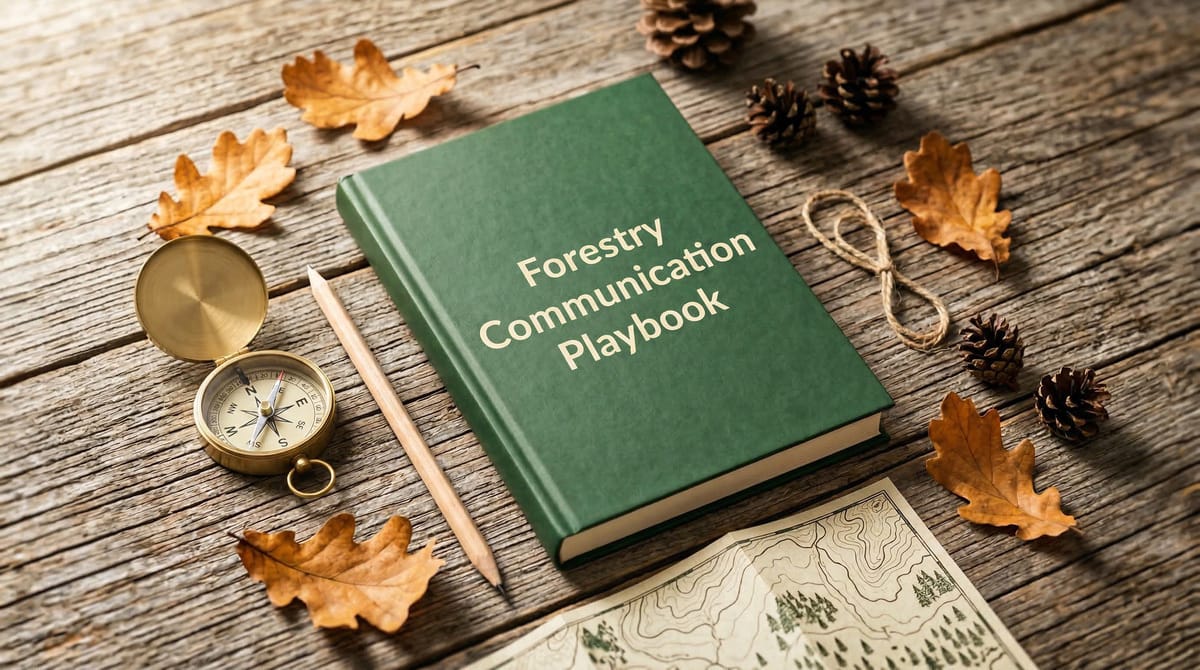
📖 The Forestry Communication Playbook
The next time someone asks why you cut trees, you'll have thirty seconds to answer.
Right now — what do you say?
If the answer isn't ready, the Playbook is.
📗 The Forest-Investment Dictionary
Regeneration cost sits inside every forest valuation. Somebody typed it into a spreadsheet years ago and nobody has questioned it since.
A rule that changes what you may plant, and what paperwork follows it, changes that line.
That is the kind of connection this book teaches you to make.I wrote the Forest-Investment Dictionary with Danish forest economist Anders Tærø Nielsen. It has 151 pages, 11 chapters, 14 printable tools, and 3 calculators. Investors learn to read a forest. Foresters learn to read a term sheet.
When the market turns, the people who can read the numbers make the better calls. The price is €99. Get yours below.

🤝 ForestryBriefing
The brief is free. The briefing is not.
ForestryBrief publishes verified intelligence — free, three times a week, in 25+ countries. When you need that intelligence applied to your specific situation, that's a ForestryBriefing.
Intelligence — Investment due diligence, market intelligence, EUDR compliance, cross-sector risk analysis, background verification in three languages.
Communication — Strategy, trade publication articles, stakeholder messaging, newsletters that people actually open. EN | DE | HU.
Live — Conference presentations, panel moderation, keynotes. Next: WAN-IFRA World Printers Summit, Rotterdam, October 2026.
First briefing guarantee: if it doesn't deliver intelligence you can act on, you don't pay.
Until tomorrow!
Wish you all the best: Peter
🤝 Need help with forestry communication, intelligence, or due diligence? See what we offer → ForestryBriefing
📩 Got this email forwarded to you? Subscribe to ForestryBrief here.
📚 Missed an issue? Browse the ForestryBrief archive
P.S. What’s the biggest challenge you’re facing in forestry right now?
Hit reply and let me know — I read every message personally.
P. P. S. Know a forest professional who’s drowning in EUDR complexity or missing out on timber market shifts? Forward this email to them!
Shauna Matkovich's Forest Invest Podcast is one of the best resources for understanding where forest finance is heading. If you are interested in Forest Investments, start there.
If you like FB be sure to subscribe to Boreal Tech Brief, a newsletter of my friend Axel covering tech in forestry with a Nordic angle:
